THE VOYNICH MANUSCRIPT
| DATE | Vellum radiocarbon-dated to 1404–1438 |
| HOLDINGS | Beinecke Rare Book & Manuscript Library, Yale University: MS 408 |
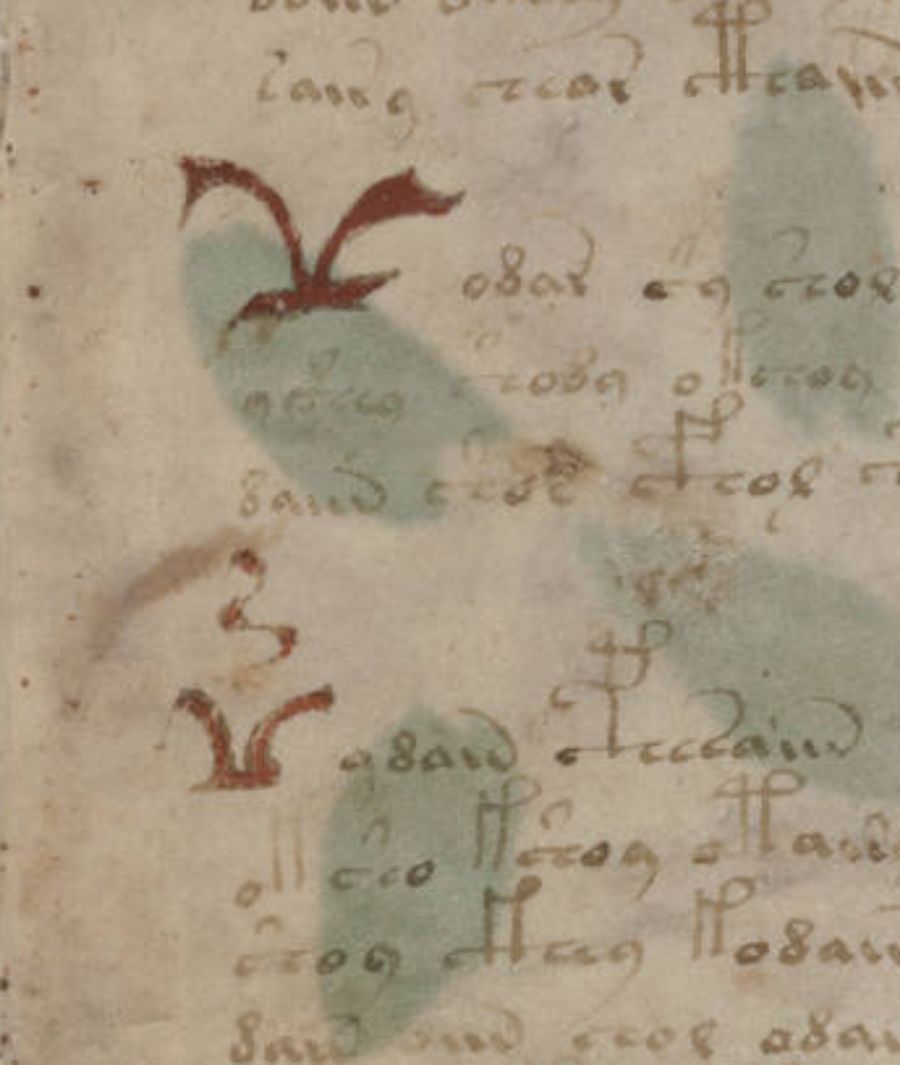
| EXTENT | About 240 pages in an unknown script, with unidentifiable illustrations |
| STATUS | Undeciphered after a century of professional attention |
THE CLAIM
That a book written six centuries ago in a script found nowhere else on Earth contains a message no one has ever read, or, in the rival telling, contains nothing at all, and is the most durable practical joke in the history of writing. Either way, the codebreakers of two world wars looked at it and went home empty-handed.
THE THEORY, AS ITS PROPONENTS TELL IT
A codex of roughly 240 vellum pages, carbon-dated to the early fifteenth century, written in a script that appears nowhere else, illustrated with plants that do not exist, astronomical diagrams, and naked women in green fluid connected by tubing. It has defeated every professional cryptanalyst who has attempted it, including teams from both world wars.
The three competing theories divide on a single question: is there anything in it? The genuine-language camp holds that it encodes a real natural language (candidates have included a Romance dialect, Hebrew, a Sinitic language, and Nahuatl) and points to the fact that the text obeys Zipf's law and shows word-frequency and entropy characteristics resembling real language rather than random strings.
The cipher camp holds that it is enciphered European text, with the vellum date establishing a fifteenth-century origin that rules out later forgery of the material at least. The hoax camp holds that it is meaningless (produced to defraud a wealthy collector, possibly Emperor Rudolf II, who is recorded as having paid a very large sum for it) and points to the absence of corrections, the mechanical regularity of the glyph sequences, and the demonstrated ability of a simple grille-and-table method to generate text with exactly these statistical properties.
The conspiracy strand proper holds that it has been solved and the solution suppressed, usually by an institution embarrassed to hold a famous forgery or in possession of something else. This office notes the far simpler explanation available: the manuscript is real, its statistics are genuinely language-like, and the reason no solution has held is that periodic announcements of decipherment have all failed peer review.
WHAT IS KNOWN
The manuscript takes its name from Wilfrid Voynich, the rare-book dealer who bought it in 1912 from a Jesuit collection in Italy. Its earlier paper trail runs through seventeenth-century Prague, a 1665/66 letter accompanying it claims Emperor Rudolf II once paid 600 ducats for it, before the record goes dark for two centuries. In 2009, University of Arizona radiocarbon testing dated the vellum to between 1404 and 1438, ruling out the popular Roger Bacon attribution and most theories of a modern forgery.
The book itself is roughly 240 vellum pages written in a flowing, confident, unknown script, organized into sections modern scholars label by their illustrations: botanical (plants matching no known species), astronomical (zodiac roundels, star charts), balneological (small figures bathing in networks of tubs and tubes), pharmaceutical, and pages of dense text. Statistical study has found two distinguishable "dialects" of the script, and the text obeys patterns real languages obey, including a Zipf-like word-frequency distribution, while violating others: words repeat in odd stutters, and the information structure is unlike any known natural language.
The failure record is distinguished. In 1921 William Romaine Newbold announced it was Roger Bacon's work in microscopic shorthand; his method was demolished within the decade. William Friedman, America's premier cryptologist, studied it for years without result. The twenty-first century has added a steady traffic of announced solutions (a 2019 "proto-Romance" reading, AI claims that it is enciphered Hebrew, and others) each dismissed by medievalists and linguists, usually within days, for producing translations that only the translator can reproduce.
LEADING THEORIES
- An enciphered natural language. The classical view: real content (herbal, medical, alchemical) hidden by a cipher or invented alphabet. Against it: fifteenth-century ciphers known to history are far simpler than anything that would defeat modern cryptanalysis.
- A constructed or private language. An invented script recording an idiosyncratic language, glossolalia, or a personal shorthand, which would explain why cryptanalysis fails: there is no cipher to break, only a lost key of one mind.
- A meaningless hoax, but a period one. Researchers have shown that quasi-Voynichese can be mass-produced with simple medieval-compatible techniques, suggesting a fraud built to sell an emperor a wonder. The text's language-like statistics are the standing objection: gibberish rarely organizes itself this well.
- Meaningful but never decipherable. The bleak middle position: too short a corpus, too strange an encoding, no bilingual crib, a real message with no surviving path back to it.
ASSESSMENT
The OSA notes with professional respect that the manuscript has survived every generation's best tool: the philologist, the wartime codebreaker, the statistician, and now the language model, each announced as its inevitable end, each defeated. The carbon date is the case's one hard fact; everything else is inference balanced on 240 pages of beautiful noise. Until a decipherment arrives that a second, independent scholar can apply and reproduce, the file remains what it has been since 1912: open, and enjoying itself.
WHAT WOULD CHANGE THE GRADE
- To CLOSED: a decipherment that produces coherent text and that other people can reproduce from the same rules. Every claimed solution so far has failed that second requirement, which is the one that matters.
- Radiocarbon dating puts the vellum between 1404 and 1438 and the inks are consistent with it, which rules out a forgery by Wilfrid Voynich himself and does not rule out a hoax made at the time.
- The text's statistics sit awkwardly between natural language and gibberish: too structured for random, too strange for a known language. Elaborate fifteenth-century nonsense remains a live answer rather than a dismissal.
FURTHER READING
- Keywords and Co-Occurrence Patterns in the Voynich Manuscript: An Information-Theoreticncbi.nlm.nih.gov
- Wikipedia: Voynich manuscript
- Wikipedia: Wilfrid Voynich
- Wikipedia: Beinecke Rare Book & Manuscript Library (the manuscript is fully digitized in Yale's collections)
RELATED FILES IN THIS ARCHIVE
- OSA-187 · THE ANTIKYTHERA MECHANISMCONFIRMEDAn ancient Greek device whose complexity was not matched until the medieval period
- OSA-086 · THE LOST COLONY OF ROANOKEOPEN CASEOne word on a post, and no distress signal
- OSA-047 · THE OAK ISLAND MONEY PITUNVERIFIED230 years of digging, six deaths, zero treasure
- OSA-079 · THE HOLLOW EARTHDEBUNKEDOnce a Royal Society hypothesis, now closed by seismology