THE GHOST ARMY
| PERIOD | June 1944 – March 1945, European Theater |
| STRENGTH | Roughly 1,100 men impersonating formations many times their size |
| TOOLKIT | Inflatable armor, sonic deception trucks, spoofed radio nets, costume-grade insignia |
| RECOGNIZED | Congressional Gold Medal, authorized 2022; presented 2024 |
THE CLAIM
That the United States Army fielded a secret unit of artists, engineers, and audio men whose weapons were rubber tanks, loudspeakers, and theatrical flair, and that this traveling illusion deceived the Wehrmacht again and again, then vanished from the record for fifty years. Veterans who mentioned it were, for decades, in violation of their oath; listeners could be forgiven for filing it under tall tales. It was all true, balloons included.
THE THEORY, AS ITS PROPONENTS TELL IT
Like Mincemeat, this file records a deception that worked and was then classified for half a century, and the classification is the part that belongs in a conspiracy archive.
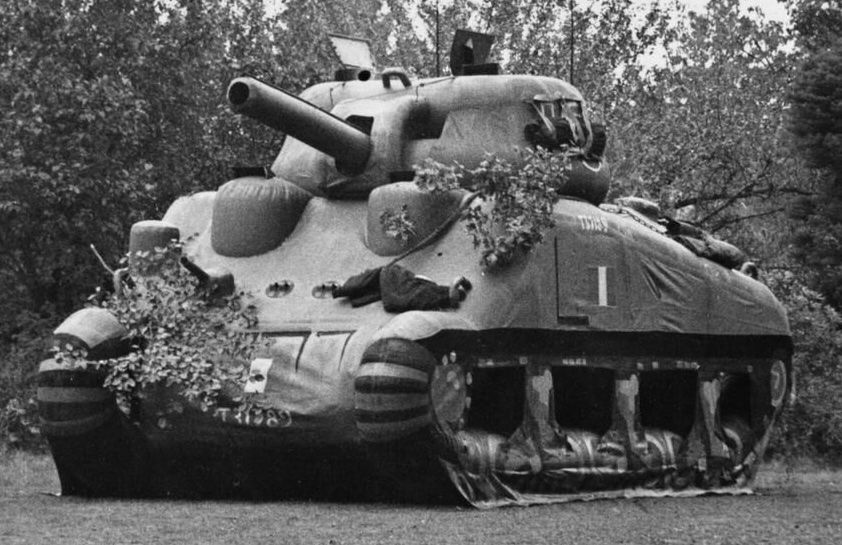
The 23rd Headquarters Special Troops comprised roughly 1,100 men, many recruited from art schools and advertising agencies, whose task was to impersonate formations of up to 30,000. They deployed inflatable rubber tanks, artillery and aircraft; played recordings of armoured columns through 500-pound speakers audible for fifteen miles; generated fake radio traffic imitating specific units' operators down to their individual keying styles; and staged theatrical impersonations in nearby towns, with officers wearing borrowed insignia and being seen in bars to seed rumour.
They ran more than twenty operations across the European theatre, including a Rhine crossing deception that drew German attention away from the real assault. Casualty estimates credit them with saving a substantial number of lives.
The point proponents draw for the wider cabinet is about verification rather than about the war. Every method the unit used (manufactured signals traffic, staged sightings, planted rumour, physical props built to be photographed) was designed to produce exactly the kind of evidence an observer would treat as independent corroboration. The unit's existence was classified until 1996. When this archive weighs eyewitness accounts, radar returns and photographs in other files, this is the file that establishes how cheaply all three can be manufactured by a competent state.
WHAT IS KNOWN
The 23rd Headquarters Special Troops was activated in 1944 as the U.S. Army's first mobile, multimedia tactical-deception unit. Its method was full-spectrum impersonation: inflatable tanks, trucks, and artillery arranged where reconnaissance would find them; "sonic deception" units playing recorded convoy, bridging, and armor noise from powerful speaker trucks audible for miles; radio operators mimicking the traffic, and even the individual sending styles, of real formations; and "special effects" men wearing counterfeit divisional patches to seed misinformation in cafés near the front.
From Normandy to the Rhine the unit staged more than twenty deception operations, typically impersonating divisions ten to thirty times its strength to draw German attention away from genuine movements. Its capstone, Operation Viersen in March 1945, simulated a two-division buildup to cover the Ninth Army's actual Rhine crossing point; the German defense arrayed itself substantially against the phantom. The unit's ranks, recruited in part from art schools, included future fashion designer Bill Blass, painter Ellsworth Kelly, and photographer Art Kane.
The 23rd's existence and methods remained classified for roughly half a century, with substantive declassification in 1996. Public recognition followed slowly: a PBS documentary in 2013, and in February 2022 the Ghost Army Congressional Gold Medal Act, signed into law and presented in a Capitol ceremony in March 2024, three surviving members then living.
EVIDENCE FOR
- Declassified Army records of the unit's operations, released in the 1990s.
- The veterans' own sketchbooks, photographs, and journals, an unusually well-illustrated archive, given the personnel.
- The official U.S. history of tactical deception and subsequent scholarship (notably Rick Beyer and Elizabeth Sayles's The Ghost Army of World War II).
- An act of Congress, which as paperwork goes is difficult to improve upon.
EVIDENCE AGAINST (THE WILDER VERSIONS)
- The Ghost Army did not win the war with balloons; its operations were force multipliers at the margins of real campaigns, and assessing exactly how many German units each ruse moved remains an estimate.
- It is sometimes conflated with the far larger Operation Fortitude/D-Day deception apparatus; the 23rd was a tactical outfit, not the author of the Calais illusion.
- The work was not bloodless theater, the unit took casualties, and deceiving enemies at close range with rubber armor is a job description with obvious downside risk.
ASSESSMENT
A confirmed government cover-up in which the thing being covered up was a magic act. The bureau flags the Ghost Army for two reasons. First, as a companion to OSA-056: proof that wartime deception units really existed, really worked, and really were hidden for decades, the factual bedrock on which shakier "secret unit" claims free-ride. Second, as an epistemics case study: eleven hundred men kept a secret for fifty years because the institution told them to and the stakes justified it. Secrecy at scale is possible, for finite missions, with disciplined participants, and an expiration date. The medal took seventy-eight years; the silence, remarkably, held longer than most of the men.
WHAT WOULD CHANGE THE GRADE
- CONFIRMED: the 23rd Headquarters Special Troops, its inflatable tanks, sound trucks and false radio traffic, and 21 documented deception operations. Declassified in 1996, Congressional Gold Medal awarded in 2022.
- Nothing here is in dispute, and the file is not kept for its mystery.
- It is kept for the arithmetic. Around 1,100 men held this secret for fifty years, and it held because the group was small, the objective was finite, and the war ended. Most claimed conspiracies require far more people to stay silent for far longer with no end date, and that is a testable difference.
FURTHER READING
- The Ghost Army of World War II Used Art to Deceive the Nazissmithsonianmag.com
- When an Army of Artists Fooled Hitlersmithsonianmag.com, archived
- Ghost Army · Wikipedia
- Operation Fortitude · Wikipedia (the strategic cousin)
- The Ghost Army of World War II · Rick Beyer & Elizabeth Sayles, 2015
RELATED FILES IN THIS ARCHIVE
- OSA-056 · OPERATION MINCEMEATCONFIRMEDThe corpse that misdirected the German army
- OSA-063 · THE GLEIWITZ INCIDENTCONFIRMEDThe staged attack that opened the Second World War
- OSA-064 · THE NAYIRAH TESTIMONYCONFIRMEDThe incubator story that helped sell a war
- OSA-011 · OPERATION PAPERCLIPCONFIRMEDNazi scientists, freshly laundered dossiers