PAUL IS DEAD
| PERIOD | Alleged death 9 November 1966; rumour peaked September–November 1969 |
| ORIGIN | WKNR-FM Detroit call-in, 12 October 1969; Michigan Daily review, 14 October 1969 |
| SUBJECT | Paul McCartney, allegedly replaced by a lookalike named William Campbell or "Billy Shears" |
| STATUS | False. Subject alive and touring; principal source of the "clues" admitted invention |
THE CLAIM
That Paul McCartney died in a car crash on 9 November 1966, that the surviving Beatles concealed it to protect the band's commercial position, that a lookalike was installed in his place, and that the group encoded confessions of this in album artwork and backwards-masked audio for the attentive listener to find.
THE THEORY, AS ITS PROPONENTS TELL IT
The theory held that Paul McCartney died in a car accident on 9 November 1966, that the remaining Beatles concealed it to protect the group's commercial position, that a lookalike, variously named William Campbell or identified with the "Billy Shears" of the Sgt. Pepper lyric, took his place, and that the band encoded the truth in their records for attentive listeners.
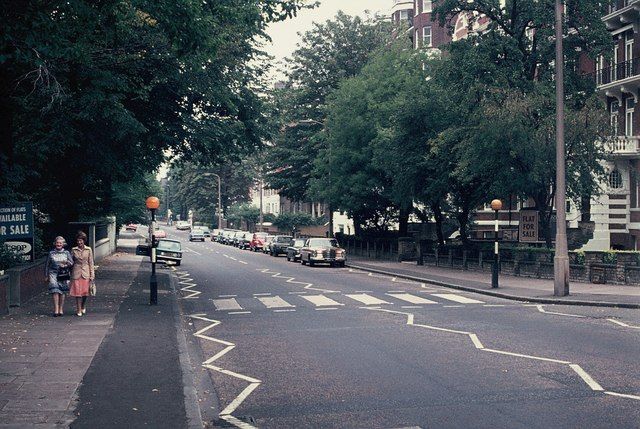
The clue system is the substance, and its internal logic is genuinely ingenious. The Abbey Road cover is read as a funeral procession: Lennon in white as the preacher, Starr in black as the undertaker, Harrison in denim as the gravedigger, and McCartney barefoot, out of step, and holding a cigarette in the wrong hand, the corpse. The Volkswagen behind them carries the registration LMW 28IF, glossed as his age if he had lived. On Sgt. Pepper a hand is raised above his head in the manner of a benediction over the dead, the group stands behind a floral arrangement resembling a grave, and a patch on his uniform was read as OPD, for officially pronounced dead.
The audio clues required playing records backwards (the run-out of "Revolution 9" heard as "turn me on, dead man") or listening closely to the coda of "Strawberry Fields Forever" for what sounded like "I buried Paul."
Almost all of it traces to one document. On 14 October 1969 the Michigan Daily published a review by the student Fred LaBour headlined "McCartney Dead; New Evidence Brought to Light." LaBour was writing satire and invented much of the supporting detail, including the replacement's name. He has said so repeatedly since. The patch reads OPP, for Ontario Provincial Police. McCartney was 27, not 28. Lennon identified the murmur as "cranberry sauce." The theory has outlived its author's confession by fifty-seven years.
WHAT IS KNOWN
The rumour circulated in student papers as early as 1969 but detonated on 12 October 1969, when a caller to Detroit DJ Russ Gibb on WKNR-FM described clues in Beatles records. Two days later the Michigan Daily ran a review by student Fred LaBour headlined "McCartney Dead; New Evidence Brought to Light." LaBour was writing satire and later stated plainly that he had invented much of the supporting detail, including the name of the supposed replacement. The piece was picked up as reportage.
The canonical "clues": on the Abbey Road cover, McCartney is barefoot and out of step with the others, read as a funeral procession, and a Volkswagen in the background carries the plate "LMW 28IF," glossed as McCartney's age "if" he had lived. He was 27, not 28. On Sgt. Pepper, a hand appears above his head and a uniform patch was read as "OPD" for "officially pronounced dead"; the patch reads OPP, for Ontario Provincial Police. Played backwards, the run-out of "Revolution 9" was heard as "turn me on, dead man." The murmur at the end of "Strawberry Fields Forever," heard as "I buried Paul," was identified by John Lennon as "cranberry sauce."
McCartney, who had retreated to his farm in Scotland, was located there by Life magazine and appeared on the cover of the 7 November 1969 issue under the line "Paul is still with us." He has continued to record and tour in the fifty-seven years since, released a 1993 live album titled Paul Is Live whose cover parodies the Abbey Road crossing, and has discussed the episode repeatedly on the record.
EVIDENCE FOR
- Nothing in the evidentiary sense. The strongest honest statement available to the theory is that some of the coincidences are genuinely striking, the barefoot figure and the number plate are real features of a real photograph.
- The Beatles did embed jokes, backwards audio, and deliberate cover puzzles in their work, which is why the pattern-matching found so much material to work with.
EVIDENCE AGAINST
- Fred LaBour, who wrote the article that supplied most of the "evidence," has repeatedly and publicly said he made it up as a humour piece.
- The specific readings fail on inspection: the patch is OPP, not OPD; McCartney was 27 in 1969, not 28; "I buried Paul" is "cranberry sauce," as Lennon himself explained.
- A living, ageing, continuously documented man, sixty years of interviews, performances, medical events, family, and now DNA-era scrutiny of a public figure with no gap in the record.
- The mechanism is impossible at the required scale: a replacement would need to duplicate a distinctive left-handed bass technique, a singing voice, a songwriting sensibility, and personal history convincingly enough to fool bandmates, family, and collaborators, permanently, starting in 1966.
- Backwards masking is a known perceptual effect. Told what to hear in a reversed recording, listeners hear it; told nothing, they do not.
ASSESSMENT
DEBUNKED, and preserved here as the archive's cleanest specimen of how the clue-hunting instinct works. Every element of this theory is an artefact of the search rather than of the evidence: a rich, deliberately playful body of work, scanned by motivated listeners, will always yield anomalies, because anomalies are what scanning produces. Note the two features this file shares with several others in the cabinet, the founding document was a joke that lost its frame, and the subject's continued visible existence has never once been treated by believers as disconfirming. A theory that survives the living presence of the person it says is dead is not responsive to evidence at all.
WHAT WOULD CHANGE THE GRADE
- Closed by the least exotic evidence available: Paul McCartney is alive and has spent sixty years in public.
- To reopen: nothing. Fred LaBour, whose 1969 Michigan Daily article supplied most of the canonical clues, said at the time and has said since that he invented them for a student newspaper.
- The file is kept as a study in method. Once a pattern is proposed, album art, lyrics played backwards and cover photographs supply unlimited confirmation, and the original author's confession changes nothing at all. That mechanism recurs throughout this archive.
FURTHER READING
- Paul is dead · Wikipedia
- "McCartney Dead; New Evidence Brought to Light" · Fred LaBour, Michigan Daily, 14 October 1969
- Life, 7 November 1969, "The case of the 'missing' Beatle: Paul is still with us"
RELATED FILES IN THIS ARCHIVE
- OSA-120 · THE McMARTIN PRESCHOOL TRIALDEBUNKEDSecret tunnels, satanic rituals, 321 counts, zero convictions
- OSA-006 · THE MAX HEADROOM INCIDENTOPEN CASEAmerica's most famous broadcast hijacking
- OSA-064 · THE NAYIRAH TESTIMONYCONFIRMEDThe incubator story that helped sell a war
- OSA-199 · SLENDER MANDEBUNKEDA fictional creature with a documented author, and a real attempted murder