THE TOYNBEE TILES
| FIRST NOTED | Around 1983, Philadelphia; hundreds since across the US and South America |
| TEXT | TOYNBEE IDEA / IN MOVIE 2001 / RESURRECT DEAD / ON PLANET JUPITER |
| METHOD | Layered linoleum and asphalt crack filler, laid under paper, embedded by traffic |
| STATUS | Open. No maker has ever been identified with certainty |
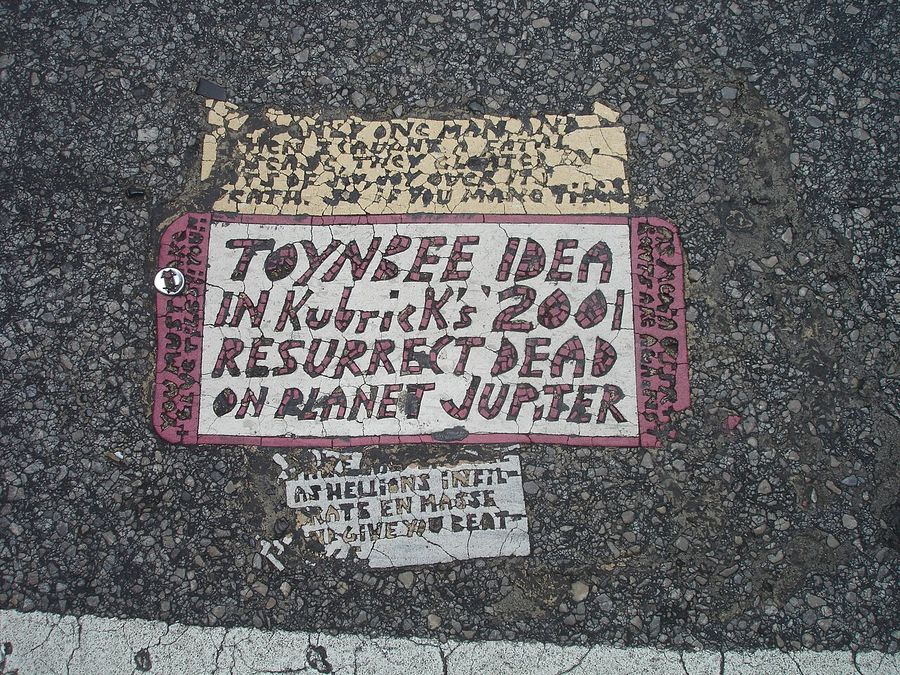
THE CLAIM
That an unidentified person or persons has been embedding hundreds of hand-made tiles bearing an identical cryptic message into busy road surfaces across two continents for over forty years, without ever being observed doing it.
THE THEORY, AS ITS PROPONENTS TELL IT
There is no supernatural claim here. The mystery is entirely one of identity and method, which makes it unusually tractable in principle and unsolved in fact.
The tiles carry variations on a fixed text referring to Arnold Toynbee, the film 2001, and resurrecting the dead on Jupiter. Some carry long marginal screeds about media conspiracies, the Soviet Union, and named individuals.
The method was reverse engineered by enthusiasts. The tiles appear to be made of layered linoleum and asphalt crack filler, covered with paper or tar paper, and laid on the road surface, where passing traffic wears away the covering and presses the tile into the softened asphalt. This can be done from a car with a hole in the floor, which is a claim the tiles themselves make in some versions.
The leading suspect is Philadelphia resident Severino Verna, identified by researchers through a combination of a shortwave radio broadcast, a classified advertisement, an unusual car, and the geography of the earliest tiles. He never confirmed it, refused contact, and died in 2017. Tiles have continued to appear, which either points to copycats or to a different answer.
WHAT IS KNOWN
The tiles are real, numerous, and physically consistent with each other. Hundreds have been documented and catalogued by researchers, and their distribution is mapped.
The South American tiles, in Chile, Brazil and Argentina, are the strangest element. Somebody either travelled to lay them or coordinated with others, and the original suspect had no known means to do so.
The 2011 documentary Resurrect Dead assembled the case for Verna. It is careful and circumstantial, and it is not proof.
Later tiles vary in quality and some are demonstrably by other hands, so a copycat population certainly exists. Distinguishing originals from imitations is now a substantial part of the research.
EVIDENCE FOR
- Hundreds of physically consistent objects, laid in public traffic lanes over four decades.
- A reconstructed and reproducible method that explains how it could be done unobserved.
- A named suspect fitting an unusual number of independent constraints.
EVIDENCE AGAINST (A SINGLE MAKER)
- The South American tiles are very difficult to reconcile with the leading suspect, who had no known travel and limited means.
- Tiles have continued to appear after his death, which requires at least some other hands.
- The identification rests entirely on circumstantial convergence. He never admitted it and was never observed, and no physical evidence links him to any tile.
ASSESSMENT
Open, and enjoyably so. There is nothing paranormal here, no government, and no victim. There is a person, or a small number of people, who made hundreds of durable objects carrying a fixed and slightly deranged message, installed them in the middle of public roads in dozens of cities on two continents over forty years, and were never once seen doing it. The leading candidate fits well and cannot account for the South American tiles. This office keeps the file open because a circumstantial case, however elegant, is not an identification, and OSA-006 sits beside it for the same reason.
WHAT WOULD CHANGE THE GRADE
- To CLOSED: an identification. The leading candidate fits an unusual number of independent constraints and never admitted it, was never observed, and no physical evidence links him to any tile.
- The strongest argument against a single maker is geographic: tiles in Chile, Brazil and Argentina cannot easily be reconciled with a suspect who had no known travel and limited means.
- Tiles have continued to appear since his death in 2017, so at minimum a copycat population exists, and separating originals from imitations is now most of the research.
FURTHER READING
- Toynbee tiles · Wikipedia
- Resurrect Dead (2011) · the documentary case
- Toynbee tile research archives · community catalogues of documented tiles
RELATED FILES IN THIS ARCHIVE
- OSA-044 · CICADA 3301OPEN CASEThe internet's most elaborate recruitment puzzle, recruiter unknown
- OSA-191 · SATOSHI NAKAMOTOOPEN CASEThe creator of Bitcoin, who left and never touched the money
- OSA-015 · NUMBERS STATIONSCONFIRMEDAnonymous voices, unbreakable arithmetic
- OSA-160 · STUXNETCONFIRMEDSoftware built to physically destroy Iranian centrifuges