AGENT ORANGE
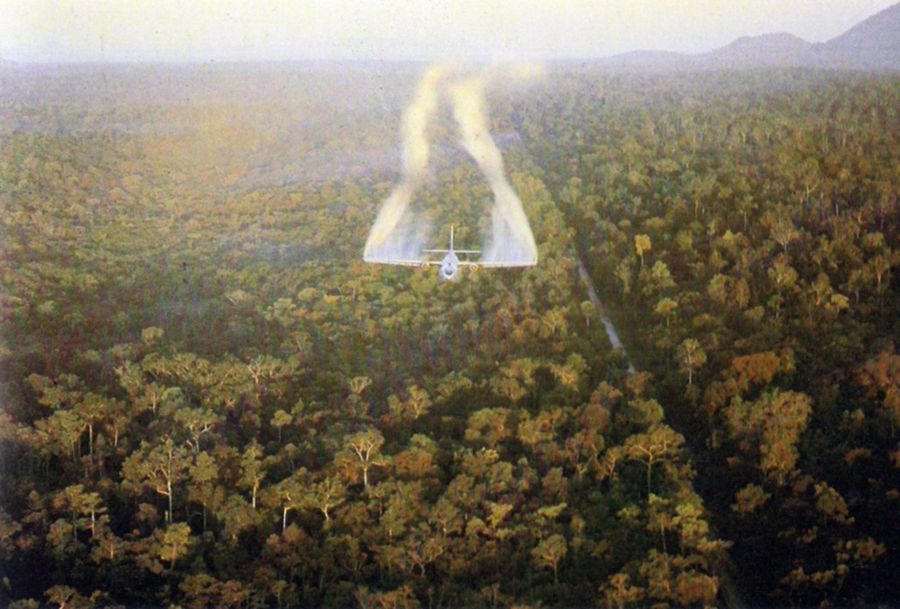
| SPRAYED | Roughly 75 million litres over Vietnam, Laos and Cambodia, 1961 to 1971 |
| CONTAMINANT | TCDD, a dioxin, present as a by-product of manufacture |
| US OUTCOME | $180m settlement 1984; VA presumptive service connection for many conditions |
| STATUS | Confirmed. Vietnamese claims have been dismissed in US courts |
THE CLAIM
That the manufacturers of Agent Orange knew it was contaminated with a highly toxic dioxin, did not disclose this to the government or to those exposed, and that both American veterans and Vietnamese civilians were harmed as a result.
THE THEORY, AS ITS PROPONENTS TELL IT
The chemistry is the crux. The herbicide itself was not the main problem; the manufacturing by-product was.
Agent Orange was a mixture of two herbicides. The production process for one of them generated TCDD, among the most toxic dioxins known, as a contaminant. Levels varied by manufacturer and by how fast the batch was produced, and wartime demand pushed production rates up.
Internal correspondence produced in litigation shows manufacturers discussing the dioxin problem in the mid-1960s, including concern about what would happen if it became public and attracted regulatory attention. This is the concealment element and it is documented.
American veterans reported cancers, neurological conditions and birth defects in their children. A 1984 class settlement produced $180 million without an admission of liability. The Department of Veterans Affairs later established presumptive service connection for a growing list of conditions, which is a substantive acknowledgement.
Vietnamese claimants have never succeeded. A 2004 suit was dismissed on the basis that herbicides were not chemical weapons under international law at the time. Contamination hotspots at former storage bases remain, and remediation has been slow.
WHAT IS KNOWN
The spraying, the contamination and the dioxin's toxicity are established.
The VA's presumptive conditions list has expanded repeatedly, most recently to include additional cancers and respiratory diseases, which reflects accumulating evidence.
The manufacturer correspondence is real and was central to the American litigation.
Causation for individual illnesses remains difficult, which is why the American system moved to presumption rather than proof.
EVIDENCE FOR
- Internal manufacturer correspondence discussing the dioxin contaminant and regulatory risk.
- A $180 million settlement in 1984.
- The VA's expanding list of presumptive conditions, which is a government concession on causation at population level.
- Persistent dioxin contamination at former base sites, measurable today.
EVIDENCE AGAINST (THE STRONGEST CLAIMS)
- Individual causation is genuinely hard to establish, and presumptive service connection is a policy decision rather than a scientific finding for any specific person.
- Studies of birth defects in veterans' children have produced mixed results, with some associations supported and others not.
- The government specified the product and set the delivery schedule, so responsibility is shared with the buyer in a way that pure corporate concealment cases are not.
ASSESSMENT
Confirmed as to the contamination and the manufacturers' knowledge, and included as much for the asymmetry as for the chemistry. American veterans obtained a settlement and, eventually, a presumption in their favour. Vietnamese civilians exposed to the same compound in far greater numbers have obtained neither, on a legal technicality about how herbicides were classified at the time. Compare OSA-103, where the same asymmetry appears: the harm is acknowledged, and the acknowledgement stops at a border.
WHAT WOULD CHANGE THE GRADE
- CONFIRMED: the dioxin contaminant TCDD was a manufacturing by-product, and internal industry correspondence from the mid-1960s discusses it alongside concern about regulatory attention.
- The American system moved to presumption rather than proof, and the VA's list of presumptive conditions has expanded repeatedly. That is a government concession on causation at population level, not proof for any individual.
- The asymmetry is the finding: US veterans obtained a settlement and a presumption. Vietnamese claimants have obtained neither, their 2004 suit dismissed on the basis that herbicides were not chemical weapons under the law at the time.
FURTHER READING
- Post-Vietnam Dioxin Exposure in Agent Orange-Contaminated C-123 Aircraftnap.edu
- Veterans and Agent Orange: Herbicide/Dioxin Exposure and Type 2 Diabetesiom.edu, archived
- Agent Orange · Wikipedia
- Institute of Medicine, Veterans and Agent Orange · biennial update series
- In re Agent Orange Product Liability Litigation, US District Court (1984)
RELATED FILES IN THIS ARCHIVE
- OSA-105 · THE PENTAGON PAPERSCONFIRMEDA classified study showing four administrations had misled the public
- OSA-012 · THE GULF OF TONKIN INCIDENTCONFIRMEDThe attack that launched a war didn't happen
- OSA-104 · OPERATION POPEYECONFIRMEDWeather as a weapon, five years of secret cloud seeding over Vietnam
- OSA-113 · THE PHOENIX PROGRAMCONFIRMEDOver 26,000 dead by the programme's own official count