THE BATTLE OF LOS ANGELES
| OCCURRED | Night of 24 to 25 February 1942, over Los Angeles |
| FIRED | Over 1,400 rounds of 12.8 pound anti-aircraft ammunition |
| CASUALTIES | Five civilian deaths, none from enemy action; no aircraft downed |
| STATUS | Debunked. Official conclusion: war nerves, weather balloons and friendly fire |
THE CLAIM
That American forces engaged unidentified craft over Los Angeles in February 1942, and that the official explanation of war nerves conceals a genuine encounter.
THE THEORY, AS ITS PROPONENTS TELL IT
The event is real and remarkable, which is why the claim has survived. What is contested is what was in the sky.
Ten weeks after Pearl Harbor, and one day after a Japanese submarine had shelled an oil facility near Santa Barbara, air raid sirens sounded over Los Angeles. A blackout was ordered, searchlights swept the sky, and anti-aircraft batteries fired for around an hour.
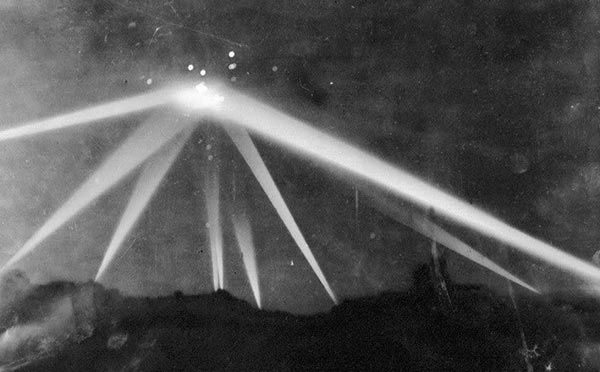
The Los Angeles Times published a photograph showing searchlight beams converging on an object. It became the central piece of evidence and is still reproduced constantly.
Proponents point to the volume of fire, the duration, and the number of experienced military observers who reported seeing something. Some accounts describe a large, slow object unaffected by the shelling.
WHAT IS KNOWN
No aircraft was recovered, no wreckage was found, and no bombs were dropped. Japan confirmed after the war that it had no aircraft over the city that night.
The famous photograph was retouched before publication, which was standard newspaper practice at the time to improve contrast for printing. Analysis of the original negative shows the convergence of searchlight beams rather than a solid object, and the retouching darkened and sharpened it considerably.
The Secretary of the Navy called it a false alarm within a day. The Army initially said one to five unidentified aircraft. A 1983 US Air Force historical study concluded meteorological balloons, released routinely, probably initiated the alert, compounded by war nerves and by shell bursts from other batteries being reported as new targets.
The five deaths were all indirect: three in blackout traffic accidents and two heart attacks.
EVIDENCE FOR
- The scale of the response, over 1,400 rounds fired by trained crews over roughly an hour.
- Reports from experienced observers, including military personnel, describing an object.
- The genuine strangeness of a sustained barrage with no identified target.
EVIDENCE AGAINST
- Nothing was hit and nothing was found, despite 1,400 rounds fired over a populated area.
- Japan's own records confirm no aircraft were present.
- The photograph was retouched, and the original shows converging searchlights rather than a craft.
- The feedback mechanism is documented: shell bursts illuminated by searchlights were reported as new contacts, which produced more fire, which produced more contacts.
ASSESSMENT
Debunked, and kept because the underlying event needs no embellishment. A city ten weeks into a war, one day after a real enemy attack on its coast, fired 1,400 shells into an empty sky for an hour and killed five of its own people. That is a genuine and instructive thing to have happened. The famous photograph is a retouched newspaper image of searchlights, and OSA-146 shows what happens to a case when its most iconic image turns out not to be what everyone thought.
WHAT WOULD CHANGE THE GRADE
- Closed: nothing was hit and nothing was found despite over 1,400 rounds fired across a populated area, and Japanese records confirm no aircraft were present.
- The famous photograph was retouched before publication, which was routine newspaper practice for contrast. The original shows converging searchlight beams rather than a solid object.
- The feedback mechanism is documented: shell bursts lit by searchlights were reported as fresh contacts, which produced more fire and more contacts. All five deaths were indirect, three in blackout traffic and two heart attacks.
FURTHER READING
- California in World War II: The Battle of Los Angelesmilitarymuseum.org, archived
- another good story ruined the battle of los angeleslatimesblogs.latimes.com, archived
- The Great Los Angeles Air Raid Terrified Citizens—Even Though No Bombs Were Droppedsmithsonianmag.com
- Battle of Los Angeles · Wikipedia
- US Office of Air Force History, The Army Air Forces in World War II · the 1983 assessment
- Los Angeles Times, 26 February 1942, and the original unretouched negative analysis
RELATED FILES IN THIS ARCHIVE
- OSA-195 · THE ARIEL SCHOOL ENCOUNTERUNVERIFIEDSchoolchildren in Zimbabwe reported a craft and figures during morning break
- OSA-144 · THE HINDENBURGCONTESTEDStatic discharge or a saboteur, argued for eighty-eight years
- OSA-050 · THE TIC TAC VIDEOSUNVERIFIEDNavy sensors, fighter pilots, and footage the Pentagon admits is real
- OSA-146 · THE BELGIAN UFO WAVECONTESTEDAn air force that investigated openly, and a triangle nobody identified