THE HINDENBURG
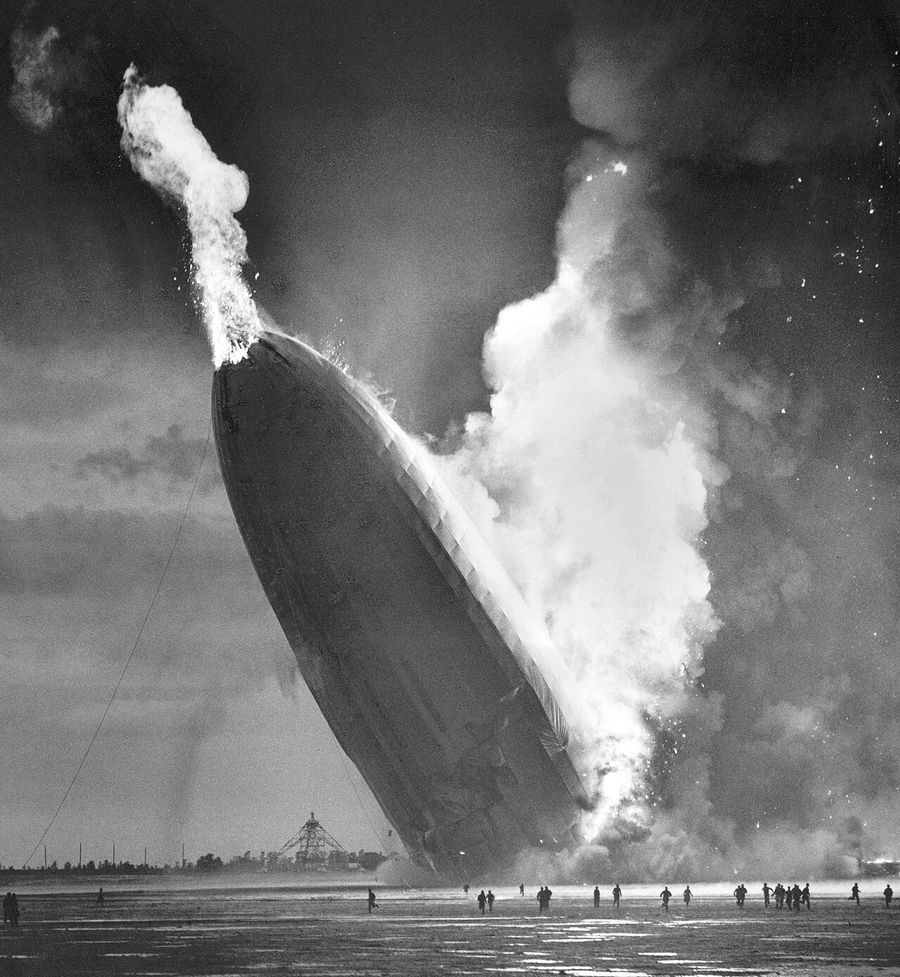
| BURNED | 6 May 1937, Lakehurst, New Jersey; 36 of 97 aboard and one ground crew died |
| OFFICIAL FINDING | US and German commissions: leaking hydrogen ignited by electrostatic discharge |
| SABOTAGE CLAIM | Advanced by Zeppelin company investigators, naming rigger Erich Spehl |
| STATUS | Contested. No physical evidence of a device was found |
THE CLAIM
That the Hindenburg was destroyed by deliberate sabotage rather than by accidental ignition, and that the finding of accident was reached for political and commercial convenience.
THE THEORY, AS ITS PROPONENTS TELL IT
Two competing sabotage arguments exist and they are not equally serious.
The stronger one comes from inside the Zeppelin company. Investigator Max Pruss and, later, company figures argued for a device, and named rigger Erich Spehl, who died in the fire, on the basis that he had anti-Nazi sympathies, a girlfriend under Gestapo surveillance, and access to the area where the fire is believed to have started. Proponents note the ship was a prestige object of the regime and an obvious target.
The circumstances offer some support. The airship had been delayed and was landing hours late, so a timed device would have detonated at an unintended moment. The fire began at the stern, near gas cell four, which is consistent both with the sabotage account and with the leaking hydrogen account.
The commercial motive for finding accident is also argued. A sabotage finding would have implicated German internal security and embarrassed the regime, and the American commission had diplomatic reasons for not reaching it. Both governments had an interest in the tidier answer.
WHAT IS KNOWN
Both official inquiries, American and German, concluded that hydrogen leaking from a cell was ignited by an electrostatic discharge, most likely as the mooring lines earthed the ship in damp, electrically active air.
No physical evidence of an incendiary or explosive device was found in the wreckage, which was examined closely by both commissions.
A later hypothesis by Addison Bain held that the doped fabric covering, containing reflective compounds including iron oxide and aluminium, was itself highly flammable and was the primary fuel. Subsequent testing, including a Mythbusters replication and academic work, found the covering could not have burned fast enough to account for a thirty-six second destruction, and that hydrogen was necessarily the main fuel.
Survivor accounts and film show the fire propagating at a speed consistent with hydrogen, from the upper stern, downward and forward.
EVIDENCE FOR
- A named suspect with means, opportunity and a plausible motive, advanced by investigators from the company that built the ship.
- The airship's status as a prestige symbol of the Nazi regime, making it a rational target.
- The delayed landing, which would explain a device detonating at the wrong moment.
- Institutional incentives on both sides to prefer a finding of accident.
EVIDENCE AGAINST
- No trace of a device was found by either commission, examining a wreck that came down largely in one place and was not dispersed at sea.
- The electrostatic discharge explanation accounts for the timing, the location and the propagation speed without requiring anything additional.
- Spehl's accusation rests on association and access rather than on evidence, and he died in the fire and could not answer it.
- Hydrogen airships had a substantial prior record of fires. The Hindenburg was not anomalous in kind, only in visibility.
ASSESSMENT
Contested, and this office leans clearly toward accident while recording why the argument persists. The physical evidence supports ignition of leaking hydrogen, the incendiary paint hypothesis has been tested and does not survive, and no device was ever found. The sabotage case rests on a plausible motive, an accessible suspect who cannot answer, and a real institutional preference on both sides for the less embarrassing conclusion. That last point is legitimate and is not enough. Compare OSA-131, where the same structure produced a permanently open file because the evidence was destroyed rather than examined.
WHAT WOULD CHANGE THE GRADE
- The physical evidence supports the official finding: leaking hydrogen ignited by electrostatic discharge as the ship earthed, which accounts for the timing, the location and the propagation speed.
- To CONFIRMED as sabotage: physical evidence of a device. Neither commission found any, in a wreck that came down largely in one place.
- The incendiary paint hypothesis has been tested since and does not survive: the doped covering could not burn fast enough to destroy the ship in thirty-six seconds, so hydrogen was necessarily the main fuel.
FURTHER READING
- History's Mysteries: Caltech Professor Helps Solve Hindenburg Disastercaltech.edu
- The real cause of the Hindenburg disaster?philly.com, archived
- Hindenburg disaster · Wikipedia
- US Department of Commerce, report of the Board of Inquiry (1937)
- Addison Bain, The Freedom Element (2004) · the incendiary paint hypothesis
RELATED FILES IN THIS ARCHIVE
- OSA-063 · THE GLEIWITZ INCIDENTCONFIRMEDThe staged attack that opened the Second World War
- OSA-192 · THE BATTLE OF LOS ANGELESDEBUNKEDAn all-night barrage over a city, at a target nobody could identify
- OSA-002 · D.B. COOPEROPEN CASEThe only unsolved commercial skyjacking in U.S. history
- OSA-037 · MALAYSIA AIRLINES FLIGHT 370OPEN CASEA Boeing 777, 239 aboard, six silent hours of flight