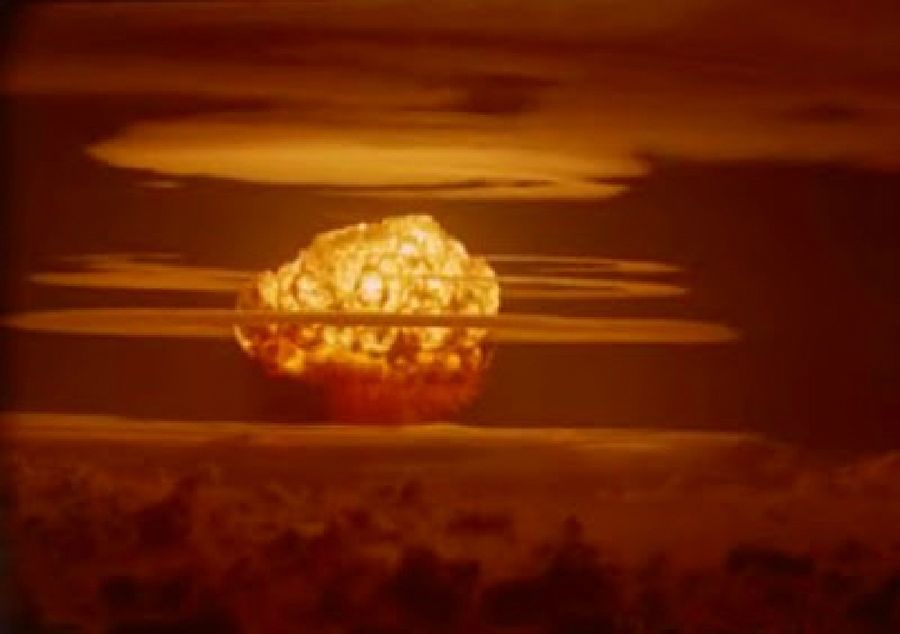
CASTLE BRAVO
| DETONATED | 1 March 1954, Bikini Atoll, Marshall Islands |
| YIELD | 15 megatons against a predicted 6, from a lithium reaction the designers had discounted |
| EXPOSED | Rongelap and Utirik islanders, and the crew of the Daigo Fukuryu Maru |
| STATUS | Confirmed. Compensation paid; Project 4.1 medical study documented |
THE CLAIM
That the United States knew fallout from Castle Bravo would cross inhabited islands, proceeded anyway, delayed evacuation, and then studied the exposed population rather than only treating it.
THE THEORY, AS ITS PROPONENTS TELL IT
The physical facts are established and the argument concerns intent and what happened next.
The device yielded fifteen megatons rather than the predicted six, because the designers had assumed lithium-7 would be inert and it was not. That much is a genuine scientific error. What proponents point to is the weather: forecasts before the shot showed winds trending toward Rongelap and Rongerik, the decision was taken to fire regardless, and evacuation of Rongelap did not begin until two days later, by which time islanders had watched white ash fall and children had played in it.
Project 4.1, the medical study of the exposed population, was numbered and its objectives drafted before the test. Its stated purpose was the study of response of human beings exposed to significant beta and gamma radiation. Proponents read the pre-existing study number as evidence that exposure was anticipated. The counter-reading is that contingency studies are routinely numbered in advance.
The islanders were returned to Rongelap in 1957 and lived there for twenty-eight years amid continuing contamination, with a documented pattern of thyroid disease and cancers, before evacuating themselves in 1985 with help from Greenpeace. The United States has paid compensation through a claims tribunal that was never fully funded.
WHAT IS KNOWN
The yield error, the fallout track and the exposures are all documented and have never been disputed. Castle Bravo remains the largest US detonation and the worst American radiological incident.
The Japanese fishing vessel Daigo Fukuryu Maru was outside the declared danger zone and was heavily contaminated; its radio operator Aikichi Kuboyama died months later. The incident caused a diplomatic crisis and a settlement paid to Japan.
Project 4.1 is real, its documents are declassified, and the long-term medical follow-up of the Rongelap population was conducted by Brookhaven National Laboratory over decades. Islanders have consistently described it as study rather than care.
The 1957 return to Rongelap was authorised on the basis that levels were acceptable. Later review found the island significantly more contaminated than stated, and dietary uptake through local food was not adequately accounted for.
EVIDENCE FOR
- Pre-shot weather forecasts showing unfavourable wind trends, which are in the declassified record.
- The two-day delay before evacuating Rongelap, with ash observed falling on the first day.
- Project 4.1, numbered and scoped before the detonation, with human radiation response as its stated object.
- The 1957 resettlement of a population onto an island later shown to be more contaminated than represented, followed by decades of documented thyroid disease.
EVIDENCE AGAINST (THE STRONGEST READING)
- The yield error was genuine physics, not deception. The lithium-7 reaction was not understood, and the designers were as surprised as anyone.
- Contingency medical studies are numbered in advance as a matter of routine, so the existence of a Project 4.1 number is weaker evidence of intent than it is usually presented as.
- American personnel on Rongerik were also exposed and required evacuation, which is difficult to square with a deliberate exposure plan.
- Compensation was eventually paid and the medical follow-up, whatever its motives, produced the data now used to understand radiation exposure in populations.
ASSESSMENT
Confirmed as to the events and contested only as to intent, which is the honest place to leave it. The archive's position is that deliberate exposure is not established and reckless disregard plainly is: the forecast was known, the shot went ahead, the evacuation was slow, the return in 1957 was premature, and the population was studied for decades by people who were not primarily there to treat them. Compare OSA-061, where the same institutional habit appears in a different form. The pattern across both is not malice so much as a settled assumption that some populations are data.
WHAT WOULD CHANGE THE GRADE
- The events are CONFIRMED and not disputed: a 15-megaton yield against a predicted 6, fallout across inhabited atolls, and the contamination of a Japanese fishing vessel outside the declared danger zone.
- To CONFIRMED for deliberate exposure: an order, or a planning document treating the islanders as intended subjects. Project 4.1 was numbered and scoped before the shot, which proponents read as intent, and contingency studies are routinely numbered in advance.
- What is established without needing that: pre-shot forecasts showed unfavourable winds, the shot went ahead, evacuation took two days, and the 1957 resettlement put people back on an island later shown to be more contaminated than represented.
FURTHER READING
- Castle Bravo · Wikipedia
- Daigo Fukuryu Maru · the Japanese fishing boat
- Advisory Committee on Human Radiation Experiments, final report (1995)
RELATED FILES IN THIS ARCHIVE
- OSA-061 · PROJECT SUNSHINECONFIRMEDThe government collected human bones to measure fallout
- OSA-100 · THE VELA INCIDENTCONTESTEDA satellite built to spot nuclear tests spotted one nobody claims
- OSA-160 · STUXNETCONFIRMEDSoftware built to physically destroy Iranian centrifuges
- OSA-147 · THE CASH-LANDRUM INCIDENTOPEN CASEMedical injuries consistent with radiation, and a lawsuit dismissed for lack of a defendant