THE DYATLOV PASS INCIDENT
| DATE | Night of February 1–2, 1959 |
| VICTIMS | Nine experienced ski-hikers led by Igor Dyatlov; the tenth turned back early with illness and survived |
| SOVIET VERDICT | Deaths caused by "a compelling natural force", case closed, files classified |
| STATUS | Modern natural explanations strong but not universally accepted |
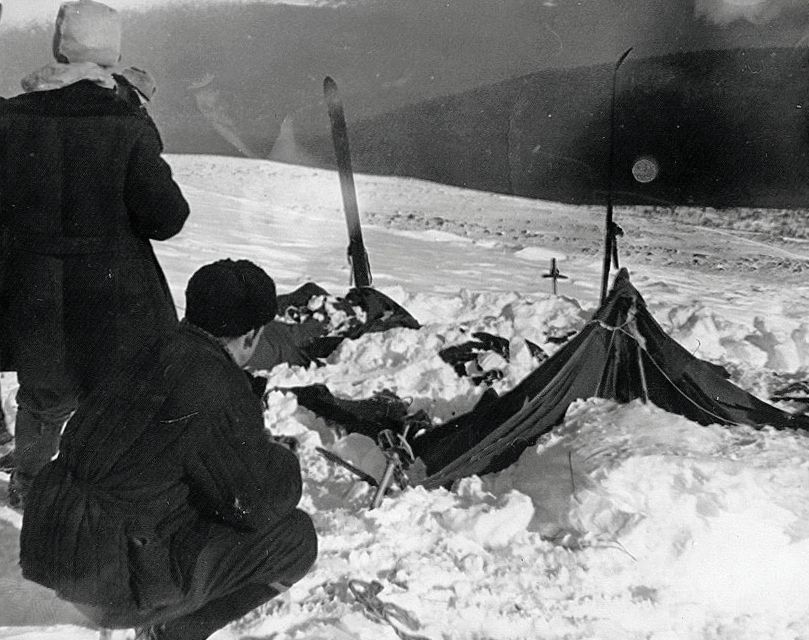
THE CLAIM
Something terrifying enough to make nine capable mountaineers slash their way out of their own tent and flee barefoot into a −25°C night killed them on Kholat Syakhl, and the Soviet state knew more than it said.
THE THEORY, AS ITS PROPONENTS TELL IT
Nine experienced ski hikers cut their way out of a tent from the inside on a February night in 1959, walked into roughly minus twenty-five degrees inadequately dressed, and died. Four of the bodies showed severe internal injuries (a fractured skull, crushed ribs) without corresponding external wounds. One was missing her tongue and eyes. Some clothing carried elevated radiation. The Soviet investigation closed with the finding that a "compelling natural force" had caused the deaths and the case file was archived.
That formulation is what created the theory. Proponents argue that no natural explanation accounts for the combination of the tent cut from within, the injuries, and the classification, and that the Soviet state closed the file because the cause was a military test. The specific candidates are a parachute mine test, whose air-blast overpressure could produce internal crush injuries without external trauma, or an R-7 rocket stage, which would explain the orange lights reported in the sky that week by observers elsewhere in the Urals.
The other durable strands: an encounter with indigenous Mansi hunters, investigated at the time and abandoned for lack of evidence and motive; an escaped-prisoner or KGB-operation scenario; and an infrasound hypothesis in which a Kármán vortex forming over the ridge in high wind induced panic.
In 2019 Russian prosecutors reopened the case and concluded in 2020 that a slab avalanche had struck the tent, forcing an emergency exit, with the injuries caused by the slab and by falls onto rocks in the dark, and the eyes and tongue lost to ordinary decomposition and scavengers in running water. A 2021 paper in Communications Earth & Environment modelled the slab mechanics on that slope and found them plausible. Proponents note that the survivors of the original investigation were told the same thing in 1959 and did not believe it either.
WHAT IS KNOWN
The facts that launched a thousand theories are all real. The tent was found collapsed and cut open from the inside, the group's boots and gear still in it. Footprints (some bare, some in socks) led downslope to a treeline. Two bodies were found under a cedar by the remains of a fire; three more, including Dyatlov, on the slope back toward the tent, as if trying to return. The final four were found months later in a ravine under four meters of snow. Six died of hypothermia; three had severe trauma, a fractured skull, and chest injuries a examining doctor compared to a car crash. One woman was missing her tongue and eyes (consistent, forensically, with months in a snowmelt streambed). Trace radioactivity was found on two garments (consistent with lantern mantles and one hiker's past work at a nuclear facility). The inquest closed with the phrase above and the files went into the archive.
EVIDENCE FOR (SOMETHING UNEXPLAINED)
- The searchers in 1959 reported no classic avalanche debris, and the slope above the tent was comparatively shallow, the standard avalanche story sat badly for sixty years.
- The trauma pattern, crushing injuries without external wounds, and the group's flight from safety remain genuinely strange behavior for nine disciplined mountaineers.
- The Soviet closure ("compelling natural force"), the classified file, and a nearby military test range fed reasonable suspicion in a state that habitually lied.
EVIDENCE AGAINST (TOWARD A NATURAL ANSWER)
- A 2021 peer-reviewed model (Gaume & Puzrin, using snow physics and, memorably, animation tech from Frozen) showed a small, delayed slab avalanche was possible on that slope: the group cut the tent platform into the snowpack, katabatic winds loaded it for hours, and a meter-scale slab onto sleeping bodies explains the crush injuries without external wounds, and why little debris remained days later.
- Fleeing a collapsed, snow-loaded tent, then dying of exposure while attempting survival by the book (fire, snow cave, return attempt), matches the terrain evidence without any exotic actor.
- Russia's 2019–2020 re-investigation reached the same family of answer: avalanche, poor visibility, hypothermia.
- Every exotic theory (infrasound panic, Mansi attack, escaped prisoners, weapons tests, yeti) either contradicts the physical evidence or requires evidence that doesn't exist.
ASSESSMENT
Contested, leaning natural. The slab-avalanche model is the first explanation that fits the injuries, the timeline, and the searchers' observations at once, and the surviving relatives' skepticism is about the Soviet handling, not the snow physics. What keeps the stamp at contested rather than debunked is honest residue: no one saw it happen, the 1959 evidence collection was poor, and the model shows possibility, not proof. Sixty-seven years on, the mountain keeps the only complete file.
WHAT WOULD CHANGE THE GRADE
- To CONFIRMED as a military event: a range log, test record, or flight record placing an activity in the Northern Urals on 1 or 2 February 1959. The Soviet and Russian archives have never produced one.
- The 2019 to 2021 Russian review concluded slab avalanche, and 2021 modelling in Nature Communications showed the slope geometry could produce one with the injuries recorded. That is the strongest natural account the file has ever had.
- It does not comfortably explain everything: the radiation on two garments, the soft-tissue losses on the bodies found last, and the decision to leave the tent barefoot in the dark all sit awkwardly with it.
- Parts of the original criminal case file remain unreleased.
FURTHER READING
- Case files 355-357dyatlovpass.com, archived
- Wikipedia: Dyatlov Pass incident
- Gaume & Puzrin, "Mechanisms of slab avalanche release and impact in the Dyatlov Pass incident" (Communications Earth & Environment, 2021)
- Donnie Eichar, Dead Mountain (2013)
RELATED FILES IN THIS ARCHIVE
- OSA-002 · D.B. COOPEROPEN CASEThe only unsolved commercial skyjacking in U.S. history
- OSA-088 · THE YUBA COUNTY FIVEOPEN CASEA working car abandoned seventy miles the wrong way
- OSA-092 · THE SODDER CHILDRENOPEN CASEA house fire that left five children and not one bone
- OSA-185 · THE ALCATRAZ ESCAPEOPEN CASEThree men left the island and were never found, alive or dead