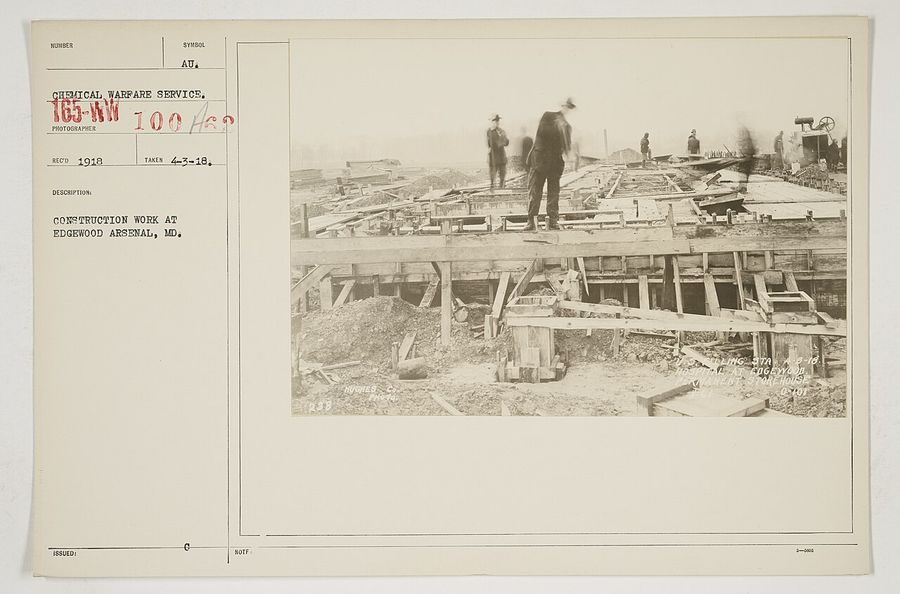
EDGEWOOD ARSENAL
| RAN | 1948 to 1975, at Edgewood Arsenal, Maryland |
| SUBJECTS | Approximately 7,000 US service members |
| AGENTS | Over 250 substances, including sarin, VX, mustard and the incapacitant BZ |
| STATUS | Confirmed. Reviewed by the Army Inspector General (1975) and the IOM (1982 onward) |
THE CLAIM
That the United States Army exposed thousands of its own soldiers to nerve agents and psychoactive chemicals without meaningful informed consent, and then lost track of them.
THE THEORY, AS ITS PROPONENTS TELL IT
The programme is confirmed by the Army's own investigations, so the argument is about consent and about what happened to the men afterwards.
Soldiers volunteered for what was described in general terms as testing of protective equipment and of the effects of chemical agents. They were not told which agents, what the doses were, or what the risks might be. Many were told they were contributing to national defence and would be unable to discuss it.
The substances included nerve agents at sub-lethal doses, mustard, irritants, and a large programme around BZ, a deliriant producing hallucinations and confusion lasting days. Some subjects have described episodes they could not distinguish from psychosis.
The follow-up is the enduring complaint. The Army did not systematically track participants afterwards, and many were unable to obtain records establishing what they had been given, which made claiming veterans' benefits extremely difficult. Litigation in the 2000s produced an order requiring the Army to notify participants and provide medical care.
WHAT IS KNOWN
The programme, the agent list and the participant numbers are established in Army records and in the 1975 Inspector General review.
The National Academy of Sciences, through the Institute of Medicine, conducted health follow-up studies from 1982 and reported findings across three volumes. It identified some long-term effects and noted substantial limitations from the poor original record-keeping.
A class action, Vietnam Veterans of America v. CIA, produced a 2013 ruling requiring the Army to provide notice and medical care to test participants.
Consent documentation exists but is generic. The Inspector General's own review found the consent obtained did not meet the standards in force at the time.
EVIDENCE FOR
- Army records naming the agents and the numbers exposed.
- The 1975 Inspector General review finding the consent process inadequate by contemporary standards.
- A federal court order in 2013 requiring notification and care, decades after the fact.
- Participant testimony consistent across large numbers of unconnected men.
EVIDENCE AGAINST (THE HEALTH CLAIM)
- The Institute of Medicine's follow-up did not find the scale of long-term harm many participants expected, though it was limited by the records available.
- Doses were generally sub-lethal and deliberately calibrated, and there were no deaths in the programme.
- The programme ended in 1975 and the practices it used would be impossible under modern research ethics rules, which were substantially written in response to cases like this one.
ASSESSMENT
Confirmed, and part of a pattern this cabinet now documents four times over. Compare OSA-121, OSA-123 and OSA-061: the government's own personnel or patients were the convenient population, consent was nominal, the records were poor, and the accounting came decades later and only under pressure. The distinctive feature here is the aftermath. These men were not merely experimented on, they were then unable to prove it had happened, which turned a wrong into an unprovable one for most of their lives.
WHAT WOULD CHANGE THE GRADE
- CONFIRMED: roughly 7,000 service members exposed to over 250 substances, established in Army records and the 1975 Inspector General review, which itself found the consent obtained inadequate by the standards then in force.
- The health question is limited by the records rather than settled by them. The Institute of Medicine follow-up found less long-term harm than participants expected, and could only assess exposures the Army had documented.
- The enduring wrong is the aftermath: no systematic tracking, so most participants could not prove what they had been given. A 2013 court order finally required notification and care.
FURTHER READING
- Edgewood/Aberdeen Experiments - Public Healthpublichealth.va.gov
- Edgewood-Aberdeen Experimentswarrelatedillness.va.gov
- Edgewood Arsenal human experiments · Wikipedia
- Institute of Medicine, Possible Long-Term Health Effects of Short-Term Exposure to Chemical Agents (1982 to 1985)
- Vietnam Veterans of America v. CIA, US District Court, Northern District of California (2013)
RELATED FILES IN THIS ARCHIVE
- OSA-103 · THE GUATEMALA EXPERIMENTSCONFIRMEDAmerican researchers infected Guatemalans with syphilis on purpose
- OSA-055 · UNIT 731 & THE IMMUNITY DEALCONFIRMEDHuman experiments in Manchuria, and the data America bought
- OSA-121 · PROJECT 112 AND SHADCONFIRMEDShipboard and land tests of live agents on American servicemen
- OSA-171 · THE SALISBURY POISONINGSCONFIRMEDNovichok on a door handle, and one death that was never the target