PILTDOWN MAN
| ANNOUNCED | December 1912, by Charles Dawson and Arthur Smith Woodward |
| COMPOSED OF | A medieval human cranium, an orangutan jaw, chimpanzee teeth, all stained |
| EXPOSED | 1953, by Weiner, Oakley and Le Gros Clark, using fluorine dating |
| STATUS | Debunked. A 2016 study points to a single forger, most likely Dawson |
THE CLAIM
That Piltdown Man was a deliberate forgery, assembled from modern and animal material, and accepted by the scientific establishment for forty years because it told them what they wanted to hear.
THE THEORY, AS ITS PROPONENTS TELL IT
Nobody now disputes that Piltdown was a fake, so the live claim is about the mechanism of belief rather than about the bones.
The find suited its audience precisely. In 1912 the earliest human remains were being pulled out of Germany and France, and Piltdown supplied England with an ancestor of its own. It also matched the theoretical expectation of the day, that a large brain evolved before a modern jaw, which is exactly backwards but was the mainstream view.
Proponents of the strong reading argue that this is what institutional consensus failure looks like from the inside: not a lie agreed in a room, but a whole field applying less scrutiny to the evidence it was hoping for. Contrary finds, including the Taung Child in 1924, which was genuine and pointed the other way, were dismissed partly because Piltdown made them look wrong.
The forty years is the part that carries the argument. The material was available for examination throughout. The tests that eventually exposed it, including simple ones, were not applied, because nobody with standing wanted the answer badly enough to look.
WHAT IS KNOWN
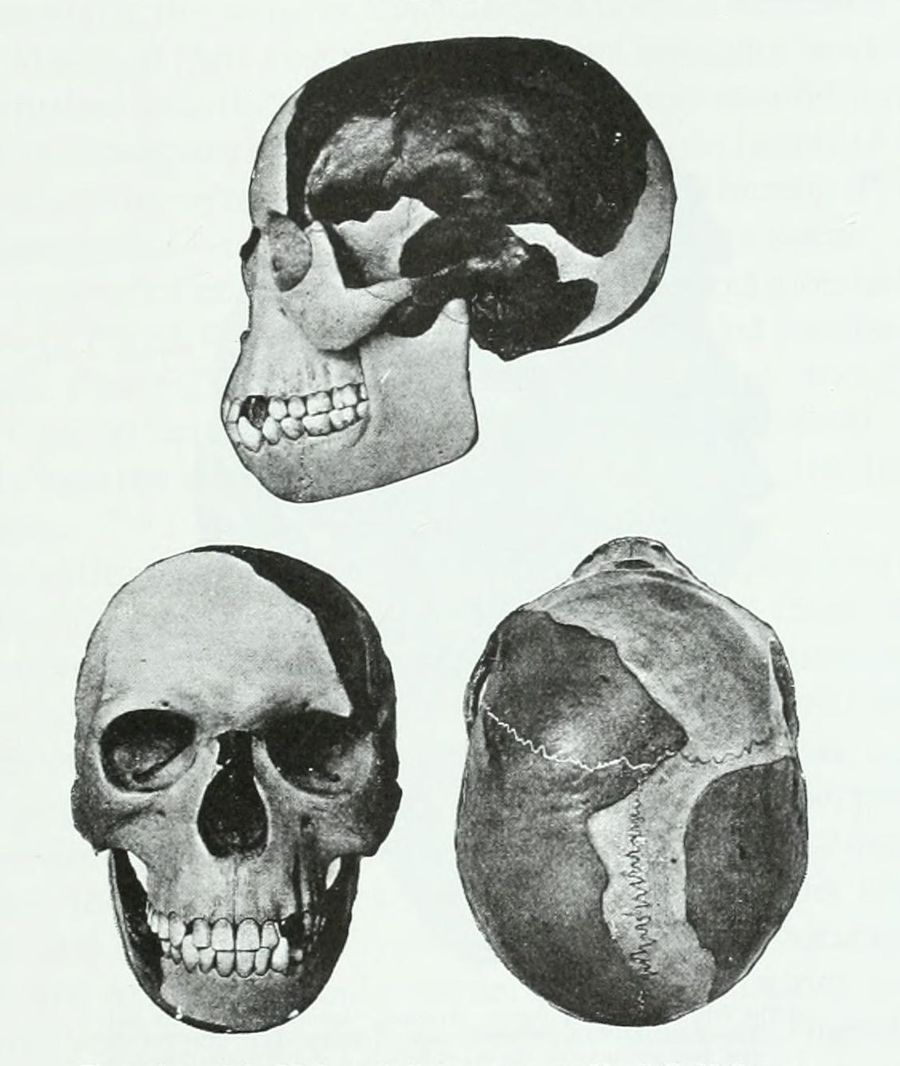
The composition is established. The cranium is human and medieval, the jaw is that of an orangutan, the teeth were filed down to simulate human wear, and everything was stained with iron and chromate to match the gravel bed.
The exposure came in 1953 when Kenneth Oakley, Joseph Weiner and Wilfrid Le Gros Clark applied fluorine absorption dating and found the pieces were of different ages and far younger than claimed. Under magnification the file marks on the teeth were obvious once anyone looked.
A 2016 study in Royal Society Open Science used DNA and computed tomography to show the animal material came from a single orangutan specimen and that the same technique, including dental putty, was used throughout. That points to one forger rather than several, and Charles Dawson, who had a documented history of other archaeological fakes, is the overwhelming favourite.
EVIDENCE FOR
- The fluorine dating, which is decisive and repeatable.
- Physical file marks on the teeth, visible under a hand lens, on material that had been in a museum for four decades.
- The 2016 genetic and tomographic work, which established a single source and a consistent method.
- Dawson's record: at least thirty-eight other finds attributed to him have since been questioned or shown to be faked.
EVIDENCE AGAINST (THE WIDER USE)
- Piltdown is regularly deployed as an argument against evolutionary science generally, which inverts the actual lesson. It was exposed by scientists, using scientific methods, and the genuine fossils that contradicted it turned out to be the ones that survived.
- The forty-year delay is often overstated. Doubts were raised from the 1910s onward, and by the 1930s the find sat awkwardly with almost everything else being discovered.
- The identity of the forger, while strongly indicated, is not conclusively established, and candidates including Martin Hinton and Arthur Conan Doyle have been argued for on thin grounds.
ASSESSMENT
Debunked, comprehensively, and kept in the cabinet as the best available study of how a false thing survives. Piltdown did not last forty years because the forgery was good. It lasted because it confirmed a national preference and a theoretical expectation at the same time, and because the people best placed to test it had the least appetite to. That is the same mechanism that keeps several other files in this archive alive long after their evidence has gone, and the useful difference is that this one had a profession capable of eventually turning on its own result. Compare OSA-034, where the forgery was cruder and the believing community had no such mechanism.
WHAT WOULD CHANGE THE GRADE
- Closed, twice over: fluorine dating in 1953, and a 2016 genetic and tomographic study showing a single orangutan source and one consistent method throughout.
- The one open question is the forger's identity. Charles Dawson is the overwhelming favourite given the thirty-eight other finds attributed to him that have since been questioned, and it is not formally established.
- To reopen the fossil itself: nothing. The material is in a museum, has been examined with every technique available, and is a human cranium with an ape jaw.
FURTHER READING
- Piltdown Man · Wikipedia
- De Groote et al., New genetic and morphological evidence suggests a single hoaxer, Royal Society Open Science (2016)
- Frank Spencer, Piltdown: A Scientific Forgery (1990)
RELATED FILES IN THIS ARCHIVE
- OSA-188 · THE SHROUD OF TURINCONTESTEDA linen cloth bearing a faint image, and forty years of argument about one test
- OSA-034 · MAJESTIC 12DEBUNKEDThe secret UFO committee that existed only on film
- OSA-163 · THE NIGER URANIUM FORGERYCONFIRMEDDocuments so bad the IAEA needed a few hours and a search engine
- OSA-117 · THE DREYFUS AFFAIRCONFIRMEDThe state framed an innocent man and then forged evidence to keep him convicted