PRISM & THE SNOWDEN DISCLOSURES
| EXPOSED | June 2013, via Edward Snowden, to The Guardian and The Washington Post |
| OPERATOR | National Security Agency, under FISA-court orders |
| REFORMED | USA FREEDOM Act, June 2015 (ended bulk telephony collection) |
| STATUS | Programs documented; bulk collection ruled unlawful on appeal (2015, 2020) |
THE CLAIM
The NSA was secretly collecting Americans' communications data on a mass scale, phone records of essentially everyone, plus internet content obtained from major U.S. technology companies, under classified interpretations of law the public had never seen.
THE THEORY, AS ITS PROPONENTS TELL IT
Before June 2013, the claim that the National Security Agency was collecting the telephone records of essentially every American, and had direct pipes into the servers of the major technology companies, was a conspiracy theory. Two officials had hinted at it and been ignored; the Director of National Intelligence had told the Senate under oath that the NSA did not collect data on millions of Americans.
The theory as it circulated beforehand, chiefly through the accounts of NSA veterans William Binney, Thomas Drake and Kirk Wiebe, and through the 2006 discovery of Room 641A in an AT&T facility in San Francisco, held that the agency had built the capacity for total domestic collection, that it was operating under secret legal interpretations no court had tested adversarially, and that Congressional oversight was a formality conducted by members who could not read the underlying orders.
Each of those propositions was confirmed by the Snowden documents. The bulk telephony metadata programme was running under a secret reading of Section 215 of the PATRIOT Act. The FISA court had approved it in proceedings with no opposing party. The Director of National Intelligence's sworn denial was false, and he subsequently described it as the "least untruthful" answer available. In 2020 the Ninth Circuit held the bulk collection programme unlawful.
The unresolved portion, where proponents still argue and the government still declines to answer, concerns scope. Whether the corporate participation was as direct as the leaked slides implied, what the successor authorities now collect, and how much of the architecture was rebuilt rather than retired after the 2015 reforms, remain outside the public record. The file is graded CONFIRMED on what was disclosed, not on what is currently running.
WHAT IS KNOWN
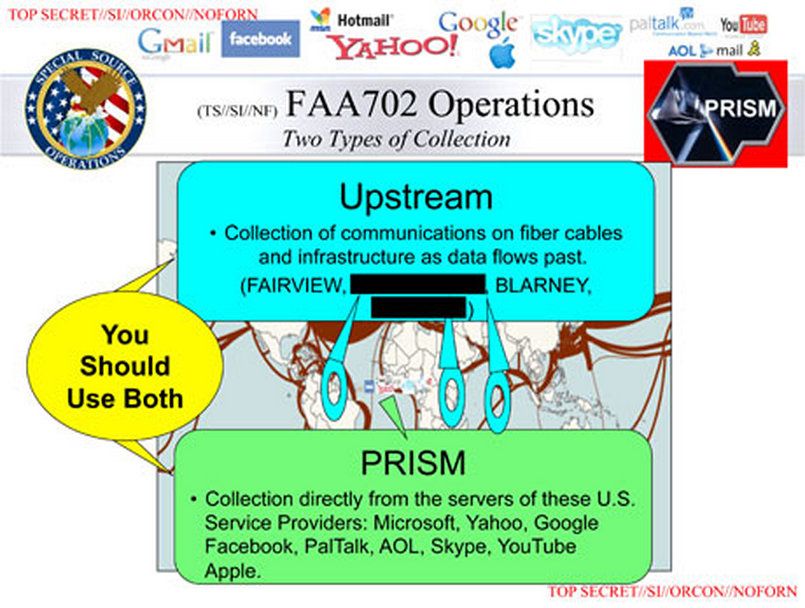
In June 2013, Edward Snowden, an NSA contractor, gave journalists at The Guardian and The Washington Post a large cache of classified documents. The first story published a FISA court order compelling Verizon to hand the NSA metadata on all its customers' calls, daily, the visible edge of a bulk telephony-metadata program run under Section 215 of the Patriot Act. Days later came the PRISM slides: a program under Section 702 of the FISA Amendments Act for collecting internet communications from nine U.S. companies, including Microsoft, Google, Facebook, and Apple. The government confirmed both programs existed within days.
The disclosures landed awkwardly on the record. Three months earlier, Director of National Intelligence James Clapper had told Senator Ron Wyden, under oath, that the NSA did not collect data on millions of Americans, "not wittingly." He later called the answer "clearly erroneous." In January 2014 the Privacy and Civil Liberties Oversight Board concluded the Section 215 program lacked a viable statutory basis and had not been essential to stopping any attack.
The courts went further. In ACLU v. Clapper (2015), the Second Circuit held that bulk collection exceeded what Section 215 authorized. Congress replaced the program with the USA FREEDOM Act (June 2015), leaving records with the phone companies. And in United States v. Moalin (2020), the Ninth Circuit ruled the bulk metadata program had violated FISA and may well have been unconstitutional. Snowden was charged under the Espionage Act and remains in Russia, which granted him citizenship in 2022.
EVIDENCE FOR
- The primary documents themselves (FISA court orders, agency slide decks, internal reports) whose authenticity the government confirmed rather than denied.
- Official corroboration on every major point: declassified FISA opinions, the PCLOB report, congressional findings, and two federal appellate rulings against the bulk program.
- Statutory reform: Congress does not usually rewrite surveillance law to end a program that never existed.
EVIDENCE AGAINST (THE WILDER VERSIONS)
- PRISM was compelled, court-supervised collection targeting foreigners' accounts, not, as early coverage implied, the NSA sitting with "direct access" inside company servers; the companies denied that framing and the fuller record supports compelled legal process.
- Bulk telephony collection took metadata (numbers, times, durations), not the recorded content of everyone's calls.
- Oversight, however feeble, existed: the FISA court, congressional intelligence committees, and inspectors general all knew, this was secret law, not a rogue agency.
ASSESSMENT
Confirmed, comprehensively. This file is the modern calibration point the way MKULTRA is the Cold War's: when someone asks whether mass domestic surveillance "could really happen," the answer is that it did, under seal, with every branch of government's participation, until one contractor's thumb drives forced the argument into open court, where the government lost. The bureau's read: the scandal was less the collection than the secret legal theory beneath it. What would change the stamp: nothing; the record is adjudicated. The live question is Section 702's recurring reauthorization, which is where this file's descendants will be written.
WHAT WOULD CHANGE THE GRADE
- CONFIRMED: the programmes exist as described, and the bulk telephony metadata programme under Section 215 was ruled unlawful by the Second Circuit in ACLU v. Clapper in 2015.
- The extension, routine warrantless collection of Americans' communications content at scale, is where the argument continues. The record establishes the capability and documents specific incidents of improper querying, which is not the same as establishing routine practice.
- Much of the FISA court docket remains sealed, and almost everything known publicly arrived through one unauthorised disclosure rather than through oversight. Absence of further evidence here is weak evidence of absence.
FURTHER READING
- NSA Prism program taps in to user data of Apple, Google and otherstheguardian.com
- Wikipedia: Edward Snowden and PRISM
- Privacy and Civil Liberties Oversight Board, Report on the Telephone Records Program (January 2014)
- Glenn Greenwald, No Place to Hide (2014); Barton Gellman, Dark Mirror (2020)
RELATED FILES IN THIS ARCHIVE
- OSA-183 · KAREN SILKWOODCONTESTEDA union activist gathering evidence on plant safety, dead in a single-car crash
- OSA-105 · THE PENTAGON PAPERSCONFIRMEDA classified study showing four administrations had misled the public
- OSA-108 · THE KING ASSASSINATIONCONTESTEDOne convicted man who recanted, and a civil verdict nobody talks about
- OSA-184 · INSLAW AND PROMISCONTESTEDA software company, a stolen program, and a journalist found dead in a bathtub