THE REICHSTAG FIRE
| DATE | 27 February 1933, evening |
| LOCATION | Reichstag building, Berlin, Germany |
| CONVICTED | Marinus van der Lubbe (executed January 1934; pardoned posthumously, 2008) |
| DISPUTE | Sole arsonist vs. Nazi assistance or instigation |
THE CLAIM
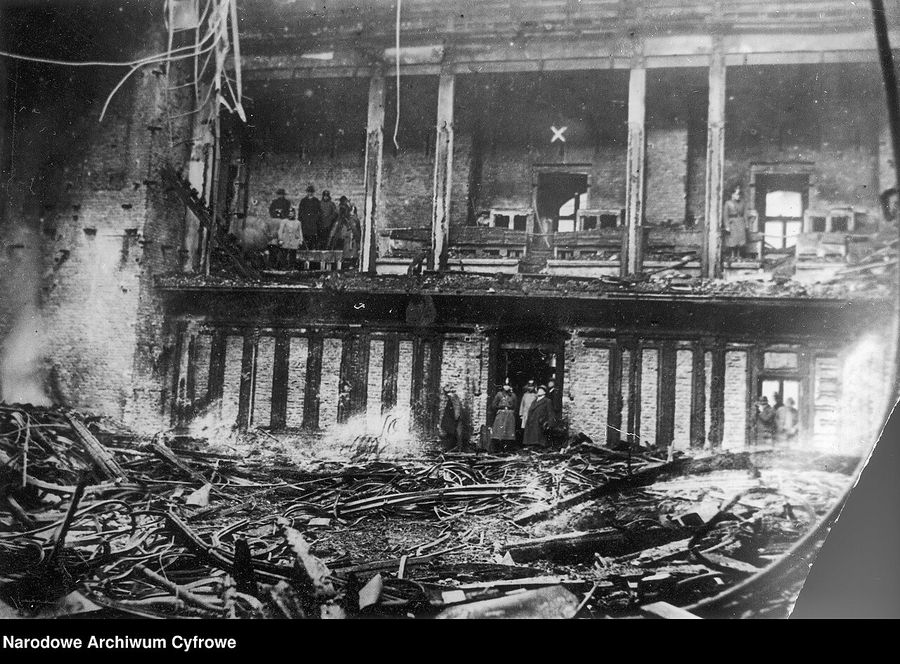
That the fire which gutted the German parliament building on the night of 27 February 1933, four weeks after Adolf Hitler became chancellor, was not the work of one man, but was set or assisted by the Nazis themselves to manufacture a communist emergency and seize dictatorial power.
THE THEORY, AS ITS PROPONENTS TELL IT
The German parliament burned on the night of 27 February 1933. A Dutch council communist, Marinus van der Lubbe, was arrested inside with firelighters and confessed. The following day the Reichstag Fire Decree suspended civil liberties across Germany, and mass arrests of communists began immediately from lists that had been prepared in advance.
The Nazi-arson theory dominated for fifty years and was advanced first by the exiled left in the Brown Book of 1933. It holds that van der Lubbe could not have set a fire of that size alone in the time available, that the SA entered the building through the tunnel connecting it to Hermann Göring's official residence, and that the speed and scope of the response prove foreknowledge. Göring's alleged boast of responsibility, and the testimony of SA man Hans Gisevius at Nuremberg, are the supporting evidence.
The lone-arsonist counter-theory was argued from the 1960s by Fritz Tobias and Hans Mommsen, who concluded van der Lubbe acted alone and that the Nazis were surprised and merely exploited it brilliantly, the opportunism reading. It became the mainstream German academic position for decades.
The pendulum has swung back somewhat: later work, including analysis of the fire's physical requirements and a 2013 examination of a suppressed statement by a Berlin prosecutor, has revived the multiple-arsonist argument, and some historians now regard the lone-actor thesis as unsafe. The file remains contested because the strongest evidence on both sides is inference about a fire in a building that no longer exists, and because everyone with direct knowledge had an overwhelming interest in lying. Van der Lubbe was beheaded in 1934 and posthumously pardoned in 2008.
WHAT IS KNOWN
Police arrested Marinus van der Lubbe, a 24-year-old Dutch council communist, inside the burning building. He confessed, insisted throughout that he had acted alone, and was tried at Leipzig alongside four alleged communist accomplices, including the Bulgarian Georgi Dimitrov. The court convicted only van der Lubbe; he was executed by guillotine in January 1934. The four co-defendants were acquitted, an outcome that infuriated Hitler and led to the creation of the People's Court.
What happened next is not contested by anyone. Within hours, the government blamed a communist uprising. The next day President Hindenburg signed the Reichstag Fire Decree, suspending civil liberties, enabling mass arrests of communists and other opponents, and clearing the path to the Enabling Act in March. Whoever lit the match, the Nazis converted the fire into dictatorship with remarkable speed, which is precisely why suspicion attached to them from the first night, at home and abroad.
The historians' war began in 1959–62, when Fritz Tobias published a detailed case that van der Lubbe acted entirely alone, a finding later endorsed by the influential historian Hans Mommsen and long treated as the mainstream position. It was reopened most prominently by Benjamin Carter Hett's Burning the Reichstag (2014), which attacked Tobias's methods and sources and argued that Nazi involvement remains the better explanation. In 2008 Germany formally voided van der Lubbe's conviction under a law annulling Nazi-era verdicts.
EVIDENCE FOR
- The speed and completeness of the fire's spread through the plenary chamber struck contemporary fire experts as difficult for one man with firelighters to achieve in the time available, a point revived by Hett and others.
- The Nazis were the fire's sole and immediate beneficiaries, and the decree machinery moved with striking readiness.
- A tunnel connected the Reichstag to the palace of Reichstag president Hermann Göring, and postwar testimony (including an affidavit at Nuremberg recounting an alleged boast by Göring, which Göring denied under oath) kept the involvement thesis alive.
- Hett documented that key postwar defenders of the lone-arsonist account had professional and personal stakes in exonerating former officials.
EVIDENCE AGAINST
- Van der Lubbe confessed consistently, demonstrated his method, and no physical evidence ever tied a second arsonist to the scene.
- Tobias and Mommsen argued the Nazi leadership's documented panic and improvisation that night fits opportunistic exploitation better than a staged plot.
- No order, plan, or credible insider account of a Nazi arson operation has surfaced in ninety years of archival access, including postwar captured records.
- The Leipzig court, under heavy political pressure to convict communists, still acquitted the four alleged accomplices for lack of evidence.
ASSESSMENT
This file is stamped CONTESTED because the professional literature is genuinely split: the lone-arsonist school and the involvement school each include serious historians working from the same incomplete record. The Office notes that the exploitation of the fire is a settled fact requiring no conspiracy, the decree, the arrests, and the end of the republic are documented beyond dispute. What would change the stamp: authenticated documentary evidence of an SA or SD arson order, or a forensic reconstruction commanding consensus that one man could, or could not, have set the chamber alight alone.
WHAT WOULD CHANGE THE GRADE
- To CONFIRMED as a Nazi operation: a document or a credible participant account. Neither has surfaced in ninety years, on either side of the question.
- The historiography has swung twice. Fritz Tobias's lone-arsonist thesis dominated for decades; Benjamin Carter Hett's 2014 work argues it cannot account for how fast the chamber was fully involved, or for how a single man with firelighters achieved it.
- Marinus van der Lubbe was executed for it, and was posthumously pardoned in 2008 under a law voiding Nazi-era sentences. Both sides argue from the same 1933 record, which is exactly why this stays contested.
FURTHER READING
- 75 Years Ago, Reichstag Fire Sped Hitler′s Power Grabdw.de, archived
- Neues zum Reichstagsbranddeutschlandfunkkultur.de, archived
- Reichstag fire · Wikipedia
- Reichstag Fire Decree · Wikipedia
- Benjamin Carter Hett, Burning the Reichstag (2014); Fritz Tobias, The Reichstag Fire (1962, tr. 1964)
RELATED FILES IN THIS ARCHIVE
- OSA-051 · WATERGATECONFIRMEDThe break-in, the tapes, and the only presidential resignation
- OSA-052 · OPERATION AJAXCONFIRMEDThe CIA–MI6 coup that removed Iran's elected prime minister
- OSA-053 · OPERATION PBSUCCESSCONFIRMEDGuatemala's president overthrown by a radio station and a bluff
- OSA-158 · CHILE 1973CONFIRMEDThree years of covert action against an elected government