THE SOMERTON MAN
| DATE | Body found December 1, 1948 |
| LOCATION | Somerton Park beach, Adelaide, South Australia |
| IDENTITY | Proposed 2022 via DNA genealogy: Carl "Charles" Webb, b. 1905, Melbourne |
| CAUSE OF DEATH | Undetermined, in 1948 and still |
THE CLAIM
A man found dead against the seawall of an Adelaide beach, well dressed, unidentifiable, every label cut from his clothes, a scrap of Persian poetry sewn into his trousers and an uncracked cipher in his effects, was a spy, poisoned at the dawn of the Cold War.
THE THEORY, AS ITS PROPONENTS TELL IT
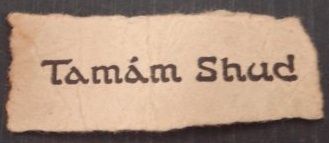
A man in a suit was found dead against the seawall at Somerton Park, Adelaide, on 1 December 1948, with no identification, the labels cut from his clothing, an unsmoked cigarette on his collar, and, sewn into a hidden fob pocket, a scrap of paper torn from a book bearing the printed words Tamám Shud, Persian for "it is finished."
The espionage theory dominated for seventy years and had unusually good grounds. The torn page came from a specific copy of the Rubaiyat of Omar Khayyam, which was found in a car nearby, and which carried in the back an unbroken sequence of capital letters that reads as a cipher, together with a telephone number belonging to a nurse, Jessica Thomson, who lived a few hundred metres from where the body was found and who, when shown a cast of the man's face, reacted strongly and denied knowing him. Adelaide in 1948 sat near Woomera, then one of the West's most sensitive rocket ranges, and the Cold War defection of Soviet agents in Australia was live. A poison undetectable by 1948 toxicology was suspected and never identified.
The counter-theory was always more mundane: an unknown man, a suicide, and a coincidence of circumstance amplified by a cipher that may be nothing more than the first letters of a remembered verse.
In 2022 a genealogical DNA identification named him as Carl "Charles" Webb, a Melbourne electrical instrument maker, estranged from his wife, who had moved to South Australia. That resolution has been accepted by many and disputed by South Australia Police pending formal confirmation. It supports the mundane reading and leaves the cipher and the nurse's reaction unexplained, which is why the file is still open rather than closed.
WHAT IS KNOWN
On the morning of December 1, 1948, a man was found dead on Somerton Park beach, propped against the seawall as if asleep. The autopsy found an engorged, unexplained internal state suggestive to the examiners of poisoning, but no poison was ever detected and no cause of death was ever established. Months later, a tightly rolled scrap of paper reading "Tamám Shud" ("it is ended," the closing words of the Rubaiyat of Omar Khayyam) was found in a fob pocket of his trousers. A public appeal turned up the very copy of the book it had been torn from, handed in by a man who said it had been tossed into his parked car. In the back of that book: faint pencilled capital letters that have resisted every cryptanalytic effort since, and a telephone number belonging to a nurse living a few hundred meters from where the body was found. She told police she knew nothing, and maintained that for the rest of her life. A suitcase he had checked at Adelaide railway station contained clothing with the labels likewise removed.
The identification drought broke in 2022. Professor Derek Abbott of the University of Adelaide, working with forensic genealogist Colleen Fitzpatrick, used DNA recovered from the man's exhumed remains and hairs preserved in a plaster bust to build a family tree pointing to Carl "Charles" Webb, an electrical instrument maker from Melbourne, born 1905, who had separated from his wife and dropped out of the record in the late 1940s. The identification has been widely accepted as sound, though as of the mid-2020s South Australia Police had not formally confirmed it. Webb had no known intelligence connection.
LEADING THEORIES
- Espionage. The classic reading: 1948, the stripped labels, the cipher, the undetectable poison, Adelaide's proximity to sensitive defense research. Atmospheric, but nothing in the file, before or after the Webb identification, documents an intelligence link.
- A private tragedy. The Webb-era evidence points at an estranged husband who traveled to Adelaide, possibly in connection with a woman, and died, by suicide by poison, or by an undiagnosed natural cause. "Tamám Shud" reads naturally as a farewell. The nurse's lifelong silence fits an inconvenient acquaintance better than a handler.
- The code page as anything at all. Analyses suggest the pencilled letters may be first-letter initialism of English text rather than cipher, which would make the case's most glamorous exhibit a private note, not tradecraft.
ASSESSMENT
Open, but transformed. The 2022 genealogy work did what 74 years of police work could not, and did it from a plaster bust, the bureau tips its hat. What remains open is the part that mattered from the start: how he died, and why. The spy theory survives on mood alone; every documented fact is compatible with a solitary, deliberate death dressed up by coincidence and mid-century tabloids. Formal police confirmation of the Webb identification and a definitive reading of the code page would close most of this file. The cause of death, absent a confession preserved somewhere unlikely, is probably gone for good, the toxicology of 1948 kept the secret, and the beach isn't talking.
WHAT WOULD CHANGE THE GRADE
- Substantially resolved in 2022: genetic genealogy by Derek Abbott and Colleen Fitzpatrick identified him as Carl Webb, a Melbourne electrical instrument maker. South Australia Police have not formally confirmed the identification.
- To CLOSED: official confirmation, and an account of how and why a Melbourne man died on an Adelaide beach in 1948.
- The Tamam Shud slip torn from a copy of the Rubaiyat, and the letters written in the back of that book, remain unexplained. This file answered who and left why completely open, which is the reverse of the usual pattern here.
FURTHER READING
- Umar Khayyam (Stanford Encyclopedia of Philosophy)plato.stanford.edu
- Wikipedia: Somerton Man
- Wikipedia: Rubaiyat of Omar Khayyam
- University of Adelaide project materials on the DNA identification (Abbott & Fitzpatrick, 2022)
RELATED FILES IN THIS ARCHIVE
- OSA-038 · THE ZODIAC KILLEROPEN CASEFive dead, two survivors, and ciphers mailed to the press
- OSA-082 · THE ISDAL WOMANOPEN CASENine aliases, a coded diary, and no name at all
- OSA-015 · NUMBERS STATIONSCONFIRMEDAnonymous voices, unbreakable arithmetic
- OSA-114 · CRYPTO AGCONFIRMEDHalf a century reading the secret traffic of allies and adversaries alike