NUMBERS STATIONS
| ACTIVE | Cold War era – present |
| MEDIUM | Shortwave radio, worldwide; voice, Morse, and digital modes |
| CONFIRMED | US federal court, 1998–2001: Cuban transmissions entered as trial evidence |
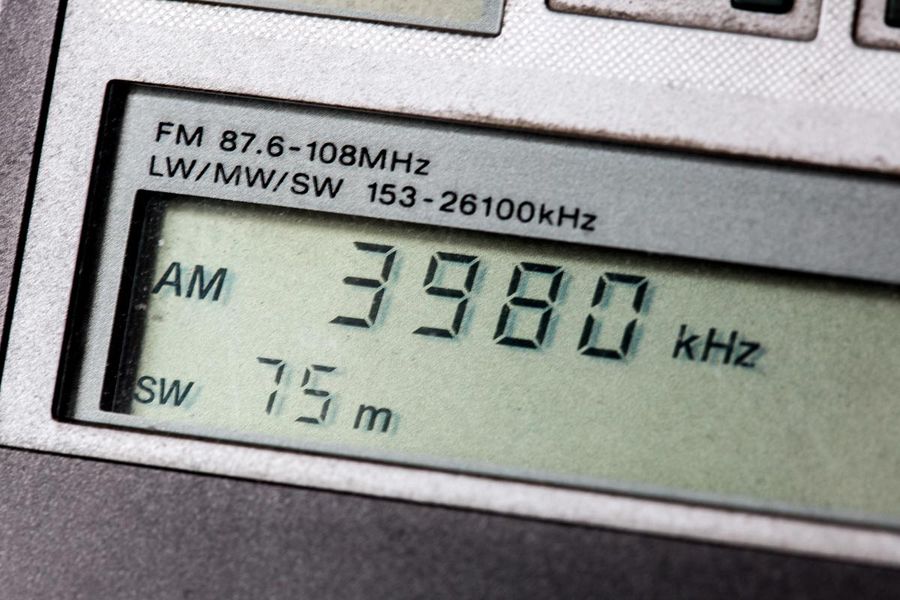
| STATUS | Still broadcasting; tune a shortwave receiver and hear for yourself |
THE CLAIM
That the strange shortwave stations broadcasting nothing but strings of numbers (read by mechanical voices, prefaced by chimes, folk tunes, or buzzing) are intelligence agencies sending one-way encrypted instructions to agents in the field. This is one of the rare files where the fun explanation is the true one.
THE THEORY, AS ITS PROPONENTS TELL IT
Shortwave listeners have for decades recorded automated voices reading strings of numbers, letters or phonetic groups on fixed frequencies, often preceded by distinctive interval signals, frequently in a woman's or a child's voice, transmitting to no acknowledged recipient. The theory, that they are one-way intelligence broadcasts to field agents, is not really contested any more. What is contested is who is still running them and for whom.
The mechanism proponents describe is elegant and is the reason the practice has never been retired. A one-time pad is mathematically unbreakable if the key is truly random, used once, and held only by sender and recipient. Broadcasting the ciphertext on shortwave to the whole world means the receiving agent needs only a domestic radio and a pad small enough to swallow, no transmitter to be detected, no network traffic to be analysed, no metadata at all. In an era of comprehensive digital surveillance, a numbers station is arguably more secure than anything on the internet.
The confirmations are real. Cuban numbers traffic featured in the prosecution of the Wasp Network in Florida; Soviet illegals arrested in the United States in 2010 were found with shortwave receivers and decryption materials; and the British "Lincolnshire Poacher" station was widely reported to have transmitted from a facility in Cyprus. No government has ever formally acknowledged operating one.
The wilder strands attribute the stations to drug trafficking coordination, to nuclear command and control, or to dead-man systems, the Russian station UVB-76, "the Buzzer," broadcasting a continuous tone since the 1970s and interrupted only rarely by voice messages, attracts most of these. Proponents of the mundane reading note that a signal designed to be heard by everyone and understood by one person will always attract more theories than it answers.
WHAT IS KNOWN
Since at least the Cold War, shortwave listeners have logged numbers stations: unlicensed, unattributed transmitters that broadcast groups of spoken numbers (or Morse, or digital bursts) on fixed schedules. The mechanics make professional sense. An agent anywhere with a cheap consumer radio can receive orders with zero return signature, nothing to raid, nothing to trace. Encoded with a one-time pad, the message is mathematically unbreakable if the pad is used properly and burned after reading. The system is antique, and that is the point: it cannot be hacked, logged, or subpoenaed.
Official confirmation is thin on the ground but not absent. The clincher came in a US federal courtroom: members of the Cuban Five, a Havana-run spy ring arrested in Miami in 1998, had received their instructions from Cuba's "Atención" station; decrypted transmissions, recovered because the ring's laptop decryption materials were seized, were entered as evidence in the prosecution that ended in 2001 convictions. Elsewhere, the hobbyist group ENIGMA has catalogued dozens of stations by call-letter nicknames; the "Lincolnshire Poacher," which opened with bars of the English folk song and was widely attributed by enthusiasts to British intelligence transmitting from Cyprus, fell silent in 2008; Russia's UVB-76, "the Buzzer," has droned since the 1970s, occasionally interrupting itself with cryptic voice callouts and attracting a devoted online audience awaiting each one. Cuba's HM01 and various agencies' digital successors are audible this week.
EVIDENCE FOR
- The Cuban Five trial record: decoded Atención traffic presented by federal prosecutors, a government formally telling a jury what numbers stations are for.
- Espionage prosecutions on both sides of the Atlantic have described defendants receiving one-way shortwave instructions, including US cases against agents working for Cuba (among them Ana Montes, arrested 2001, and the Myers case, 2009).
- Decades of consistent logging by independent listeners: fixed schedules, format discipline, and traffic surges correlated with world events.
- The one-time pad method is textbook tradecraft, documented in intelligence histories since World War II.
EVIDENCE AGAINST (THE WILDER VERSIONS)
- Not every weird signal is a spy. Utility transmissions, military channel markers, propagation beacons, and hoaxes salt the logs; UVB-76 in particular is plausibly a military channel marker whose voice messages are routine traffic, not doomsday countdowns.
- The internet-era legend that stations transmit "dead hand" nuclear triggers or messages to the public is unsupported; the boring reading, logistics for people who cannot receive email safely, fits all observed behavior.
- Attribution of specific stations to specific agencies mostly rests on hobbyist direction-finding and inference, not acknowledgment. Governments almost never comment; a British official once memorably declined by noting the transmissions were "not for public consumption."
ASSESSMENT
CONFIRMED, in purpose, if rarely in ownership. The evidence that numbers stations carry espionage traffic is courtroom-grade; the identity behind any given transmitter usually is not, and this office grades those attributions case by case. What charms the bureau is the persistence: in a century of zero-day exploits, several services still trust a voice, a radio, and arithmetic done in pencil. They are, in a sense, the last honest broadcasters: they never claim to be anything at all.
WHAT WOULD CHANGE THE GRADE
- CONFIRMED as one-way agent communication: Cuban station traffic was entered as evidence in United States espionage prosecutions, including the Wasp Network and the Ana Montes case, where the decryption method was demonstrated in open court.
- The content of most traffic will never yield. Properly used one-time pads are not breakable, so this is not a problem more computing power solves.
- What could change is attribution for the stations still transmitting. That takes a defector, a seizure, or an archive release, and nothing else.
FURTHER READING
- STASI Sprach / Morse Machine - German Crypto Machinenumbers-stations.com, archived
- Wikipedia: Numbers station
- The Conet Project (1997), the four-CD field-recording set that made the stations famous
- ENIGMA 2000 newsletters and station catalogues (hobbyist primary logging)
RELATED FILES IN THIS ARCHIVE
- OSA-007 · THE WOW! SIGNALUNVERIFIEDThe best candidate alien signal ever recorded
- OSA-141 · THE BLOOPDEBUNKEDAn ultra-low frequency sound detected 5,000 kilometres apart
- OSA-094 · KRYPTOSOPEN CASENinety-seven characters that have beaten the world's codebreakers
- OSA-114 · CRYPTO AGCONFIRMEDHalf a century reading the secret traffic of allies and adversaries alike