TWA FLIGHT 800
| CRASHED | 17 July 1996, off East Moriches, New York; 230 killed |
| WITNESSES | Around 250 reported a streak of light rising toward the aircraft |
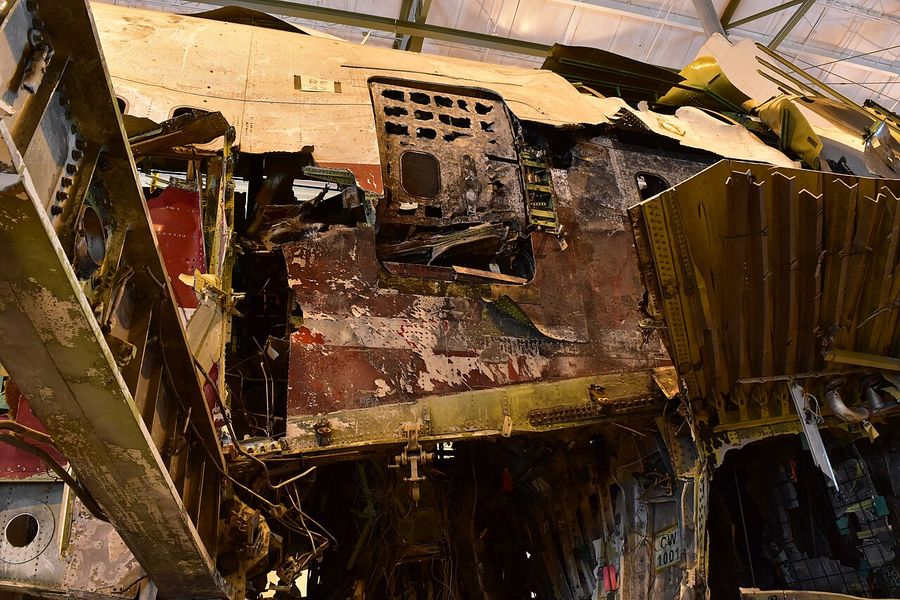
| INVESTIGATED | NTSB, four years, with 95 percent of the aircraft recovered and reconstructed |
| STATUS | Debunked as to a missile. Cause: centre wing fuel tank explosion |
THE CLAIM
That TWA 800 was destroyed by a missile, either a terrorist weapon or an errant US Navy test, and that the investigation was steered to a mechanical conclusion to conceal it.
THE THEORY, AS ITS PROPONENTS TELL IT
This file is included because the proponents' case is genuinely strong on its face, which makes it a better test of method than the weaker theories in this cabinet.
Roughly 250 witnesses reported seeing a streak of light rise from the surface or low altitude toward the aircraft before the explosion. That is an unusually large and consistent witness set, and many of the witnesses were experienced observers including pilots and boat crews.
The Navy was conducting exercises in the area. Proponents argue that an errant missile, followed by an institutional decision to avoid the consequences of admitting it, would explain both the witness accounts and what they characterise as an investigation that decided its answer early.
Several people associated with the investigation, including former investigator Hank Hughes and a group of retired officials in a 2013 documentary, publicly disputed the finding, which proponents treat as insider corroboration.
WHAT IS KNOWN
Around ninety-five percent of the aircraft was recovered from shallow water and physically reconstructed in a hangar. No part showed the pitting, penetration or explosive residue pattern a missile warhead produces. This is the central fact and it is not seriously contested by anyone who has examined the reconstruction.
The NTSB concluded the probable cause was an explosion of the centre wing fuel tank, most likely ignited by a short circuit in wiring outside the tank carrying voltage into it through the fuel quantity indication system. The tank contained heated, near-empty fuel vapour after extended ground time in summer heat.
The witness accounts were studied specifically. The CIA produced an analysis, and the NTSB conducted its own, concluding that the streak observed was the aircraft itself: after the initial explosion the forward fuselage separated and the remaining aircraft, still under power and much lighter, pitched up and climbed several thousand feet while trailing burning fuel. Witnesses looking up at the sound would have seen a rising streak of flame that was the airliner.
The finding produced a durable safety consequence: fuel tank inerting systems are now required on transport aircraft, which is not what regulators do about a phenomenon they believe to be fictional.
EVIDENCE FOR
- Approximately 250 witness reports of a rising streak, an unusually large and consistent set.
- Naval exercises in the vicinity at the time.
- Public dissent from a small number of people who had worked on the investigation.
EVIDENCE AGAINST
- Ninety-five percent of the airframe was recovered and reconstructed, and no piece bears missile damage. A warhead detonation leaves a signature that cannot be absent.
- The rising streak is explained by the aircraft's own post-explosion behaviour, which the reconstruction established from the wreckage distribution rather than from theory.
- No missile debris was recovered from a shallow, heavily searched debris field.
- The identified ignition mechanism led to a costly worldwide regulatory change, which is a strange outcome for a fabricated cause.
ASSESSMENT
Debunked, and kept as the archive's best lesson about eyewitnesses. Two hundred and fifty people saw something real and described it accurately, and the thing they saw was not what they concluded it was. That is not a failure of honesty on their part and it should not be treated as one. It is a reminder that a large consistent witness set establishes that something visible happened, and almost nothing about what caused it. Compare OSA-024, where the same structure appears with a different resolution, and OSA-118, where the witnesses and the physical evidence conflict and the physical evidence is the problem rather than the answer.
WHAT WOULD CHANGE THE GRADE
- Closed by the wreckage: about 95 percent of the airframe was recovered and reconstructed, and no piece carries the pitting, penetration or residue signature a warhead leaves.
- To reopen: recovered missile debris from a shallow, exhaustively searched debris field, or a piece of airframe showing warhead damage. Neither exists.
- The witness accounts are explained rather than dismissed: after the initial explosion the forward fuselage separated and the lightened aircraft climbed several thousand feet trailing burning fuel, which is the rising streak roughly 250 people accurately reported seeing.
FURTHER READING
- Learning from a Tragedy: Explosions and Flight 800resolver.caltech.edu
- TWA Flight 800 · Wikipedia
- NTSB Aircraft Accident Report AAR-00/03 (2000)
- NTSB witness group study and the CIA analysis of witness accounts
RELATED FILES IN THIS ARCHIVE
- OSA-130 · IRAN AIR 655CONFIRMED290 civilians killed by a US missile cruiser in the Gulf
- OSA-071 · THE HAMMARSKJÖLD CRASHCONTESTEDA UN Secretary-General down nine miles short of the runway
- OSA-129 · LOCKERBIECONTESTED270 dead, one man convicted, and an appeal that never finished
- OSA-136 · KOREAN AIR LINES 007CONTESTED269 dead, and a navigational error nobody has fully explained