IRAN AIR 655
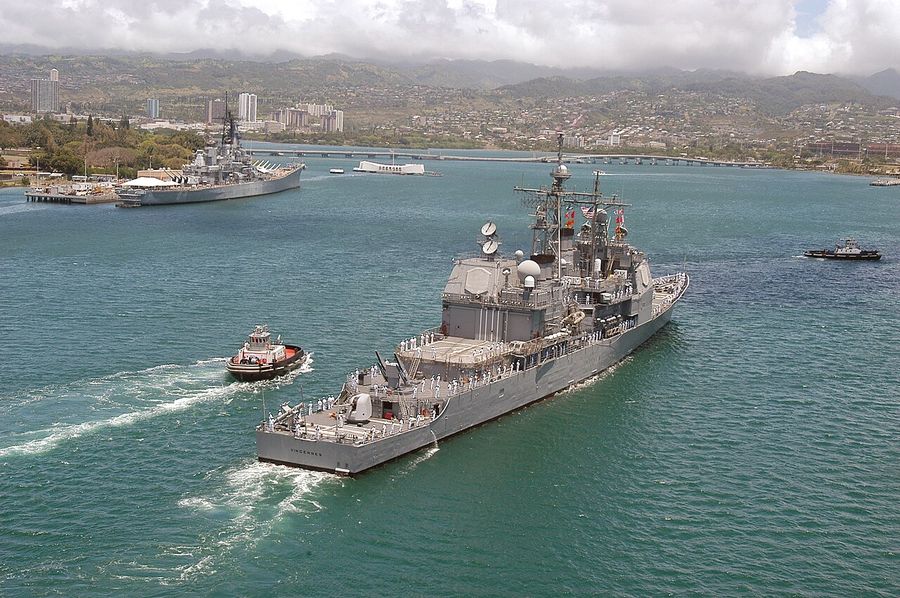
| DESTROYED | 3 July 1988, Strait of Hormuz, by USS Vincennes |
| KILLED | 290, including 66 children |
| US POSITION | A tragic accident; the aircraft was misidentified as an attacking F-14 |
| STATUS | Confirmed as to facts. $61.8 million paid to Iran in 1996; no admission of liability |
THE CLAIM
That the United States shot down a civilian airliner, misreported the circumstances to Congress and the public, and decorated the officers responsible rather than disciplining them.
THE THEORY, AS ITS PROPONENTS TELL IT
The core facts are not disputed by either government. The argument is about what the discrepancy between the ship's account and the recorded data means.
Flight 655 was a scheduled Airbus A300 on its published route from Bandar Abbas to Dubai, climbing, transmitting a civilian identification code, and inside the commercial air corridor. USS Vincennes reported it as an Iranian F-14 descending in an attack profile, and fired two surface-to-air missiles.
The ship's own Aegis system recorded the aircraft climbing. The initial American account, given to Congress, stated that the aircraft was descending, that it was outside the corridor, and that warnings had gone unanswered on civilian frequencies. The recorded data contradicted the first two, and the warnings were largely issued on military frequencies and with reference to a speed and heading the airliner did not have.
Proponents note the context. Vincennes was engaged with Iranian gunboats at the time, had a reputation in the fleet for aggression, and was inside Iranian territorial waters when it fired, a fact not included in early accounts. Captain Will Rogers III later received the Legion of Merit for his command tour, and the air warfare coordinator received a commendation.
WHAT IS KNOWN
The shootdown, the death toll and the aircraft's identity are established and accepted by the United States.
The Fogarty report, the American investigation, concluded the crew acted reasonably under combat stress and scenario fulfilment, a psychological effect in which incoming information is fitted to an expected pattern. It also documented that the aircraft had in fact been climbing.
The International Civil Aviation Organization investigated and found the aircraft was on its assigned route and squawking civilian. In 1996 the United States paid Iran $61.8 million in settlement at the International Court of Justice, expressly without admitting liability.
The decorations are a matter of record and were defended at the time as relating to the officers' overall tours rather than to this engagement specifically.
EVIDENCE FOR
- The Aegis system's own recorded data showing the aircraft climbing, contradicting the account given to Congress.
- ICAO findings that the aircraft was on its assigned civil route with a civilian transponder code.
- The American investigation's own acknowledgement of the discrepancy and its explanation of the misidentification.
- The $61.8 million settlement, and the decorations awarded afterwards, both documented.
EVIDENCE AGAINST (THE DELIBERATE READING)
- Nothing suggests the shootdown was intentional. The evidence supports catastrophic misidentification under combat conditions, which is what the investigation found.
- The Vincennes was in an active engagement with small craft at the time, which is context that the deliberate reading tends to omit.
- Scenario fulfilment is a documented and studied phenomenon, not an invented excuse.
ASSESSMENT
Confirmed as to every material fact, and included because of what happened after rather than what happened during. This office does not find that the shootdown was deliberate. It does record that the initial official account was wrong in specifics the ship's own instruments had recorded correctly, that the correction was slow and quiet, that no admission of liability was ever made, and that the officers involved were decorated. It matters here for a second reason: the destruction of Flight 655 is the motive most often cited in OSA-129, five months later, which is why the two files sit together.
WHAT WOULD CHANGE THE GRADE
- CONFIRMED as to every material fact, including by the United States: the aircraft was on its assigned civil route, climbing, squawking a civilian code, and was destroyed by two missiles from USS Vincennes.
- Not supported: that the shootdown was deliberate. The evidence supports catastrophic misidentification under combat conditions, which is what the American investigation found.
- What is on the record and rarely stated together: the initial account given to Congress was wrong in specifics the ship's own Aegis system had recorded correctly, the $61.8 million settlement carried no admission of liability, and the officers involved were decorated.
FURTHER READING
- The forgotten story of Iran Air Flight 655washingtonpost.com, archived
- Malaysia Airlines Flight 17 and Iran Air Flight 655nationalinterest.org, archived
- Iran Air Flight 655 · Wikipedia
- Fogarty report, US Department of Defense investigation (1988), partially declassified
- ICAO report on the destruction of Iran Air Flight 655 (1989)
RELATED FILES IN THIS ARCHIVE
- OSA-129 · LOCKERBIECONTESTED270 dead, one man convicted, and an appeal that never finished
- OSA-068 · THE USS LIBERTY INCIDENTCONTESTEDThirty-four American sailors killed by an ally's aircraft
- OSA-135 · TWA FLIGHT 800DEBUNKEDA missile theory supported by hundreds of witnesses, and refuted by the wreckage
- OSA-069 · THE OCTOBER SURPRISECONTESTEDDid a campaign bargain to keep hostages in captivity?