THE AMITYVILLE HORROR
| DATE | Murders 13 November 1974; Lutz occupancy December 1975–January 1976 |
| LOCATION | 112 Ocean Avenue, Amityville, Long Island, New York |
| KEY PARTIES | Ronald DeFeo Jr.; George and Kathy Lutz; attorney William Weber; author Jay Anson |
| STATUS | Murders confirmed by conviction. Haunting unsupported; principal claims contradicted |
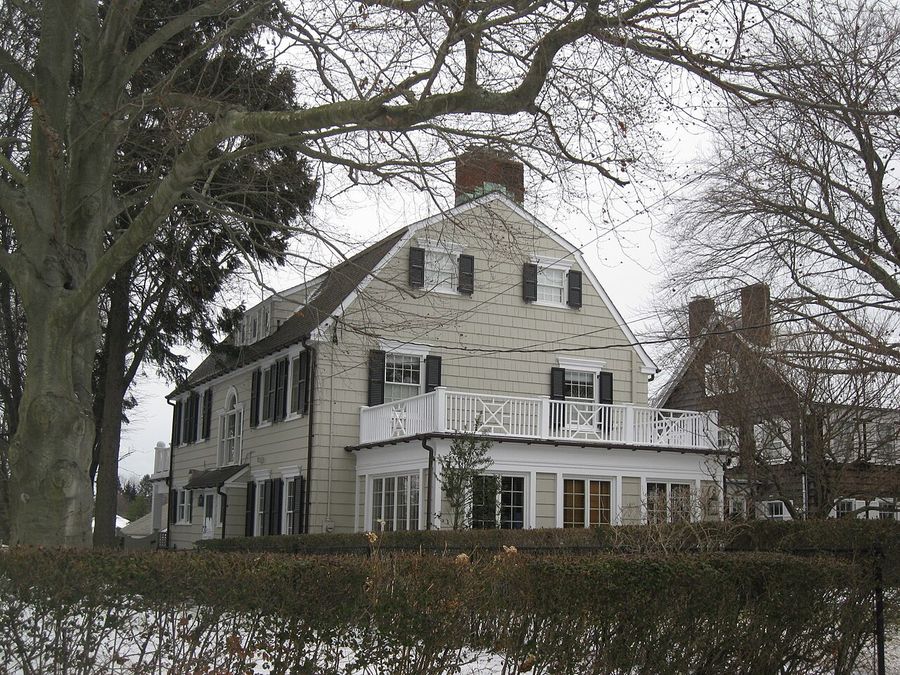
THE CLAIM
That a family fled 112 Ocean Avenue after twenty-eight days, driven out by demonic phenomena, green slime, swarms of flies in winter, a red-eyed entity, a hidden "red room," levitation, cold spots, and a priest driven away by a voice ordering him out. The house's prior history as the site of a real family annihilation is offered as the cause.
THE THEORY, AS ITS PROPONENTS TELL IT
The theory holds that 112 Ocean Avenue was genuinely haunted, that the DeFeo murders of November 1974 either awakened or were caused by something in the house, and that the Lutz family fled after twenty-eight days from phenomena they did not invent.
The claimed events, as set out in Jay Anson's 1977 book, were specific: swarms of flies in a Long Island winter, green slime in the hallways, a hidden red room behind basement shelving that appeared on no plan, cold spots, levitation, a demonic face in the fireplace, and a priest who came to bless the house and was driven out by a voice ordering him to get out. The theory's central proposition is that Ronald DeFeo Jr., who murdered six family members in their beds, had said he heard voices telling him to do it, and that the house therefore had a history the Lutzes walked into unknowingly.
The financial and legal context is where the case comes apart. William Weber, DeFeo's defence attorney, stated publicly in 1979 that he had "created this horror story over many bottles of wine" with the Lutzes, and that he had intended to use a haunting narrative to support a new trial for his client. Litigation followed in several directions; a federal judge indicated that the evidence showed much of the book to be fiction.
Every subsequent owner across nearly fifty years has reported an ordinary house, and one of them, Jim Cromarty, sued successfully over the nuisance the story created. The red room is a small painted crawlspace of a kind common in such houses. The priest's account varied between tellings and was substantially minimised under oath. George Lutz nonetheless maintained the story until his death in 2006 and passed a polygraph arranged for television, which proponents regard as their strongest remaining card.
WHAT IS KNOWN
On 13 November 1974, Ronald DeFeo Jr. shot and killed his parents and four siblings in their beds at 112 Ocean Avenue. He was convicted of second-degree murder in 1975 and died in prison in 2021. This portion of the file is entirely factual and is the foundation everything else was built on.
In December 1975 George and Kathy Lutz bought the house cheaply with their three children and left after twenty-eight days, describing escalating supernatural events. Their account, ghostwritten by Jay Anson as The Amityville Horror: A True Story (1977), became a bestseller and then the 1979 film, establishing the haunted-house template for a generation.
William Weber, DeFeo's defence attorney, stated publicly in 1979 that he and the Lutzes had "created this horror story over many bottles of wine," and that he had hoped to use a haunting narrative to support a new trial for his client. The Lutzes disputed his characterisation; litigation followed in several directions.
The subsequent owners, Jim and Barbara Cromarty, bought the house in 1977 and reported nothing unusual in years of residence. They sued over the disruption caused by sightseers and prevailed. Later owners have said the same. The house still stands; its address was changed to discourage visitors.
Investigators who checked specifics found the physical claims did not hold: the "red room" is a small painted crawlspace behind shelving, of the kind common in such houses; weather records did not support key claimed events; and the priest's account varied considerably between tellings and was substantially minimised under oath. In federal litigation, Judge Jack Weinstein indicated the evidence showed large parts of the book to be a work of fiction.
EVIDENCE FOR
- The DeFeo murders unquestionably happened in that house, on those beds, in 1974, the single true fact the entire structure rests on.
- George Lutz maintained his account, without material change, until his death in 2006; he did not recant, and he passed a polygraph arranged by a television programme.
- Something caused the family to abandon a house they had just bought and lose their deposit after less than a month, which requires some explanation.
EVIDENCE AGAINST
- The attorney involved said in public that the story was constructed with the Lutzes over wine, for a specific litigation purpose.
- Every subsequent owner across nearly fifty years has reported an ordinary house, and one of them sued successfully over the nuisance the story created.
- The falsifiable details fail: the red room is a crawlspace, the OPD-style specifics don't check out against records, and the priest's sworn account did not match the published one.
- A federal judge indicated on the record that the material was substantially fictional.
- The financial motive is documented and was realised, a bestselling book and a film franchise still generating sequels five decades later.
ASSESSMENT
DEBUNKED as to the haunting; the murders remain a real and terrible crime, and this office notes the discomfort of a genuine family annihilation being repackaged as entertainment. What makes the file instructive is the anatomy: one verifiable atrocity, one financially motivated embellishment, and a fifty-year afterlife in which the true part lends its weight to the invented part. That transfer of credibility, from the documented core outward to the fabricated shell, is the single most common mechanism in this cabinet. It is at work in the Roswell file, the Bohemian Grove file, and the 9/11 file, in each case doing the same job.
WHAT WOULD CHANGE THE GRADE
- Closed by confession: George Lutz's own attorney, William Weber, stated that he and the Lutzes created the story over many bottles of wine, and Weber repeated it publicly.
- The murders were real and are not part of the claim. Ronald DeFeo Jr killed six members of his family in the house in November 1974.
- To reopen: nothing. Every subsequent owner has reported no phenomena, and their consistent complaint has been about tourists.
FURTHER READING
- The Amityville Horror · Wikipedia
- The DeFeo family murders · Wikipedia
- The Amityville Horror Conspiracy · Stephen & Roxanne Kaplan, 1995
RELATED FILES IN THIS ARCHIVE
- OSA-096 · SKINWALKER RANCHUNVERIFIEDThirty years of study, zero published data
- OSA-140 · THE MOTHMANUNVERIFIEDPoint Pleasant, West Virginia, and a winged figure with red eyes
- OSA-032 · CROP CIRCLESDEBUNKEDMessages in the wheat, signed, eventually, by the authors
- OSA-077 · PAUL IS DEADDEBUNKEDThe lookalike theory that outlived its author's confession