THE BERMUDA TRIANGLE
| COINED | Vincent Gaddis, "The Deadly Bermuda Triangle," Argosy, February 1964 |
| PEAK | Charles Berlitz's 1974 bestseller The Bermuda Triangle |
| CLOSED BY | Larry Kusche, The Bermuda Triangle Mystery: Solved (1975) |
| STATUS | Debunked. Loss rates are unremarkable for the traffic. |
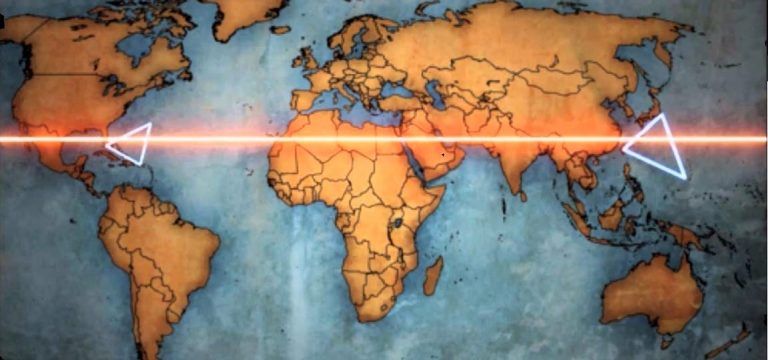
THE CLAIM
A triangle of ocean between Florida, Bermuda, and Puerto Rico swallows ships and aircraft at a rate, and in a manner, that ordinary seamanship, weather, and probability cannot explain. Compasses spin, radios die, wreckage is never found. Proposed mechanisms have included Atlantis, magnetic anomalies, methane eruptions, and doorways to elsewhere.
THE THEORY, AS ITS PROPONENTS TELL IT
The theory holds that an area of the western Atlantic bounded roughly by Miami, Bermuda and Puerto Rico consumes ships and aircraft at a rate that ordinary explanation cannot account for, and that the cause is something the authorities either do not understand or will not disclose.
The canonical cases are Flight 19 (five Navy Avengers lost on a training flight in December 1945, along with one of the flying boats sent to search for them) the disappearance of the collier USS Cyclops with 306 aboard in 1918, and a run of post-war losses that Vincent Gaddis assembled into a single pattern in a 1964 magazine article that coined the name.
The proposed mechanisms range across the plausible and the exotic: methane hydrate eruptions from the seabed reducing water density until a ship loses buoyancy; magnetic anomalies causing compass error, since the region is one of the few where true and magnetic north align; rogue waves; electronic fog; and, in the versions that made the concept a publishing industry, the technology of Atlantis, extraterrestrial collection, or a spatial rift.
The rebuttal that this file records is not a competing theory but an arithmetic one, and it was made most effectively by the librarian Lawrence David Kusche, who went back to the primary sources for each famous case and found storms omitted, positions relocated into the Triangle from hundreds of miles outside it, vessels reported missing that had arrived safely, and at least one ship that sank in the Pacific. Insurers have never charged a premium for the area. The Triangle is heavily trafficked water in a hurricane basin, and losses there are unremarkable once the denominator is included, which is precisely the step the theory omits.
WHAT IS KNOWN
The Triangle is a literary invention with a publication history, not a discovery. Vincent Gaddis named it in the February 1964 issue of the pulp magazine Argosy; a decade later Charles Berlitz , of the language-school Berlitzes, turned the accumulated anecdotes into The Bermuda Triangle (1974), a phenomenon that sold millions of copies and fixed the legend in the culture.
Then a research librarian did the unglamorous thing. Larry Kusche went back to the primary sources (contemporary newspapers, Coast Guard and Navy records, Lloyd's casualty data) for the canonical disappearances. His The Bermuda Triangle Mystery: Solved (1975) found a pattern, just not the advertised one: storms omitted from the retellings, vessels that sank nowhere near the Triangle, "calm seas" that were actually raging, wreckage that had in fact been found, and at least one loss that could not be documented as having happened at all. The mystery, he concluded, was manufactured, by careless or deliberately sensational reporting, repeated until it hardened into fact.
The keystone case, Flight 19 (five Navy Avengers lost on a training flight on December 5, 1945) is tragic but legible: flight leader Charles Taylor, whose compasses were malfunctioning, became convinced he was over the Florida Keys when he was over the Bahamas, led the flight the wrong way over open ocean, and the aircraft ran out of fuel after dark in rough seas. A Mariner flying boat sent to search exploded in mid-air, a known hazard of a type informally nicknamed the "flying gas tank," and a ship in the area reported seeing the fireball.
EVIDENCE FOR
- Real losses did occur there, some without recovered wreckage, unsurprising in deep water crossed by the Gulf Stream, which disperses debris efficiently.
- The sheer volume of retellings, which is evidence of a good story rather than of a phenomenon.
EVIDENCE AGAINST
- Kusche's source-by-source demolition: the canonical cases dissolve on contact with the original records.
- Lloyd's of London concluded the area is not unusually dangerous and does not charge higher premiums for transiting it, the insurance market being immune to atmosphere.
- The U.S. Coast Guard does not recognize the Bermuda Triangle as a hazard region and has repeatedly stated the loss record is unremarkable given the enormous traffic.
- The region features heavy amateur boat and light-aircraft traffic, sudden tropical weather, and the Gulf Stream, a full explanation with no vacancies for Atlantis.
ASSESSMENT
The Bermuda Triangle is a filing error promoted to a phenomenon. Draw a triangle over any equally busy stretch of ocean, collect fifty years of mishaps inside it, strip out the weather reports, and the result will be equally haunted. The Office regards Kusche's book as a model piece of records work and notes, with some professional envy, that checking the sources took one librarian a fraction of the time it took everyone else to not do it.
WHAT WOULD CHANGE THE GRADE
- To reopen: a loss rate demonstrably above comparable heavily trafficked ocean regions. Lloyd's of London and the US Coast Guard have both looked and found no elevation, and Lloyd's has never charged a premium for the area.
- Lawrence Kusche's 1975 case-by-case review found the canonical disappearances had been misreported in the source literature: storms omitted, vessels that sank hundreds of miles away, and in at least one case a ship that never existed.
- The name was coined in a 1964 pulp magazine article. It has never been a designation used by any maritime or aviation authority.
FURTHER READING
- National Geographicnews.nationalgeographic.com
- Bermuda Triangle · Wikipedia overview.
- Flight 19, the 1945 loss at the heart of the legend.
- Larry Kusche, the man who solved it by reading.
RELATED FILES IN THIS ARCHIVE
- OSA-143 · FLIGHT 19OPEN CASEFourteen airmen lost, then thirteen more on the search
- OSA-048 · THE HUMUNVERIFIEDThe low drone two percent of a town can hear, and no microphone can find
- OSA-200 · THE DEAD INTERNET THEORYUNVERIFIEDA claim that was paranoid when it was made and is now partly measurable
- OSA-059 · PROJECT AZORIANCONFIRMEDThe CIA stole a Soviet submarine off the ocean floor