PROJECT AZORIAN
| SUBJECT | Covert recovery of Soviet submarine K-129 by the Central Intelligence Agency |
| PERIOD | 1968 loss of K-129; recovery operation summer 1974; exposed 1975 |
| THEATER | North Pacific, approx. 1,500 miles northwest of Hawaii, depth over 16,000 feet |
| DECLASSIFIED | Redacted CIA internal history released 2010 |
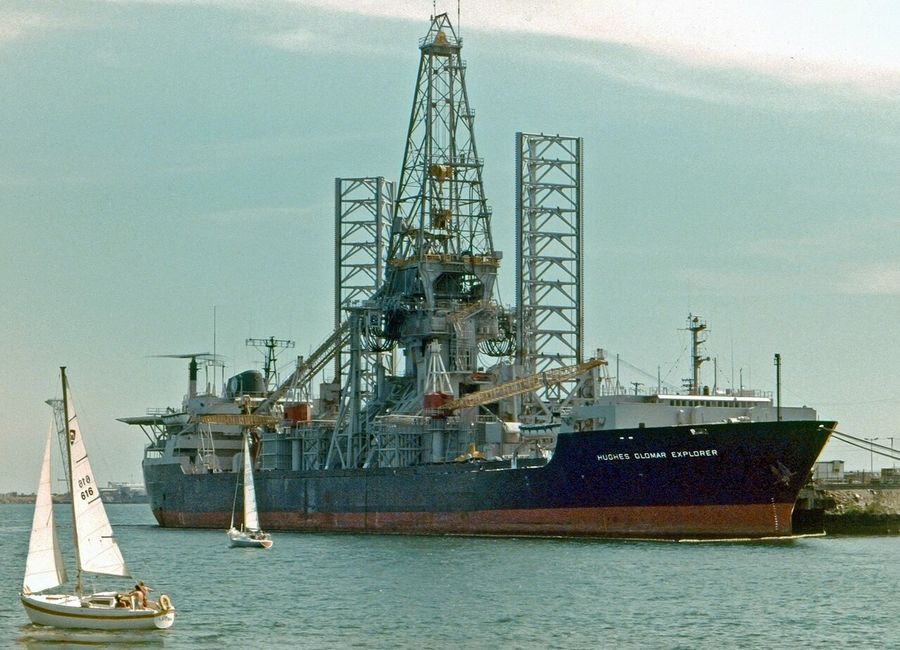
THE CLAIM
That the CIA spent years and a vast sum building a one-of-a-kind ship, disguised as a billionaire's deep-sea mining venture, to lift a sunken Soviet ballistic-missile submarine off the ocean floor three miles down, and that when journalists caught the scent, the Agency invented an entirely new way of saying nothing. Every element of this is true.
THE THEORY, AS ITS PROPONENTS TELL IT
Azorian's covert phase is over and the operation is acknowledged. The unresolved question, the one the CIA has never answered in public, is how much of the submarine was actually recovered.
The official account holds that the claw of the Hughes Glomar Explorer partially failed during the lift from roughly three miles down, that a substantial portion of the K-129 broke away and fell back to the seabed, and that the recovered section did not include the ballistic missiles or the cryptographic material that were the operation's principal objectives. Proponents argue that this is exactly what an intelligence agency would say about a successful operation, that admitting failure is the cheapest possible cover for a complete recovery, and that the released photographs and documents have been selected to support it.
The Soviet-provenance strand runs the other way: that the K-129's loss in 1968 was not accidental, with theories ranging from a collision with the American submarine USS Swordfish to a rogue launch attempt by part of the crew. Neither has documentary support and the Soviet Navy's own inquiry reached no firm conclusion.
The file's lasting contribution is procedural rather than nautical. When journalists filed for records, the Agency responded that it could neither confirm nor deny the existence of the material requested, a formulation invented for this case, upheld in litigation, and now standard across Western governments. Azorian is why "neither confirm nor deny" exists, and proponents note that a case which produced a permanent new category of official non-answer is a strange one to treat as closed.
WHAT IS KNOWN
In March 1968 the Soviet diesel-electric submarine K-129, carrying nuclear-armed ballistic missiles, sank in the North Pacific with all hands. The Soviet Navy searched for months and found nothing. The United States, using acoustic data, located the wreck and photographed it with the submarine USS Halibut. A drowned Soviet missile boat (with its weapons, codebooks, and cryptographic equipment) was an intelligence prize of the first order, if anyone could reach it at a depth no salvage operation had ever attempted.
The CIA's answer was Project Azorian. A purpose-built ship, the Hughes Glomar Explorer, was constructed under a meticulous cover story: Howard Hughes, a man famous for doing strange expensive things in secret, was said to be pioneering the mining of manganese nodules from the seabed. The cover was good enough that it briefly convinced other companies deep-sea mining was a viable industry. In the summer of 1974 the ship parked over the wreck and lowered a giant capture claw on a three-mile string of pipe. During the lift, part of the claw failed and a large section of the submarine broke away and fell back. The forward section was recovered, along with the remains of six Soviet sailors, whom the crew buried at sea with military honors, a ceremony the CIA filmed and, in 1992, gave to Russia.
In early 1975, following a burglary at a Hughes-affiliated office, the story reached the press; the Los Angeles Times and columnist Jack Anderson broke it, and a planned second recovery mission was abandoned. When journalist Harriett Ann Phillippi filed a FOIA request, the CIA responded that it could "neither confirm nor deny" the existence of relevant records, the origin of the now-standard Glomar response. In 2010 the Agency released a redacted internal history of Project Azorian, confirming the outline while still withholding exactly what was recovered.
EVIDENCE FOR
- The CIA's own declassified internal history, released in 2010 after a FOIA request by the National Security Archive.
- The physical existence of the Hughes Glomar Explorer, a ship whose design made no commercial sense and perfect salvage sense.
- Contemporaneous investigative reporting from 1975, never rebutted, only stonewalled.
- The burial-at-sea film handed to Russia in 1992, an acknowledgment in all but press release.
EVIDENCE AGAINST (THE WILDER VERSIONS)
- The claim that the whole submarine was secretly recovered and the "failure" was cover. The declassified record, participant accounts, and the engineering post-mortem agree: the claw broke, most of the hull was lost.
- The persistent name "Project Jennifer", that was a security compartment, not the operation. The operation was Azorian; the press simply got the wrong codeword first.
- Claims that intact nuclear missiles were retrieved. The recovered forward section did not contain the missile compartment; what exactly was salvaged remains redacted, but the prize sections went back down.
ASSESSMENT
Azorian is the rare file where the documented truth outruns the rumors: a fake billionaire mining venture, a claw the size of a building, a graveside service for adversary sailors performed in secret and in good faith. Its most durable product, though, is linguistic. Every time an agency tells you it can neither confirm nor deny something, you are hearing the ghost of a broken claw in the Pacific. This office regards the Glomar response as Azorian's true recovered cargo.
WHAT WOULD CHANGE THE GRADE
- CONFIRMED: the Hughes Glomar Explorer, the deep-sea mining cover story, and the partial recovery of the Soviet submarine K-129 in 1974. Declassified in 2010.
- Open: how much of the submarine came up. The CIA's released account says the forward section broke away during the lift, and analysts have disputed how much was actually lost.
- The operation produced the phrase can neither confirm nor deny, the Glomar response, which is now routine in FOIA practice worldwide. That may be its largest lasting consequence.
FURTHER READING
- Burial At Sea of Soviet Submariners from Hughes Glomar Explorerarchived copy
- Project Azorian: The CIA's Declassified History of the Glomar Explorergwu.edu
- Project Azorian · Wikipedia overview.
- Glomar response, the FOIA doctrine the case created.
- Soviet submarine K-129, the target vessel.
- "Project AZORIAN: The Story of the Hughes Glomar Explorer", the CIA's declassified internal history (2010 release).
RELATED FILES IN THIS ARCHIVE
- OSA-065 · OPERATION IVY BELLSCONFIRMEDA recording pod clamped to a Soviet cable, 400 feet down
- OSA-060 · ACOUSTIC KITTYCONFIRMEDThe CIA wired a live cat for sound
- OSA-114 · CRYPTO AGCONFIRMEDHalf a century reading the secret traffic of allies and adversaries alike
- OSA-136 · KOREAN AIR LINES 007CONTESTED269 dead, and a navigational error nobody has fully explained