THE IRAQ WMD CASE
| CLAIMED | Active chemical and biological stockpiles and a reconstituted nuclear programme |
| FOUND | None. The Iraq Survey Group reported in 2004 that no stockpiles existed |
| INQUIRIES | SSCI (2004), Butler Review (2004), Robb-Silberman (2005), Chilcot (2016) |
| STATUS | Confirmed that the case was unsupportable. Deliberate fabrication: not established |
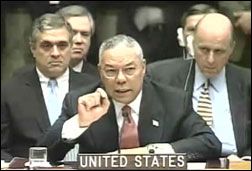
THE CLAIM
That the United States and United Kingdom presented intelligence they knew to be weak or false in order to justify an invasion, and that key sources were known to be unreliable at the time.
THE THEORY, AS ITS PROPONENTS TELL IT
This file needs its two halves kept apart, because they have very different evidential standing.
The first half is settled. There were no stockpiles. The Iraq Survey Group, led by David Kay and then Charles Duelfer, searched with full access and concluded in 2004 that Iraq had ended its programmes in the 1990s. Every subsequent inquiry agreed.
The second half is the presentation. The Senate Select Committee on Intelligence found the assessments overstated and unsupported by the underlying reporting. The Butler Review found that British intelligence had removed caveats as claims moved up toward publication. Chilcot concluded that judgements were presented with a certainty that was not justified.
Specific sources are the sharpest evidence. The aluminium tubes claim was disputed by the Department of Energy's own experts at the time. The mobile weapons laboratories rested on a single source, codenamed Curveball, whom German intelligence had warned was unreliable and who later confirmed publicly that he had invented the account. The Niger uranium claim rested on documents that were forged (OSA-163).
WHAT IS KNOWN
The absence of stockpiles is established by the searching organisation itself, appointed by the invading powers.
The Butler Review documented the removal of qualifying language, including the treatment of the 45-minute claim, which referred to battlefield munitions and was presented without that context.
Curveball, Rafid Ahmed Alwan al-Janabi, admitted fabricating in a 2011 interview. The German service's warnings about him are documented.
What no inquiry established is deliberate fabrication at the top. Each found failure, groupthink, removed caveats and pressure toward a conclusion, and each stopped short of finding that officials knowingly asserted what they believed to be false.
EVIDENCE FOR
- Four independent inquiries in two countries, all finding the public case exceeded the intelligence.
- The Iraq Survey Group's own conclusion that the stockpiles did not exist.
- Curveball's later admission that he invented the mobile laboratories account, and the documented prior warnings about him.
- Contemporaneous internal dissent, including from the Department of Energy on the aluminium tubes and the State Department's INR on the nuclear case.
EVIDENCE AGAINST (THE DELIBERATE LIE READING)
- No inquiry found that senior officials asserted what they knew to be false, and several looked specifically for that.
- Multiple foreign intelligence services, including ones opposed to the invasion, also assessed that Iraq retained some capability.
- Saddam Hussein's own conduct, obstructing inspectors while implying capability, contributed to the assessment, and Duelfer's report concluded he had deliberately cultivated that ambiguity.
ASSESSMENT
Confirmed that the case was unsupportable, and this office declines to go further. The distinction between a lie and a certainty manufactured from ambiguous material is real, and it is the whole subject of this archive. What is established is damning without embellishment: caveats were stripped, a single discredited source carried a central claim, internal dissent was excluded from the public case, and forged documents (OSA-163) reached a State of the Union address. Compare OSA-012 and OSA-064, where the same machinery ran on smaller inputs.
WHAT WOULD CHANGE THE GRADE
- Settled: there were no stockpiles. The Iraq Survey Group, appointed by the invading powers and searching with full access, concluded in 2004 that the programmes had ended in the 1990s.
- Settled separately: the public case exceeded the intelligence. Four inquiries in two countries found overstatement, stripped caveats and excluded dissent, including the Department of Energy on the aluminium tubes and the State Department's INR on the nuclear case.
- Not established, and each inquiry looked for it: deliberate fabrication by senior officials. The distinction between a lie and a certainty manufactured from ambiguous material is real, and the record supports the second.
- Curveball admitted in 2011 that he invented the mobile laboratories account, and German warnings about his reliability are documented.
FURTHER READING
- U.S. Intelligence Documents on Chemical Weapons Found in Iraqnytimes.com, archived
- Iraq and weapons of mass destruction · Wikipedia
- Butler Review, Review of Intelligence on Weapons of Mass Destruction (2004)
- The Iraq Inquiry (Chilcot), report (2016)
RELATED FILES IN THIS ARCHIVE
- OSA-068 · THE USS LIBERTY INCIDENTCONTESTEDThirty-four American sailors killed by an ally's aircraft
- OSA-064 · THE NAYIRAH TESTIMONYCONFIRMEDThe incubator story that helped sell a war
- OSA-163 · THE NIGER URANIUM FORGERYCONFIRMEDDocuments so bad the IAEA needed a few hours and a search engine
- OSA-021 · OPERATION GLADIOCONTESTEDNATO's secret stay-behind armies, and Italy's Years of Lead