THE USS LIBERTY INCIDENT
| DATE | 8 June 1967, during the Six-Day War |
| LOCATION | Eastern Mediterranean, international waters off the Sinai coast |
| CASUALTIES | 34 US sailors and personnel killed, 171 wounded |
| DISPUTE | Misidentification vs. knowing attack on a US vessel |
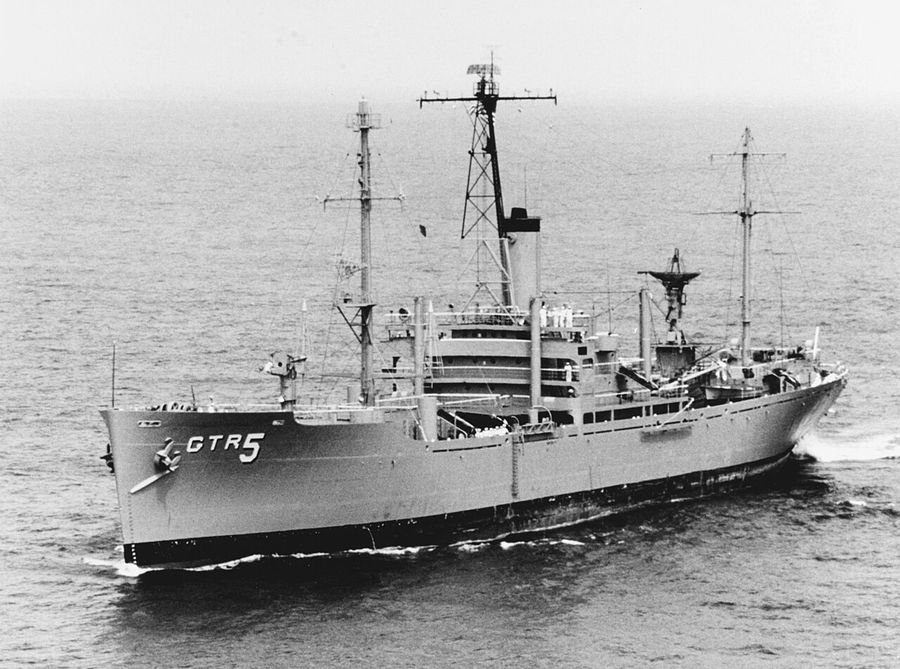
THE CLAIM
That the Israeli air and naval attack on USS Liberty, a lightly armed US Navy technical research ship, was not the case of mistaken identity both governments officially concluded it was, but a knowing attack on an identified American vessel.
THE THEORY, AS ITS PROPONENTS TELL IT
On 8 June 1967, during the Six-Day War, Israeli aircraft and torpedo boats attacked the USS Liberty, a clearly marked American signals intelligence ship in international waters, for roughly seventy-five minutes. Thirty-four American servicemen were killed and 171 wounded. Israel apologised, called it mistaken identity, and paid compensation. Both governments accepted that finding.
The survivors have never accepted it, and their theory is specific rather than vague. They state that the ship was flying a standard flag in clear weather, that unmarked reconnaissance aircraft overflew them repeatedly for hours beforehand at low altitude, that the attacking aircraft returned in successive waves and that the torpedo boats machine-gunned the life rafts after the ship was disabled, behaviour they argue is inconsistent with a misidentification that would have been corrected on the first pass.
The motive proposed is that the Liberty was intercepting Israeli communications during the war, and specifically that it might have detected preparations for the assault on the Golan Heights, which began the following day, or activity at El Arish. On this reading the attack was intended to blind the ship, and its survival was the failure.
The American strand is about the response. Aircraft launched from carriers to assist were recalled, a fact not in dispute, and survivors were instructed not to discuss the incident. Admiral Thomas Moorer, later Chairman of the Joint Chiefs, publicly stated in retirement that he believed the attack was deliberate and had been covered up. The Naval Court of Inquiry was completed in about a week, and its president's later statements suggested he had been constrained. Israel's position, supported by its own inquiries and by several American reviews, is that the ship was misidentified as the Egyptian vessel El Quseir in a chaotic battle environment.
WHAT IS KNOWN
On the fourth day of the Six-Day War, Israeli fighter aircraft strafed and rocketed Liberty in international waters; motor torpedo boats followed, and a torpedo struck the ship's starboard side. Thirty-four Americans were killed and 171 wounded. The crew kept the ship afloat; her captain, William McGonagle, received the Medal of Honor. Israel stated its forces had misidentified Liberty as an Egyptian vessel, apologized within hours, and over subsequent years paid compensation to the wounded, to the families of the dead, and to the United States for the ship.
The official record is consistent across both governments: a US Navy Court of Inquiry convened immediately under Rear Admiral Isaac Kidd found the available evidence consistent with mistaken identity, and subsequent US governmental reviews over the following decades, along with Israel's own inquiries, reached the same conclusion. In 2003 the NSA declassified intercepted communications from the day, which partisans of both readings cite in support of their position.
The dissent is not fringe. The survivors' association has maintained since 1967 that the attack was deliberate and that the inquiry was rushed. Then-CIA Director Richard Helms wrote skeptically of the accident finding in his memoir; Secretary of State Dean Rusk said publicly that he never accepted the Israeli explanation. In 2003 an unofficial panel convened by the veterans' association and chaired by Admiral Thomas Moorer, a former Chairman of the Joint Chiefs, concluded the attack was deliberate and called for a full congressional investigation, which has never been held.
EVIDENCE FOR
- Survivors testify the ship flew a US flag in daylight, had distinctive hull markings, and was overflown by reconnaissance aircraft in the hours before the attack.
- The attack was sustained and multi-phase, air strikes followed by a torpedo run, which survivors argue is inconsistent with a fleeting identification error.
- Senior officials with full access, including Helms and Rusk, recorded lasting doubts; the Moorer panel, though unofficial, carried significant flag-rank weight.
- The Court of Inquiry was completed in days, and its scope was limited to US actions; no US investigation ever took testimony from the Israeli personnel involved.
EVIDENCE AGAINST
- Every official investigation, American and Israeli, across multiple administrations, concluded misidentification, and no declassified document has established foreknowledge that the target was American.
- The fog-of-war context was real: Israeli forces were engaged on multiple fronts, and the initial misreport of a shore bombardment set the engagement in motion.
- Israel's rapid apology and payment of compensation is the documented conduct of a government treating the event as an error.
- The 2003 NSA-released intercepts, read in full, do not contain an order to attack a ship known to be American; researchers such as Judge A. Jay Cristol argue they affirm confusion, not intent.
ASSESSMENT
The Office grades this file CONTESTED because the disagreement runs through the record itself: the official findings of two governments on one side, and the sworn recollections of the surviving crew plus the recorded doubts of senior US officials on the other. No public document proves intent; no account has satisfied the survivors. What would change the stamp: release of the complete, unredacted signals record of the attack, or sworn testimony from the attacking units, the two things no inquiry has yet put on the table.
WHAT WOULD CHANGE THE GRADE
- The attack itself is not in dispute: Israeli aircraft and torpedo boats attacked the ship on 8 June 1967, killing 34 Americans and wounding 171.
- To CONFIRMED as deliberate: an intercept, an order, or a pilot's account showing the attackers knew the ship was American. Survivors and some senior officials, including Admiral Thomas Moorer, have said the available evidence supports that reading.
- Ten US inquiries concluded misidentification, and Israel paid compensation while maintaining it was an error. The NSA holds intercepted communications from that day which have been released only in part, and that partial release is the whole reason this file cannot close.
FURTHER READING
- USS Liberty incident · Wikipedia
- A. Jay Cristol, The Liberty Incident (accident thesis); James Bamford, Body of Secrets (deliberate thesis)
- NSA declassified USS Liberty documents (2003 release)
RELATED FILES IN THIS ARCHIVE
- OSA-013 · IRAN–CONTRACONFIRMEDMissiles to Tehran, money to Managua
- OSA-130 · IRAN AIR 655CONFIRMED290 civilians killed by a US missile cruiser in the Gulf
- OSA-162 · THE IRAQ WMD CASECONFIRMEDA war argued on intelligence that four inquiries found unsupportable
- OSA-169 · THE KHASHOGGI KILLINGCONFIRMEDA journalist killed inside his own country's consulate abroad