JACK THE RIPPER
| PERIOD | August 31 – November 9, 1888 (the canonical five) |
| LOCATION | Whitechapel and Spitalfields, East End of London |
| VICTIMS | Nichols, Chapman, Stride, Eddowes, Kelly, with a wider Whitechapel file of eleven |
| STATUS | Never identified; the oldest open file in the drawer |
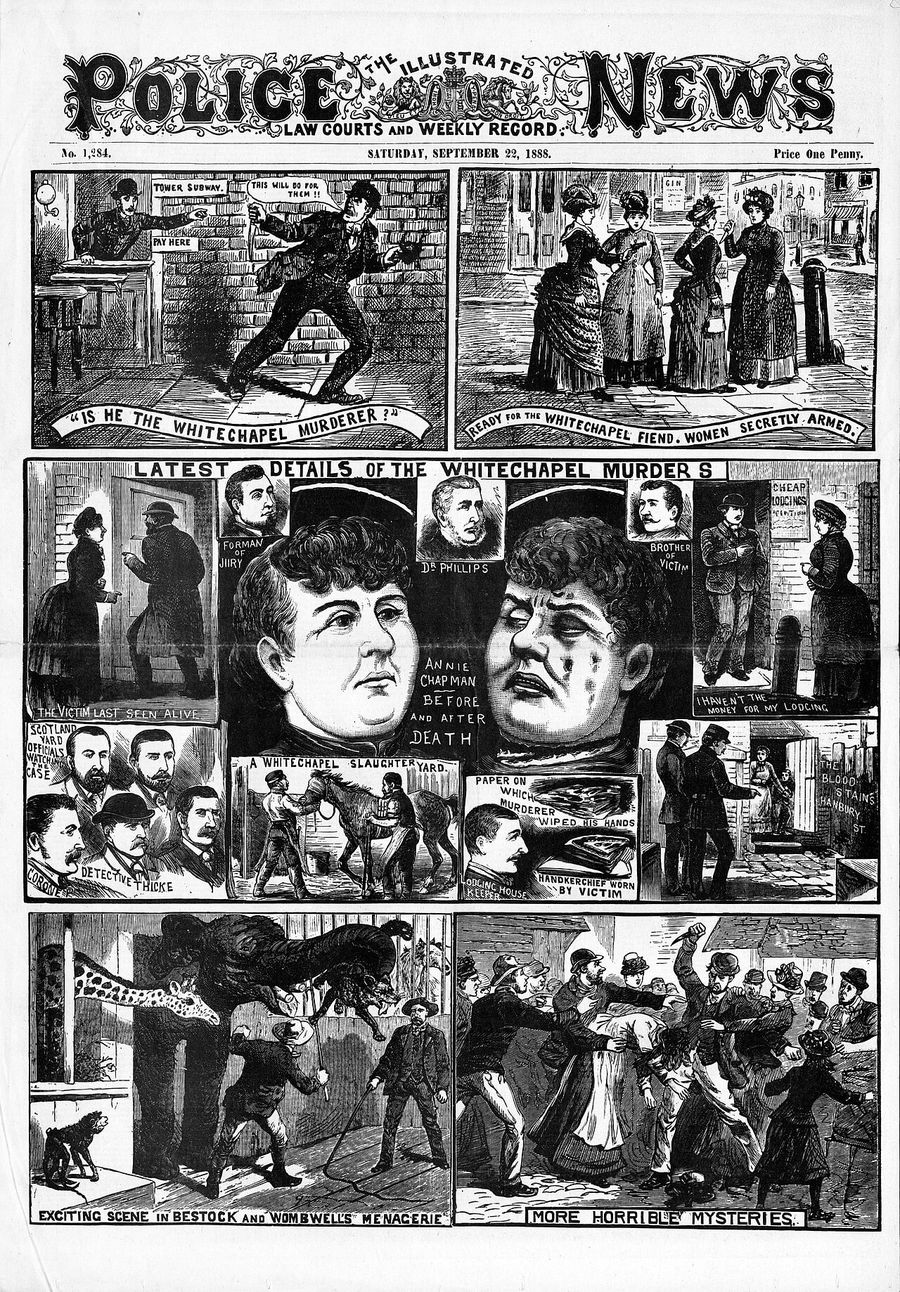
THE CLAIM
That a single unidentified man murdered and mutilated at least five women in a few square miles of Victorian London over ten weeks, wrote taunting letters signed with the most famous alias in criminal history, and vanished. Roughly half of that is well supported. The letters, notably, are probably not his.
THE THEORY, AS ITS PROPONENTS TELL IT
The five canonical Whitechapel murders of autumn 1888 produced the first modern media panic, the first serial-killer nickname, and a suspect literature that now runs to hundreds of names, which is itself the file's defining problem.
The royal conspiracy is the most famous version: that Prince Albert Victor, grandson of Queen Victoria, had fathered a child with a Whitechapel woman, and that the murders were carried out by the royal physician Sir William Gull to silence the women who knew. It was advanced in the 1970s on the basis of an account its own source later retracted, requires Gull to have been physically capable of it after a stroke, and has no documentary support, but it supplied the template for a century of fiction.
The serious candidates are of a different character: Aaron Kosminski, a Polish barber named by senior officers at the time; Montague Druitt, whose suicide shortly after the final murder impressed the Metropolitan Police; Francis Tumblety, an American quack arrested in London that autumn; and Carl Feigenbaum. A 2014 claim of a DNA match to Kosminski from a shawl attributed to victim Catherine Eddowes was published outside peer review and criticised on provenance and methodology.
The suppression strand holds that police files were culled, that the Home Office knew the identity and concealed it to protect either the establishment or its own reputation, and that Sir Melville Macnaghten's 1894 memorandum naming three suspects was written to close a case rather than solve one. What is documented is more ordinary and more damning: the investigation had no forensic capability, competing forces did not cooperate, and one commissioner ordered a chalked message wiped from a wall before it could be photographed.
WHAT IS KNOWN
Between late August and early November 1888, five women (Mary Ann Nichols, Annie Chapman, Elizabeth Stride, Catherine Eddowes, and Mary Jane Kelly) were killed in and around Whitechapel, most with escalating post-mortem mutilation that suggested one hand. These are the "canonical five," a grouping most, though not all, researchers accept; the Metropolitan Police's broader Whitechapel murders file ran to eleven deaths between 1888 and 1891. Despite an enormous investigation (house-to-house canvasses, dozens of arrests, a witness description or two of a man of unremarkable appearance) no one was ever charged.
The name came from a letter. The "Dear Boss" letter of September 1888, signed "Jack the Ripper," and the "Saucy Jacky" postcard that followed were suspected by senior police officials at the time, and by most historians since, of being the work of an enterprising journalist drumming up copy; hundreds of imitation letters followed. Only the "From Hell" letter, posted to a local vigilance committee with half a preserved human kidney, retains any serious claim to authenticity, and even that is disputed. It is entirely possible the killer never wrote a word.
What survives is thin: inquest records, some police memoranda naming late-period suspicions (Kosminski, Druitt, Ostrog appear in an 1894 memorandum), and a case file thinned by loss and souvenir-hunting over 130 years. Onto that thin record a "suspect industry" has built more than a hundred named candidates, from Polish barbers to royal physicians to the painter Walter Sickert, most demonstrably impossible, none provable.
LEADING THEORIES
- Aaron Kosminski. A Polish-born Whitechapel resident named in contemporary police memoranda and committed to an asylum in 1891. A 2019 peer-reviewed paper matched mitochondrial DNA from a shawl allegedly found with Eddowes to descendants of Kosminski's line. Critics answered on every front: the shawl has no documented connection to the crime scene, it was handled for a century, and mitochondrial DNA excludes rather than identifies, the matched type is shared by thousands. The claim persuaded headline writers, not geneticists.
- Montague Druitt. A barrister who drowned himself weeks after the Kelly murder, named in the same 1894 memorandum. The timing is suggestive; the evidence connecting him to Whitechapel is essentially nil.
- A local nobody. The unglamorous consensus of modern profilers: a resident of the district, socially invisible, who stopped because he died, was institutionalized, or was jailed for something else, and was never in any file at all.
- No single Ripper. A minority of researchers argue the canonical five conceal two or more killers, with Stride in particular a frequent candidate for removal from the series.
ASSESSMENT
This case will never close, and the OSA says so without regret: the evidence needed to close it stopped existing decades ago. What remains is a mirror, each era convicts the suspect it finds most interesting, which is how a squalid series of murders of poor women acquired royal conspiracies and celebrity culprits. The five women are the facts of the case. Everything wearing a top hat is marketing.
WHAT WOULD CHANGE THE GRADE
- To CLOSED: realistically nothing. The physical evidence is gone, the Metropolitan Police files are incomplete, and the chain of custody on every surviving artifact is broken beyond repair.
- The 2014 shawl DNA claim failed on provenance, on the statistical treatment of the mitochondrial match, and on peer review. It has not been replicated.
- This file marks a hard boundary in the archive. Past a certain age, a case stops being unsolved and becomes unresolvable, and no amount of new technique reverses it once the material is gone.
FURTHER READING
RELATED FILES IN THIS ARCHIVE
- OSA-038 · THE ZODIAC KILLEROPEN CASEFive dead, two survivors, and ciphers mailed to the press
- OSA-046 · THE SOMERTON MANOPEN CASEA body on an Adelaide beach, a scrap of Persian poetry, an uncracked code
- OSA-081 · THE TYLENOL MURDERSOPEN CASESeven dead, no charges, and the reason every bottle is sealed
- OSA-082 · THE ISDAL WOMANOPEN CASENine aliases, a coded diary, and no name at all