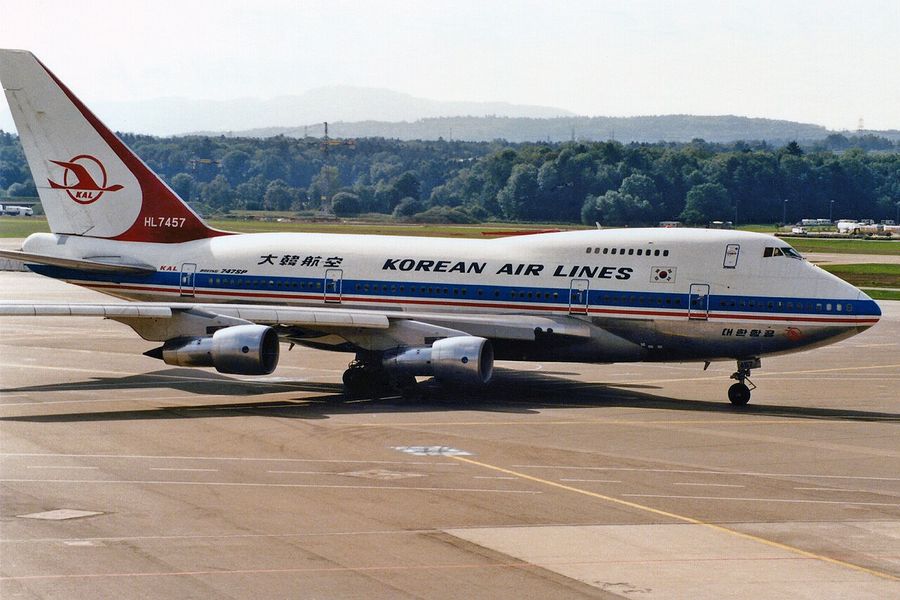
KOREAN AIR LINES 007
| DESTROYED | 1 September 1983, near Sakhalin, by a Soviet Su-15; 269 killed |
| DEVIATION | Roughly 200 nautical miles north of its assigned route |
| RECORDERS | Recovered by the USSR in 1983, concealed, and released by Russia in 1992 |
| STATUS | Contested. ICAO 1993: probable crew error in autopilot mode. Motive still argued |
THE CLAIM
That KAL 007 was not simply lost, that the deviation served an intelligence purpose, and that both the United States and the Soviet Union concealed what they knew about the flight.
THE THEORY, AS ITS PROPONENTS TELL IT
The confirmed part of this file is the concealment, on both sides, and the argued part is why the aircraft was where it was.
KAL 007 flew approximately 200 nautical miles off its assigned route, crossing the Kamchatka peninsula and Sakhalin, over some of the most sensitive Soviet military territory in existence, during a period of extreme tension. It was shot down by a Su-15 interceptor with the loss of all 269 aboard, including a sitting United States congressman.
The Soviet Union initially denied knowledge, then admitted the shootdown and asserted the aircraft was on a deliberate reconnaissance mission. It recovered the flight recorders and concealed that fact for nine years, releasing them only in 1992 under Yeltsin.
Proponents point to the coincidence of an American RC-135 reconnaissance aircraft operating in the same region earlier that night, whose track at one point came within tens of miles of the airliner's, and argue the Soviet radar picture may have conflated them. The stronger version holds that the deviation was deliberate and intended to activate Soviet air defences for collection purposes, with the passengers unaware.
WHAT IS KNOWN
The shootdown, the death toll and the scale of the deviation are established.
The Soviet concealment of the flight recorders for nine years is established, and their eventual release changed the analysis substantially.
The 1993 ICAO reinvestigation, using the recovered recorders, concluded the probable cause was the crew leaving the autopilot in heading mode rather than engaging inertial navigation, producing a constant magnetic heading and a progressively widening deviation. The recorders showed no discussion suggesting the crew knew they were off course.
The RC-135 was real and its presence is documented. The United States also delayed releasing some of its own intercept material, and the initial American presentation at the United Nations omitted context about Soviet confusion over the target's identity.
EVIDENCE FOR
- A 200 nautical mile deviation over the most sensitive airspace available, which remains remarkable however it is explained.
- Soviet concealment of the flight recorders for nine years, which is proven.
- A documented American reconnaissance aircraft in the same region that night.
- Selective presentation of intercept material by the United States in the immediate aftermath.
EVIDENCE AGAINST
- The recovered cockpit voice recorder shows a crew behaving entirely normally, with no awareness of being off course, which is very difficult to reconcile with a deliberate mission.
- The autopilot heading-mode explanation accounts for the deviation profile precisely, including its progressive widening.
- Using a civilian airliner with 269 people aboard, including a congressman, as a deliberate provocation would be an extraordinary risk for marginal collection value.
- The Soviet interceptor pilot's own recorded transmissions indicate genuine uncertainty about the target's identity rather than knowledge that it was civilian.
ASSESSMENT
Contested, with the technical question closer to settled than the political one. The navigational explanation is strong, fits the recorder data, and this office regards the deliberate mission theory as unsupported. What remains legitimately in the file is conduct after the fact: a superpower recovered the flight recorders from a mass-casualty incident and hid them for nine years, and the other superpower presented its intercepts selectively while knowing more about Soviet confusion than it said. Neither government lied about the central fact. Both shaped the record around it, which is the more common behaviour this archive documents.
WHAT WOULD CHANGE THE GRADE
- The technical question is close to settled. The recovered cockpit voice recorder, concealed by the USSR for nine years and released in 1992, shows a crew with no awareness of being off course, and the autopilot heading-mode explanation accounts for the deviation profile precisely.
- Confirmed on both sides: the Soviet Union hid the flight recorders for nine years, and the United States presented its intercepts selectively while knowing more about Soviet target confusion than it said.
- To CONFIRMED for a deliberate mission: any document. Using a civilian airliner with 269 aboard including a sitting congressman as a provocation would be an extraordinary risk, and nothing in any archive supports it.
FURTHER READING
- Tailspin: Behind the Korean Airliner Tragedy (1989)tcm.com, archived
- Korean Air Lines Flight 007 · Wikipedia
- ICAO, Report of the completion of the investigation regarding KE 007 (1993)
- Seymour Hersh, The Target Is Destroyed (1986)
RELATED FILES IN THIS ARCHIVE
- OSA-196 · THE MANTELL INCIDENTDEBUNKEDAn Air National Guard captain flew too high after something he could not identify
- OSA-059 · PROJECT AZORIANCONFIRMEDThe CIA stole a Soviet submarine off the ocean floor
- OSA-060 · ACOUSTIC KITTYCONFIRMEDThe CIA wired a live cat for sound
- OSA-065 · OPERATION IVY BELLSCONFIRMEDA recording pod clamped to a Soviet cable, 400 feet down