OPERATION IVY BELLS
| PERIOD | First tap emplaced 1971; compromised 1980; pod recovered by the USSR 1981 |
| THEATER | Sea of Okhotsk, and later the Barents Sea: Soviet territorial waters |
| PRINCIPALS | U.S. Navy submarine force, the National Security Agency, and the CIA |
| DISPOSITION | Declassified in outline; the recovered pod was displayed in Moscow |
THE CLAIM
That the United States sent submarines inside Soviet territorial waters, located a military communications cable on the seabed, and clamped a recording device around it, then returned every few months for nearly a decade to collect the tapes. Every element of this is now acknowledged, including by the Soviet side, which put the captured device in a museum.
THE THEORY, AS ITS PROPONENTS TELL IT
The operation is acknowledged and the Soviets displayed the recovered pod in a museum, so the theory here is not about whether it happened. It is about the scale of what the programme became and what replaced it.
The documented core: American submarines entered the Sea of Okhotsk, located a Soviet military communications cable on the seabed by following the shore signs warning ships not to anchor, and placed an induction tap around it that read the traffic without penetrating the sheath. Divers returned periodically to swap tapes for nearly a decade.
Proponents argue that the public account understates the programme in two ways. First, that Okhotsk was one site among several, a Barents Sea operation is generally acknowledged, and the specially configured submarines involved, particularly USS Parche, accumulated an extraordinary number of unit citations across missions that remain classified. Second, that the technology did not retire when the pod was lost; the argument is that seabed cable access simply moved from Cold War military lines to the fibre-optic cables that now carry essentially all international internet traffic, and that the Snowden disclosures (OSA-016) describing upstream collection at cable landing points are the same capability in its modern form.
The betrayal is the settled part and the least conspiratorial: no counter-intelligence service found the tap. Ronald Pelton, an indebted former NSA analyst, walked into the Soviet embassy in Washington and sold it from memory for roughly $35,000. The engineering held for ten years. The person did not.
WHAT IS KNOWN
Soviet naval traffic between the Petropavlovsk submarine base on Kamchatka and Pacific Fleet headquarters at Vladivostok crossed the Sea of Okhotsk on an undersea cable. Because the sea was ringed by Soviet territory and monitored by a hydrophone net, Soviet planners treated the line as physically secure and much of the traffic on it was reportedly unencrypted.
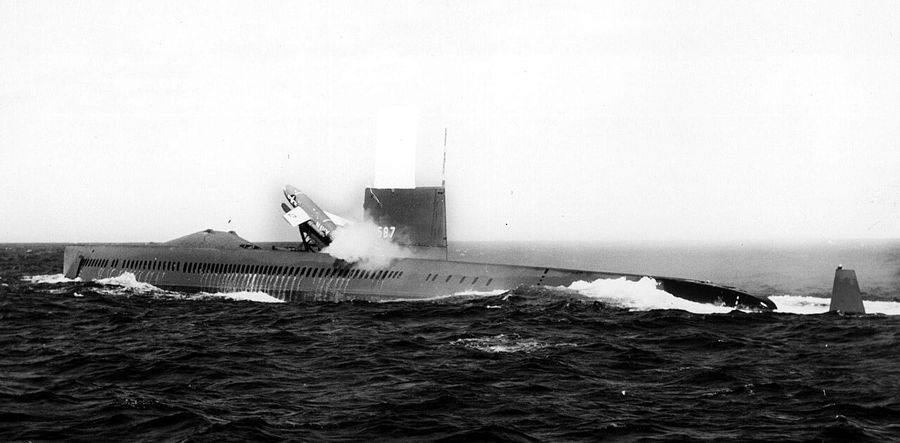
In 1971 the specially modified submarine USS Halibut entered the sea and located the cable by following the shore signs warning ships against anchoring. Saturation divers operating from the submarine at roughly 400 feet placed a recording pod on the line. The device worked by induction: it read the signal through the cable's sheath without cutting into it, so the tap caused no fault and could not be found by ordinary line testing. It was designed to detach if the cable was ever raised for maintenance.
The take was substantial enough that the operation was expanded, with larger pods and additional submarines including USS Parche and USS Seawolf, and eventually a second effort in the Barents Sea. Crews returned periodically to swap out the tapes.
The operation was not broken by Soviet counter-intelligence. In January 1980, Ronald Pelton, a former NSA analyst who had resigned in debt, walked into the Soviet embassy in Washington and sold what he remembered. He received roughly $35,000 in total. In 1981 U.S. reconnaissance found Soviet vessels sitting directly over the tap site; the pod was gone.
Pelton was identified through the debriefing of KGB defector Vitaly Yurchenko, convicted of espionage in 1986, and sentenced to three consecutive life terms. He was released in 2015. The recovered pod, stencilled with the words "Property of the United States Government," was subsequently placed on public display in Moscow.
EVIDENCE FOR
- The Soviet Union recovered the device and exhibited it, the rare intelligence operation confirmed by the target displaying the hardware in a museum.
- Pelton's espionage conviction rested on the compromise of a real program; the prosecution proceeded in open court with the operation's existence acknowledged in substance.
- Multiple participating submarines and their crews have since been decorated and publicly associated with special-project work; USS Parche became one of the most decorated vessels in Navy history.
- Extensive on-the-record accounts from participants in Sontag and Drew's Blind Man's Bluff, which the Navy did not dispute in its essentials.
EVIDENCE AGAINST (THE OPEN QUESTIONS)
- Precise dates, locations, take volume, and the number of pods remain classified; published timelines are reconstructions and differ in detail.
- The claim that the intercepted traffic was largely unencrypted rests on participant recollection rather than released product, and may be overstated.
- Whether the intelligence gained materially changed U.S. policy is genuinely unknown, the product itself has never been released.
ASSESSMENT
CONFIRMED in outline, unresolved in detail. Ivy Bells is the counterweight to Snow White in this archive: an operation of real audacity, kept genuinely secret for nearly a decade, and undone not by investigative journalism or a whistleblower's conscience but by one indebted man walking into an embassy. That is the recurring shape of successful covert work, tight compartments, a small cleared population, and a single human point of failure. Note also what stayed hidden and what did not. The engineering held for ten years. The person did not.
WHAT WOULD CHANGE THE GRADE
- CONFIRMED: the tap placed on a Soviet military cable in the Sea of Okhotsk, and its compromise by NSA analyst Ronald Pelton, who was convicted of espionage in 1986.
- One of the recording pods is on display in a Moscow museum, which is about as physically confirmed as an intelligence operation gets.
- Open: how many other taps were placed, and whether the technique is still in use. Nothing in this area is declassified while it still works, so absence of record here means very little.
FURTHER READING
- Ship Details: PARCHE (SSN 683)nvr.navy.mil
- Operation Ivy Bells · Wikipedia
- Ronald Pelton · Wikipedia
- Blind Man's Bluff: The Untold Story of American Submarine Espionage · Sherry Sontag & Christopher Drew, 1998
RELATED FILES IN THIS ARCHIVE
- OSA-059 · PROJECT AZORIANCONFIRMEDThe CIA stole a Soviet submarine off the ocean floor
- OSA-136 · KOREAN AIR LINES 007CONTESTED269 dead, and a navigational error nobody has fully explained
- OSA-138 · THE ROSENBERG CASECONTESTEDBoth executed. Later evidence supports one conviction and undermines the other.
- OSA-115 · OPERATION SHAMROCKCONFIRMEDThe telegraph companies gave the government copies of everything