LOVE CANAL
| BURIED | Roughly 21,000 tonnes of chemical waste by Hooker Chemical, 1942 to 1953 |
| SOLD | 1953, to the Niagara Falls school board for one dollar, with a liability disclaimer |
| EVACUATED | 1978 and 1980, after federal emergency declarations |
| STATUS | Confirmed. Produced the US Superfund law in 1980 |
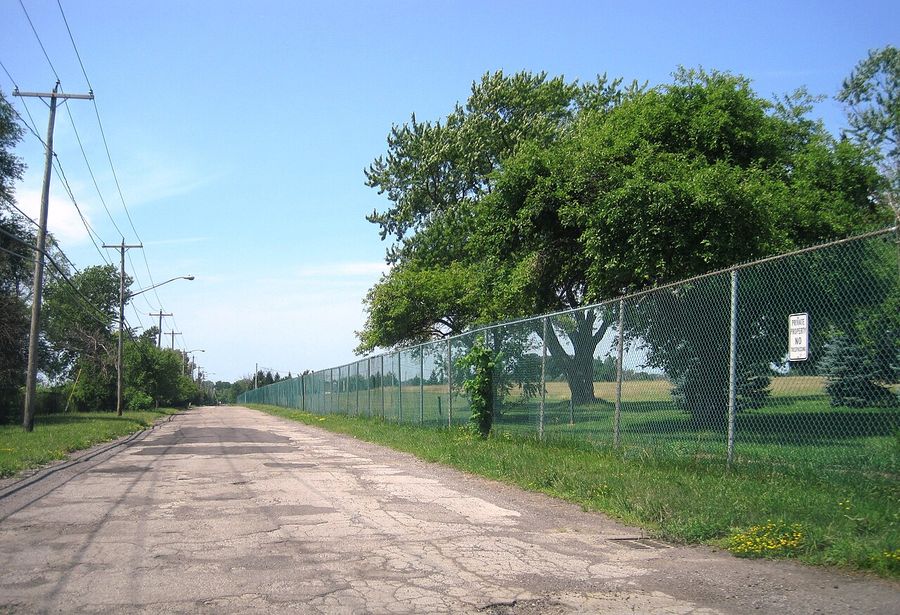
THE CLAIM
That a chemical company buried thousands of tonnes of toxic waste, sold the land knowing what was in it, and that authorities built homes and a school on the site and then resisted residents' complaints for years.
THE THEORY, AS ITS PROPONENTS TELL IT
The unusual feature of this file is that nobody hid anything at the point of sale, and the disaster happened anyway.
Hooker Chemical used a partially dug canal as a dump between 1942 and 1953, burying around 21,000 tonnes of waste including chlorinated solvents and dioxin-contaminated residues, then capped it with clay. In 1953 it sold the site to the local school board for one dollar. The deed described the presence of waste and disclaimed liability for injury, and Hooker's representatives warned against excavation.
The board built a school. Development followed, and construction breached the clay cap. By the 1970s chemicals were surfacing in basements, in the school playground, and in standing water. Residents reported unusually high rates of miscarriage and birth defects.
Lois Gibbs, a local mother, organised the Love Canal Homeowners Association and pushed the matter into national politics. Federal emergency declarations followed in 1978 and 1980, and over 800 families were eventually relocated.
WHAT IS KNOWN
The burial, the sale, the deed clause and the subsequent construction are all documented.
The health data is genuinely mixed. Some early studies reported elevated rates of miscarriage and low birth weight; a New York State study was criticised methodologically; later follow-ups have found some elevated outcomes and not others. This is the honestly unresolved part.
The response produced the Comprehensive Environmental Response, Compensation and Liability Act of 1980, the Superfund law, which is Love Canal's direct legacy.
Occidental Petroleum, which had acquired Hooker, settled with the federal government in 1995 for $129 million.
EVIDENCE FOR
- Documented burial volumes and contents, and the deed clause describing the waste.
- Physical surfacing of chemicals in basements and on the school site.
- Two federal emergency declarations and the relocation of over 800 families.
- A $129 million settlement by the successor company.
EVIDENCE AGAINST (THE HEALTH CLAIM)
- The epidemiology never became conclusive. Study populations were small, exposure could not be reconstructed precisely, and results have been inconsistent.
- Hooker did disclose the waste in the deed and did advise against building, which distinguishes this from OSA-128 and OSA-172 where the knowledge was concealed.
- The school board and the city made the decision to build, and bear a share of responsibility that the popular account often assigns entirely to the company.
ASSESSMENT
Confirmed as an event and honestly unresolved as an epidemiological question, which is an uncomfortable combination and the reason this file is worth having. It is also the counter-example within its own genre: the company wrote the warning into the deed. What failed was everything after, a school board that wanted cheap land, a city that wanted development, and years of official resistance to residents who could see chemicals coming out of the ground. Sometimes nobody has to conceal anything.
WHAT WOULD CHANGE THE GRADE
- CONFIRMED as an event: the burial volumes, the 1953 deed clause describing the waste and disclaiming liability, the construction that breached the clay cap, and the chemicals surfacing in basements and the school playground.
- Honestly unresolved: the epidemiology. Study populations were small, exposure could not be reconstructed precisely, and results have been inconsistent across decades of follow-up.
- Worth noting because it inverts the usual pattern here: Hooker disclosed the waste in the deed and advised against building. What failed was everything after, including years of official resistance to residents who could see the chemicals.
FURTHER READING
- Love Canal: A special Report to the Governor & Legislaturehealth.ny.gov, archived
- The Love Canal Tragedy | About EPA | US EPAepa.gov
- Love Canal · Wikipedia
- Lois Gibbs, Love Canal: My Story (1982)
- US EPA, Love Canal Superfund site records
RELATED FILES IN THIS ARCHIVE
- OSA-127 · THE SUGAR RESEARCH PAPERSCONFIRMEDAn industry bought a Harvard review and shaped fifty years of dietary advice
- OSA-174 · BHOPALCONTESTEDForty tonnes of methyl isocyanate over a sleeping city
- OSA-003 · HAVANA SYNDROMECONTESTED"Anomalous health incidents" among U.S. personnel
- OSA-017 · THE TOBACCO INDUSTRY COVER-UPCONFIRMED"Doubt is our product", the archetypal proven corporate conspiracy