MALAYSIA AIRLINES FLIGHT 370
| DATE | March 8, 2014, departed Kuala Lumpur 12:41 a.m. local, bound for Beijing |
| AIRCRAFT | Boeing 777-200ER, 227 passengers and 12 crew: 239 souls |
| LAST CONTACT | Voice at 1:19 a.m.; final satellite handshake 8:19 a.m. |
| STATUS | Main wreckage never located; the costliest search in aviation history |
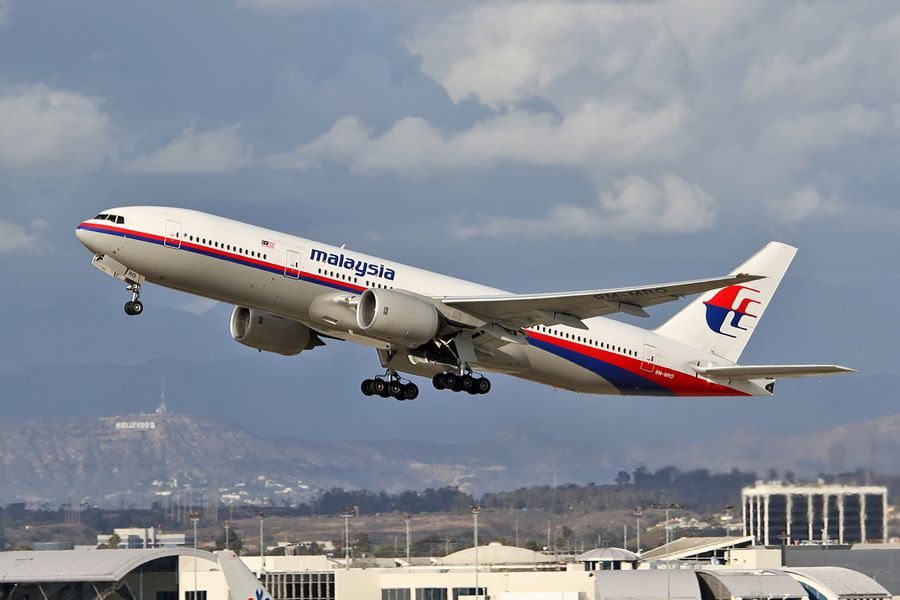
THE CLAIM
That in the age of universal surveillance, a wide-body airliner carrying 239 people could go dark over one of the busiest air corridors in Asia, fly on for six hours, and disappear so completely that a decade of searching has produced only fragments washed onto distant beaches. This is not a claim. It happened.
THE THEORY, AS ITS PROPONENTS TELL IT
A Boeing 777 with 239 people aboard turned off its transponder, reversed course across the Malay Peninsula, flew for nearly seven hours on a track reconstructed only from automated satellite handshakes, and has never been found. Every theory in this file begins from the fact that the aircraft's disappearance required deliberate action.
The pilot-suicide theory is the one most investigators privately favour and no official report has been willing to state. It notes that the transponder and ACARS were disabled in sequence rather than by a single failure, that the turn was executed with precision at the handover point between Malaysian and Vietnamese airspace where attention is lowest, and that a flight-simulator drive recovered from Captain Zaharie Ahmad Shah's home contained a manually plotted route into the southern Indian Ocean that broadly resembled the reconstructed track.
The interference theories hold that the aircraft was taken, by hijackers whose objective was never announced, by a state that shot it down and concealed it, or in the most-circulated version that it was diverted to Diego Garcia. Proponents of the cargo strand point to the 221 kilograms of lithium-ion batteries in the hold and to a consignment of electronics, and argue for either a fire that incapacitated the crew or a deliberate interception of the cargo.
The confirmed debris, a flaperon on Réunion in 2015 and further fragments along the East African coast, establishes that the aircraft came down in the Indian Ocean, which rules out the Diego Garcia strand and constrains the rest. What it does not do is explain the seven hours, and the official Malaysian report's refusal to attribute the diversion to anyone is why the file stays open rather than closed.
WHAT IS KNOWN
Flight 370 departed Kuala Lumpur for Beijing shortly after midnight. At 1:19 a.m. the cockpit signed off with Malaysian air traffic control ("Good night, Malaysian three seven zero") as it approached the handover to Vietnamese airspace. Roughly two minutes later the transponder stopped. Malaysian military radar, reviewed after the fact, showed the aircraft turning back, recrossing the Malay Peninsula, and tracking northwest up the Strait of Malacca before passing out of radar range.
The aircraft's satellite terminal, however, kept answering hourly "handshake" pings from an Inmarsat satellite until 8:19 a.m. Engineers' analysis of the timing and frequency of those signals, a technique improvised for this case, placed the aircraft's end point along an arc deep in the southern Indian Ocean, west of Australia. On that basis Australia's ATSB led an underwater search of some 120,000 square kilometers of seabed, suspended in January 2017; the private firm Ocean Infinity scanned a further large tract in 2018 on a no-find, no-fee basis. Neither found the aircraft, and Ocean Infinity returned under a new agreement with Malaysia in 2025.
The sea has returned pieces. In July 2015 a flaperon washed up on Réunion and was confirmed as MH370's; roughly thirty more fragments, several confirmed or judged highly likely to be from the aircraft, have since been recovered from shores of the western Indian Ocean, consistent with drift from the search zone. Malaysia's 2018 safety investigation report, after 495 pages, concluded the team was "unable to determine the real cause," while noting the turn-back was likely flown under manual control rather than autopilot.
LEADING THEORIES
- Deliberate diversion by a pilot. The view of many independent investigators and crash analysts: the precise turn-back, the silenced transponder, and a route threading radar coverage suggest a controlled act from the cockpit. Malaysian investigators confirmed the captain's home flight simulator contained a deleted route into the southern Indian Ocean, while cautioning that this proved nothing. No motive, note, or claim ever surfaced.
- Hypoxia "ghost flight." The ATSB's end-of-flight modelling assumed an unresponsive crew and an unpiloted final descent, consistent with the satellite data's final signals, but it does not explain the expertly flown turn-back hours earlier.
- Hijacking or third-party interference. Never excluded by the Malaysian report; never supported by evidence. No group claimed the aircraft, and no demand was ever made.
- Mechanical catastrophe. Fire or decompression scenarios struggle to explain six hours of continued, apparently stable flight after all communications ceased.
ASSESSMENT
The satellite mathematics is sound, the debris corroborates it, and yet the seabed keeps its counsel. The OSA notes that every theory must survive the same two facts: someone or something turned that aircraft around with skill, and nothing aboard it ever spoke again. Until the wreckage and its recorders are raised, the file stays open, and it is the one file in this drawer most likely to close in our lifetime, one sonar pass at a time.
WHAT WOULD CHANGE THE GRADE
- To CLOSED: the main wreckage and the flight recorders. Around thirty confirmed or likely fragments have come ashore in the western Indian Ocean, which fixes the general region and nothing else.
- Ocean Infinity's 2018 search covered 112,000 square kilometres and found nothing. A renewed search on a revised drift model is the single thing most likely to close this file, and it is the file in this drawer most likely to close in our lifetime.
- The deliberate-diversion reading rests on the transponder and ACARS ceasing separately, the turn being flown competently, and the final satellite handshakes. That is a strong circumstantial pattern, and it names nobody.
FURTHER READING
- Flight MH370: insurers make first pay out on missing Malaysia Airlines planetelegraph.co.uk, archived
- Malaysia Airlines flight MH370 co-pilot's last message was 'all right, good night'theguardian.com
- MH370 Malaysia Airlines: Anwar Ibrahim says government purposefully concealing informationtelegraph.co.uk, archived
- Wikipedia: Malaysia Airlines Flight 370
- Wikipedia: Search for Malaysia Airlines Flight 370
- ATSB: The Operational Search for MH370
RELATED FILES IN THIS ARCHIVE
- OSA-002 · D.B. COOPEROPEN CASEThe only unsolved commercial skyjacking in U.S. history
- OSA-041 · THE DISAPPEARANCE OF AMELIA EARHARTOPEN CASE"We must be on you but cannot see you", then nothing
- OSA-099 · THE VALENTICH DISAPPEARANCEOPEN CASE"It is hovering, and it's not an aircraft"
- OSA-144 · THE HINDENBURGCONTESTEDStatic discharge or a saboteur, argued for eighty-eight years