THE WOW! SIGNAL
| DATE | August 15, 1977, 22:16 EST |
| INSTRUMENT | Big Ear radio telescope, Ohio State University SETI survey |
| SIGNAL | Narrowband, ~1420 MHz (the hydrogen line), 72 seconds, ~30× background |
| STATUS | Real detection; source unidentified; never repeated |
THE CLAIM
In 1977 a radio telescope listening for extraterrestrial transmissions caught exactly what SETI theory said an alien beacon should look like (once, for 72 seconds) and it has never been heard again.
THE THEORY, AS ITS PROPONENTS TELL IT
The theory is narrow, which is why this file has survived scrutiny that has closed almost every other candidate: for seventy-two seconds on 15 August 1977, the Big Ear radio telescope at Ohio State recorded a narrowband signal at almost exactly the hydrogen line, at roughly thirty times background, with a rise and fall precisely matching what a fixed point in the sky would produce as the Earth rotated the beam past it.
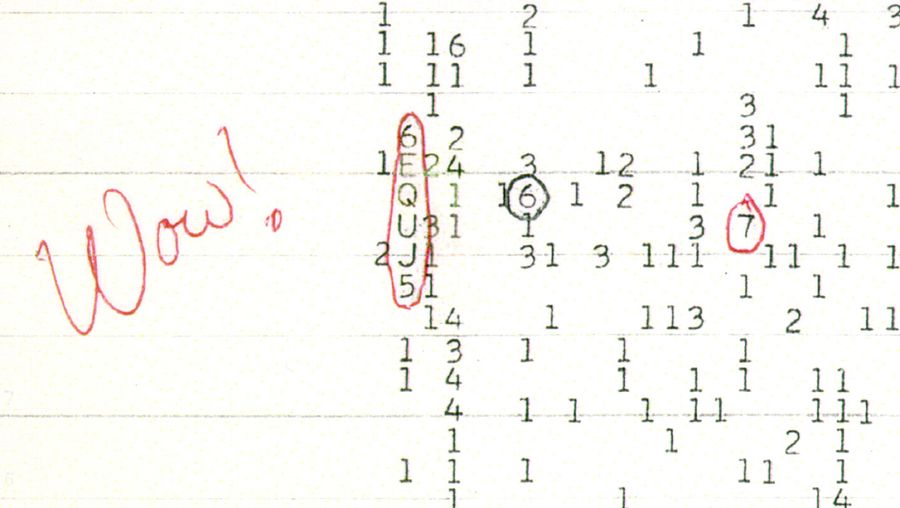
Proponents emphasise that this is not an anomaly of the diffuse kind. SETI theory had specified in advance what a deliberate beacon should look like, narrowband, near 1420 MHz because that frequency is universally significant and protected from terrestrial transmission, and sidereal rather than terrestrial in its motion. The signal satisfied every one of those criteria. Jerry Ehman's annotation on the printout, from which the file takes its name, was the reaction of a researcher looking at exactly the thing the search had been designed to find.
The conspiracy element is thin and proponents mostly avoid it, the strong claim is not that anything was concealed but that the follow-up was inadequate: Big Ear could not re-observe the position immediately, the telescope was demolished in 1998 to extend a golf course, and no subsequent search of that coordinate has produced a repeat.
The competing explanations have not held. A terrestrial transmitter reflecting off debris fails on the sidereal drift; a 2017 proposal involving hydrogen clouds around comets was rejected by other researchers on the grounds that the comets were not in the beam and would not radiate at that intensity. The signal remains the best single candidate ever recorded, and it has never repeated.
WHAT IS KNOWN
Days after the observation, astronomer Jerry Ehman was reviewing the survey's printout when he found the intensity sequence "6EQUJ5", a signal rising and falling exactly as a fixed celestial source should as the Earth's rotation swept the beam across it. He circled it and wrote "Wow!" in the margin, naming it forever.
The details are what keep the file open. The signal was narrowband (concentrated in under 10 kHz, which natural astrophysical sources generally don't do) and sat at the hydrogen line, the frequency SETI pioneers had predicted a deliberate beacon would use precisely because every radio astronomer in the galaxy would be listening there. It was strong. The 72-second envelope matched a real source on the sky, not local interference. And Big Ear's two feed horns should have caught it twice, minutes apart; it appeared in only one, meaning it turned off (or was intermittent) within that window.
Dozens of follow-up campaigns, including with far more sensitive instruments like the VLA and, later, Green Bank, have re-observed the coordinates in Sagittarius. Nothing has ever been found.
CANDIDATE EXPLANATIONS
- Extraterrestrial beacon. Fits the signal's properties; unfalsifiable while it refuses to repeat. Ehman himself has remained carefully agnostic.
- Terrestrial interference reflected off space debris. Possible in principle; transmitting on the protected 1420 MHz band is illegal, and the sky-motion match makes a local source awkward.
- Cometary hydrogen clouds (proposed 2017), widely rejected: the proposed comets weren't in the beam, and comets don't emit narrowband.
- A rare astrophysical transient, e.g. a 2024 archival study suggesting sudden maser-like brightening of cold hydrogen clouds could mimic the signature. A live hypothesis, not a confirmed mechanism.
ASSESSMENT
Unverified is the stamp doing exactly its job: the detection is real and documented; every explanation, from aliens to hydrogen clouds, remains unproven. One observation, however suggestive, is an anecdote in astronomy, the signal's silence for five decades argues against a patient beacon, but a one-time transmission is exactly what we'd never be able to confirm. The file stays in the drawer between "probably nothing" and "the most important 72 seconds ever recorded," which is an uncomfortable width.
WHAT WOULD CHANGE THE GRADE
- To CONFIRMED: a repeat detection at 1420 MHz from the same coordinates in Sagittarius. Forty-five years of targeted searching, including by META, VLA and Allen Telescope Array, has produced nothing.
- To DEBUNKED: a demonstrated terrestrial or solar-system source. The 2017 hydrogen cloud and comet proposal did not survive independent checking.
- The Big Ear telescope was demolished in 1998, so the original instrument can never be re-pointed, and the signal was recorded on one polarisation by one horn. That is the permanent limit on this file.
FURTHER READING
- Candidates for the 1977 “WOW” Signal – The Center for Planetary Scienceplanetary-science.org, archived
- Wikipedia: Wow! signal
- Jerry Ehman, "The Big Ear Wow! Signal: What We Know and Don't Know About It After 20 Years" (1997)
- Wikipedia: SETI
RELATED FILES IN THIS ARCHIVE
- OSA-015 · NUMBERS STATIONSCONFIRMEDAnonymous voices, unbreakable arithmetic
- OSA-141 · THE BLOOPDEBUNKEDAn ultra-low frequency sound detected 5,000 kilometres apart
- OSA-019 · THE TUNGUSKA EVENTCONFIRMEDThe largest impact in recorded history, and a mystery science solved
- OSA-026 · THE MOON LANDING HOAXDEBUNKED382 kg of moon rock, and a Soviet audience that never cried fake