THE BLOOP
| DETECTED | 1997, by NOAA's equatorial Pacific autonomous hydrophone array |
| LOCATION | Roughly 50 degrees south, 100 degrees west, off southern South America |
| IDENTIFIED AS | Icequake, from a large iceberg fracturing, confirmed by later recordings |
| STATUS | Debunked as an unknown organism. Origin established |
THE CLAIM
That an ultra-low frequency sound recorded in 1997, louder than any known animal call, originated from an undiscovered marine organism of enormous size.
THE THEORY, AS ITS PROPONENTS TELL IT
The claim was never really advanced by scientists, which is worth stating at the outset. It grew in the space between a genuine unexplained detection and its eventual explanation.
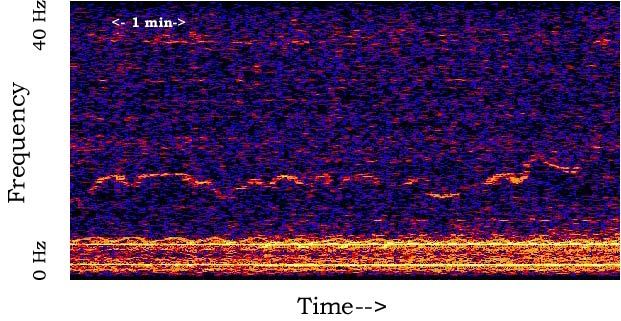
The sound was real and was recorded by NOAA hydrophones over 5,000 kilometres apart, which requires a genuinely powerful source. Its frequency profile rose rapidly over about a minute, and NOAA's own early description noted that the profile was consistent with an animal origin, while adding that it was far louder than any known creature.
That single line, that it had the character of an animal sound, is the entire foundation of the popular claim. It travelled, acquired Lovecraft associations because the estimated location was not far from the fictional location of R'lyeh, and became a fixture of internet mystery lists long after it had been explained.
WHAT IS KNOWN
NOAA identified the source as an icequake: a large iceberg cracking and fracturing as it grounded or broke up. Subsequent recordings of known iceberg events in the Scotia Sea and off Antarctica produced matching acoustic signatures.
The identification is not a hypothesis. NOAA's acoustics programme recorded many further examples and published the comparison, and the agency has stated the matter is settled.
The apparent animal-like frequency sweep is a normal feature of large-scale ice fracture, which produces a rapid rise in frequency as a crack propagates.
No candidate organism was ever proposed by any marine biologist. An animal producing that sound pressure level would need to be substantially larger than a blue whale and would have other detectable consequences.
EVIDENCE FOR
- The detection itself was real, unusually loud, and initially unexplained, which is why it was reported at all.
- NOAA's own early characterisation noted an animal-like profile, which is the origin of the claim.
EVIDENCE AGAINST
- Matching signatures have been recorded from observed iceberg fracture events, which is direct positive identification rather than mere elimination.
- The required source power exceeds any plausible biological mechanism by a large margin.
- No marine biologist ever advanced the giant animal hypothesis; it was a media and internet construction from a single descriptive phrase.
- The agency that recorded it published the answer, and the answer has been available for over a decade while the mystery version continued circulating.
ASSESSMENT
Debunked, and kept as a short lesson in how a solved thing stays unsolved in public. There was a real detection, a cautious scientific description containing one evocative phrase, and then a long afterlife in which the phrase outran the science. The answer was published by the same organisation that made the recording, using further recordings of observed ice events, and it is not in dispute among anyone who works on ocean acoustics. Compare OSA-007, which also has a single evocative detection and, unlike this one, still has no explanation.
WHAT WOULD CHANGE THE GRADE
- Closed by positive identification rather than by elimination: NOAA recorded matching acoustic signatures from observed iceberg fracture events and published the comparison.
- To reopen: a candidate organism. None was ever proposed by a marine biologist, and the required source power exceeds any plausible biological mechanism by a wide margin.
- Worth recording as the actual finding: the whole claim grew from one cautious descriptive phrase in NOAA's early characterisation, and outlived the answer by more than a decade.
FURTHER READING
- Acoustics Monitoring Program - Icequakes (Bloop)pmel.noaa.gov
- Bloop · Wikipedia
- NOAA Pacific Marine Environmental Laboratory · acoustics programme, icequake recordings
- NOAA Vents Program, published comparisons of ice-generated signals
RELATED FILES IN THIS ARCHIVE
- OSA-007 · THE WOW! SIGNALUNVERIFIEDThe best candidate alien signal ever recorded
- OSA-015 · NUMBERS STATIONSCONFIRMEDAnonymous voices, unbreakable arithmetic
- OSA-019 · THE TUNGUSKA EVENTCONFIRMEDThe largest impact in recorded history, and a mystery science solved
- OSA-048 · THE HUMUNVERIFIEDThe low drone two percent of a town can hear, and no microphone can find