OPERATION SEA-SPRAY
| DATE | September 1950 (approximately one week of spraying) |
| LOCATION / OPERATOR | San Francisco Bay area · US Navy, with Army biological-warfare researchers |
| REVEALED | Press reports 1976; US Senate hearings, 1977 |
| STATUS | Acknowledged in government testimony; litigated by the Nevin family |
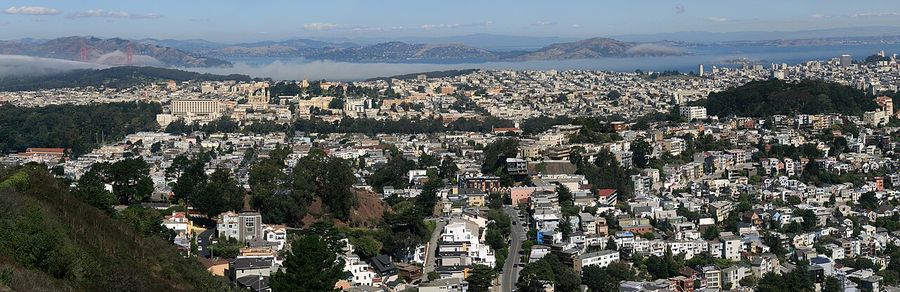
THE CLAIM
That in 1950 the US Navy covertly sprayed clouds of live bacteria over San Francisco to test the city's vulnerability to a biological attack, and that this was one of hundreds of secret open-air tests conducted over American population centers across two decades.
THE THEORY, AS ITS PROPONENTS TELL IT
The theory is short, because the record does most of the work: the United States Navy sprayed a bacterial aerosol over San Francisco in September 1950 to test how a biological attack would disperse through an American city, without telling anyone who lived there.
Proponents emphasise that this was not an isolated experiment. Sea-Spray was one of hundreds of open-air tests conducted over American and Canadian cities across roughly two decades, bacteria released in the New York subway, zinc cadmium sulphide sprayed over St Louis neighbourhoods from rooftops and trucks, tests over Minneapolis, Winnipeg and Corpus Christi. The public learned of the programme through 1977 Senate hearings, a quarter of a century after it began.
The specific harm claim concerns Edward Nevin, who died at Stanford Hospital weeks after the San Francisco release from a Serratia marcescens infection so unusual that the hospital wrote it up in a medical journal. Ten other patients developed infections from the same organism. His family sued the government in the 1980s and lost, the court finding both that causation was unproven and that the government was immune under the discretionary function exception, a ruling proponents read as the state granting itself permission.
The argument this file supplies to the rest of the cabinet is a premise, not a conclusion. When someone says a government would never conduct unconsented experiments on its own population, this is the file that answers. It is also why the chemtrails theory (OSA-028), which is not supported by any physical evidence, is nonetheless difficult to argue against from first principles, the principle it violates is one the United States violated first.
WHAT IS KNOWN
In late September 1950, a Navy vessel off the California coast released aerosols of Serratia marcescens, a bacterium chosen partly because its red pigment made it easy to trace, along with Bacillus globigii, over the San Francisco area. The exercise, Operation Sea-Spray, was a vulnerability test: sampling stations across the city measured how far the plume traveled and how much a resident would have inhaled. The answer, per later government testimony, was that nearly all of the city's residents received a dose. Both organisms were then considered harmless "simulants." Serratia is now recognized as an opportunistic pathogen.
In the weeks after the test, Stanford University Hospital physicians recorded a cluster of eleven patients with Serratia marcescens urinary-tract infections, an organism so rare in their experience that they published the outbreak in a medical journal. One patient, Edward J. Nevin, a recovering prostate-surgery patient, died when the infection reached his heart. The physicians had no way to connect the cluster to the Navy, because the test was secret.
It stayed secret until press reporting in 1976 and Senate subcommittee hearings in 1977, at which the Army disclosed a program of 239 open-air tests between 1949 and 1969, including releases in the New York City subway (bacteria-filled light bulbs dropped onto the tracks in 1966) and, under Operation LAC and related work, zinc cadmium sulfide particle releases over St. Louis, Minneapolis, and other cities. Nevin's grandson sued the government; at the 1981 trial the court ruled for the United States, holding the family had not proven the Navy's bacteria caused the death and that the test planning was shielded by discretionary-function immunity. Appeals failed, and the Supreme Court declined the case.
EVIDENCE FOR
- Sworn government testimony in the 1977 Senate hearings acknowledging the San Francisco test and the wider 239-test program.
- The contemporaneous Stanford outbreak report, a rare pathogen cluster logged by physicians with no knowledge of the spraying.
- The Nevin trial record, in which the fact of the test was not in dispute, only causation and immunity.
- Declassified Army Chemical Corps documents on simulant testing.
EVIDENCE AGAINST (THE WILDER VERSIONS)
- The tests used organisms believed harmless at the time, as vulnerability studies, not deliberate attacks on citizens, and not releases of weaponized agents like anthrax over cities. The pop-culture versions often skip that distinction.
- Causation in the Nevin death was never legally established; the court found the link unproven, and some microbiologists have noted the hospital strain match was uncertain. The moral finding and the epidemiological finding are not the same thing.
- Claims that such open-air biological testing on unwitting American cities continues today are unsupported; the program ended with the US renunciation of offensive biological weapons in 1969.
ASSESSMENT
CONFIRMED. The government fogged a major American city with live bacteria, told no one, and kept the file closed while doctors puzzled over an outbreak that had no business existing. That the intent was defensive and the organism presumed benign mitigates the malice, not the method: consent was the control variable nobody ran. The stamp is settled by the government's own testimony. The bureau notes, dryly, that "harmless simulant" is a phrase that has not aged well, and that Serratia's usefulness as a tracer came from being easy to spot, a courtesy the program itself did not extend.
WHAT WOULD CHANGE THE GRADE
- CONFIRMED: the 1950 release of Serratia marcescens over San Francisco is documented in the Army's own records, declassified in the mid 1970s.
- The open question is harm. The Nevin family's suit failed in 1981 on causation and sovereign immunity, not on whether the release happened.
- Related open-air tests are also confirmed, including the New York subway trials. The full list of vulnerability tests conducted over populated areas has never been published, so the number of people exposed remains an estimate rather than a count.
FURTHER READING
- Wikipedia: Operation Sea-Spray
- US Senate Subcommittee on Health and Scientific Research, Biological Testing Involving Human Subjects by the Department of Defense (hearings, 1977)
- Leonard A. Cole, Clouds of Secrecy: The Army's Germ Warfare Tests Over Populated Areas (1988)
RELATED FILES IN THIS ARCHIVE
- OSA-055 · UNIT 731 & THE IMMUNITY DEALCONFIRMEDHuman experiments in Manchuria, and the data America bought
- OSA-121 · PROJECT 112 AND SHADCONFIRMEDShipboard and land tests of live agents on American servicemen
- OSA-103 · THE GUATEMALA EXPERIMENTSCONFIRMEDAmerican researchers infected Guatemalans with syphilis on purpose
- OSA-154 · EDGEWOOD ARSENALCONFIRMEDUS soldiers exposed to nerve agents and incapacitants in testing