OPERATION UNDERWORLD
| RAN | 1942 to 1945, New York waterfront and Sicily-related intelligence |
| PRINCIPALS | Office of Naval Intelligence, Joseph Lanza, Meyer Lansky, Charles Luciano |
| DOCUMENTED | Herlands report, 1954, commissioned by New York State; released 1977 |
| STATUS | Confirmed. Luciano's sentence commuted 1946, deported to Italy |
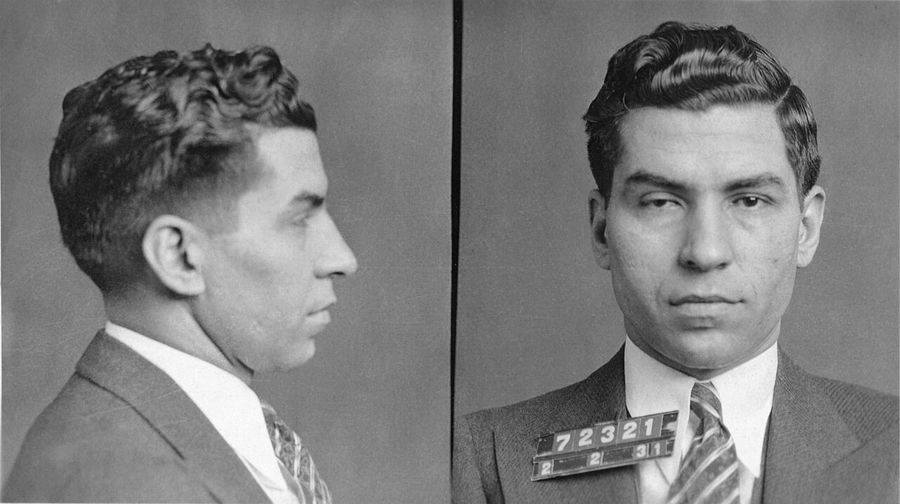
THE CLAIM
That the United States Navy made an operational arrangement with organised crime during the Second World War, and paid for it by releasing a convicted crime boss from a fifty-year sentence.
THE THEORY, AS ITS PROPONENTS TELL IT
The claim was dismissed for decades as gangster mythology and is now established by a state investigation's own report.
After the liner Normandie burned at a New York pier in 1942, and amid fears of sabotage and of U-boats receiving intelligence from the fishing fleet, the Office of Naval Intelligence approached organised crime figures who controlled the waterfront unions and the Fulton Fish Market. Joseph Lanza and then Meyer Lansky acted as intermediaries.
Charles Luciano was serving thirty to fifty years. He was moved to a more convenient prison and consulted repeatedly by naval officers. The arrangement produced union cooperation, informants on the docks, and reportedly contacts used in preparation for the Sicily landings, though the value of the Sicilian element is disputed.
In 1946 Governor Thomas Dewey, the prosecutor who had put Luciano away, commuted his sentence on the basis of wartime service and deported him to Italy. Dewey later commissioned Commissioner William Herlands to investigate the whole affair, and the resulting report confirmed the arrangement in detail. The Navy asked that it not be published, and it was not released until 1977.
WHAT IS KNOWN
The Herlands report exists, was based on sworn testimony from naval officers, and confirms the operational relationship. Its suppression at the Navy's request and its release in 1977 are documented.
Luciano's transfer, the visits, the commutation and the deportation are all matters of record.
The contribution to the Sicily campaign is the weakest part. Historians differ, and the Herlands report itself is more confident about the waterfront than about Sicily.
No sabotage of the New York waterfront occurred during the period of the arrangement. Whether that is causation or coincidence is not established, and the Normandie fire itself was eventually attributed to an accident during conversion work.
EVIDENCE FOR
- The Herlands report, based on sworn testimony from the naval officers involved.
- The commutation and deportation of Luciano by the prosecutor who had convicted him, on stated grounds of wartime service.
- The Navy's documented request that the report not be published, and its suppression for twenty-two years.
- Contemporaneous prison records showing the transfer and the pattern of visits.
EVIDENCE AGAINST (THE WIDER CLAIMS)
- The Sicilian intelligence contribution is not well established and is the part most often overstated.
- The Normandie fire, which triggered the whole thing, was found to be accidental, so the sabotage threat the operation addressed may have been smaller than believed at the time.
- Nothing indicates the arrangement continued after the war, and the deportation ended Luciano's American career.
ASSESSMENT
Confirmed, and included as a study in how these arrangements get documented and then quietly shelved. A state commissioner took sworn testimony, wrote it all down, and the report sat unpublished for twenty-two years because the Navy preferred it that way. Nothing was destroyed and nobody lied under oath. The record simply was not released, which is the most common form of concealment in this entire cabinet and the least dramatic. Compare OSA-139's cousin at OSA-125, where the useful institution was a bank rather than a union.
WHAT WOULD CHANGE THE GRADE
- CONFIRMED by the Herlands report, built on sworn testimony from the naval officers involved, and by the commutation and deportation of Luciano in 1946 by the prosecutor who had convicted him.
- The weakest and most overstated element is the Sicily contribution. The report itself is far more confident about the New York waterfront than about the invasion.
- The concealment here took the least dramatic form in this cabinet: nothing was destroyed and nobody lied under oath, the report was simply not published for twenty-two years at the Navy's request.
FURTHER READING
- Operation Underworld · Wikipedia
- Herlands report, New York State Commissioner of Investigation (1954, released 1977)
- Rodney Campbell, The Luciano Project (1977)
RELATED FILES IN THIS ARCHIVE
- OSA-011 · OPERATION PAPERCLIPCONFIRMEDNazi scientists, freshly laundered dossiers
- OSA-056 · OPERATION MINCEMEATCONFIRMEDThe corpse that misdirected the German army
- OSA-055 · UNIT 731 & THE IMMUNITY DEALCONFIRMEDHuman experiments in Manchuria, and the data America bought
- OSA-057 · THE GHOST ARMYCONFIRMEDInflatable tanks, sound trucks, and fake radio traffic