THE DANCING PLAGUE OF 1518
| DATE | July–September 1518 |
| LOCATION | Strasbourg, Alsace (then a free city of the Holy Roman Empire) |
| INDEX CASE | A woman recorded as Frau Troffea, who began dancing alone in the street |
| CASUALTIES | Uncertain, later accounts claim deaths; contemporary records are less clear |
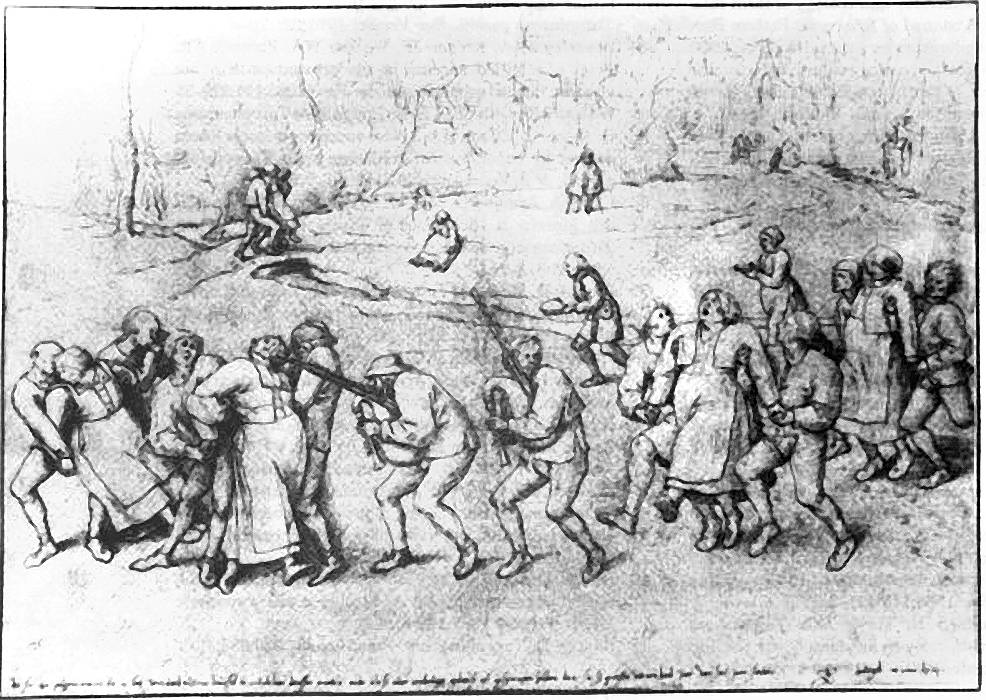
THE CLAIM
In the summer of 1518, dozens, by some accounts hundreds, of ordinary citizens of Strasbourg danced uncontrollably for days and weeks on end, some allegedly until they died, and nobody then or since has been able to say why.
THE THEORY, AS ITS PROPONENTS TELL IT
The event is not in dispute: in July 1518 in Strasbourg, a woman began to dance in the street and could not stop, others joined over the following weeks until contemporary accounts put the number in the hundreds, and people danced until they collapsed and in some accounts died of exhaustion, stroke or heart failure.
What is contested is the cause, and the explanations divide along a line that recurs throughout this archive, poisoning versus psychology. The ergot theory holds that the dancers had eaten rye infected with Claviceps purpurea, whose alkaloids are chemically related to LSD and can produce convulsions and hallucination. This is the same mechanism proposed for Pont-Saint-Esprit in 1951 (OSA-070) and for the accusers at Salem, and it has the same weakness in each case: ergotism typically produces gangrene and seizures rather than sustained coordinated movement, and it does not readily explain why the afflicted danced rather than convulsed.
The mass psychogenic explanation holds that Strasbourg in 1518 was a city under extreme stress (famine, syphilis, and a recent series of harvest failures) and that a culturally available idiom for distress existed in the regional cult of Saint Vitus, who was believed to afflict the impious with compulsive dancing. On this reading the outbreak was real involuntary behaviour produced by belief operating on a traumatised population, and the authorities' decision to hire musicians and open guildhalls to encourage the dancing made it substantially worse.
The file sits in the cabinet because it is the archive's oldest documented case of a phenomenon that recurs in modern files: a genuine, physically observable outbreak with no external agent, spread by expectation.
WHAT IS KNOWN
The event itself is not folklore. It appears in contemporary chronicles, physician's notes, sermons, and the records of the Strasbourg city council, which had to manage it as a municipal crisis. Sometime in mid-July 1518 a woman known to the record as Frau Troffea stepped into the street and began to dance. She continued for days. Within a week others had joined her; within a month the afflicted reportedly numbered in the hundreds. Witnesses describe something that did not look like celebration, exhausted people, apparently unable to stop.
The city's response is one of history's great cautionary tales in crisis management. Advised that the dancers suffered from "hot blood" and would recover only by dancing it out, the authorities cleared guild halls, erected a stage, and hired musicians to keep the afflicted moving. The dancing, unsurprisingly, spread. The council eventually reversed course, banned public music and dancing, and sent the dancers to the shrine of St. Vitus, the saint whose curse was popularly believed to cause the condition, where the epidemic gradually burned out by early autumn. Later chronicles claim the plague killed as many as fifteen people a day at its height; the surviving contemporary sources do not clearly corroborate a death toll, and the bureau treats the mortality figures as unverified. Similar outbreaks of dancing mania are recorded in the Rhine and Mosel regions going back to at least 1374–1518 was the largest and best documented, not the first.
LEADING THEORIES
- Ergot poisoning. The perennial favorite: ergotism, from fungus-contaminated rye, can cause convulsions and hallucinations. The problem is pharmacological, ergotism restricts blood flow and produces spasms, not coordinated dancing sustained for days. Most specialists now rate this weak.
- Mass psychogenic illness. The leading account, argued most fully by historian John Waller: 1518 Strasbourg was a population under extreme stress, famine, disease, and a deep cultural belief that St. Vitus could inflict a dancing curse. In mass psychogenic illness, expectation does the work: people who believed the curse was upon them danced, and the city's decision to showcase the dancers spread the expectation.
- A religious cult or deliberate ritual. Proposed historically, but the sources describe distress and compulsion, not devotion, and the council treated it as an affliction rather than heresy.
ASSESSMENT
Open, with a strong lead. That the event occurred is as certain as anything gets at five centuries' distance; the file's live question is mechanism. The psychogenic account fits the documented facts better than its rivals (it explains the spread, the role of belief, the effect of the authorities' stage-and-musicians blunder, and the eventual resolution at the shrine) but a 508-year-old outbreak cannot be examined, so it remains the best inference rather than a finding. The stamp stays open on the honest grounds that the leading theory is unfalsifiable at this range. The bureau's operational takeaway survives either way: when managing a contagion of behavior, do not build it a stage.
WHAT WOULD CHANGE THE GRADE
- To CLOSED: nothing physical survives from Strasbourg in 1518. The file rests on municipal records, physician accounts and chronicles, which is why it is graded on testimony alone.
- Ergot poisoning is the popular explanation and fits badly. Ergotism produces convulsions, hallucination and gangrene, not sustained coordinated dancing over weeks, and it does not explain why the authorities' response was to hire musicians.
- Mass psychogenic illness under famine, disease and religious dread remains the best-supported reading. It is a description of the pattern rather than a mechanism, and the file should be read that way.
FURTHER READING
- Wikipedia: Dancing plague of 1518
- John Waller, A Time to Dance, a Time to Die (2008)
- Wikipedia: Mass psychogenic illness
RELATED FILES IN THIS ARCHIVE
- OSA-070 · THE PONT-SAINT-ESPRIT POISONINGCONTESTEDA French town lost its mind for a week
- OSA-047 · THE OAK ISLAND MONEY PITUNVERIFIED230 years of digging, six deaths, zero treasure
- OSA-079 · THE HOLLOW EARTHDEBUNKEDOnce a Royal Society hypothesis, now closed by seismology
- OSA-187 · THE ANTIKYTHERA MECHANISMCONFIRMEDAn ancient Greek device whose complexity was not matched until the medieval period