THE HOLLOW EARTH
| SUBJECT | The interior of the planet Earth |
| FIRST FILED | 1692, Royal Society of London |
| PRINCIPALS | Edmond Halley; John Cleves Symmes Jr.; a diary Admiral Byrd never kept |
| DISPOSITION | Closed by seismology; countersigned by gravity |
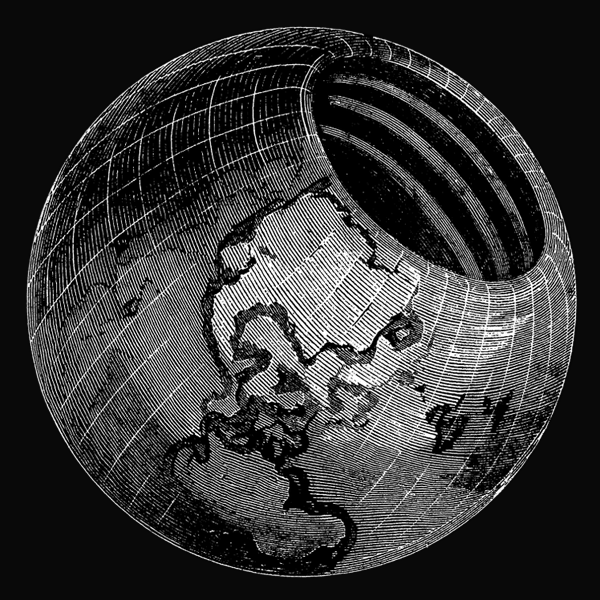
THE CLAIM
The Earth is not solid. Inside it lie nested shells, or a vast cavity, possibly warmed by a small interior sun, accessible through openings at the poles and possibly inhabited. Admiral Richard E. Byrd, the story goes, flew into one of these openings and was warned off by the residents.
THE THEORY, AS ITS PROPONENTS TELL IT
The theory has a respectable ancestor and a disreputable descent, and the distance between them is the point of the file.
In 1692 Edmond Halley, the astronomer of the comet, proposed to the Royal Society that the Earth consists of a solid shell about 800 kilometres thick, enclosing two inner concentric shells and a core, each separated by atmosphere and each potentially habitable and lit by a luminous inner medium. This was serious science addressing a real problem: the compass wandered, and multiple independently rotating magnetic shells would explain it. Halley suggested the aurora was luminous gas escaping through the thin crust at the poles.
The nineteenth century degraded it. John Cleves Symmes Jr. campaigned for an expedition to what he insisted were open holes at both poles, and by the twentieth century the theory had acquired an inner sun, a surviving prehistoric fauna, and a resident advanced civilisation, with the polar openings concealed by governments in a coordinated cartographic fraud.
The modern version's central document is a diary attributed to Admiral Richard E. Byrd, describing a flight beyond the North Pole into a warm interior land and a meeting with its inhabitants. Byrd did not write it; it first appeared decades after the flights it purports to describe. Proponents also cite Operation Highjump, Byrd's genuine 1946–47 Antarctic expedition, whose military scale they read as an assault on the southern opening rather than the postwar cold-weather training exercise it was.
WHAT IS KNOWN
The file opens honorably. In 1692 Edmond Halley (comet-namesake, Astronomer Royal to be, no one's crank) proposed to the Royal Society that the Earth might consist of concentric spheres turning independently within an outer shell. He was trying to explain why compass needles drift over the decades, a genuinely hard problem, and he had no seismographs, no gravimeters, and no data whatsoever on the interior. As a hypothesis of its era it was legitimate science: a testable model offered in good faith. The bureau salutes it.
The idea then fell into different hands. In 1818 John Cleves Symmes Jr., an American army veteran, circulated a declaration that the Earth was "hollow, and habitable within," open at both poles, and spent the rest of his life lobbying for an expedition to sail into the northern hole. The twentieth century added the mythology's crown jewel: a "secret diary" in which Byrd flies past the ice into a green inner world. The document surfaced decades after the events it describes, and its February 1947 Arctic flight is inconvenienced by the fact that Byrd spent that month in the Antarctic, running Operation Highjump, in front of several thousand witnesses.
Meanwhile the interior was actually measured. The Cavendish experiment (1798) weighed the planet: mean density about 5.5 g/cm³, roughly double that of surface rock. A hollow Earth would come in far under surface rock. And every large earthquake sends seismic waves clean through the planet to instruments on the far side. Their travel times, shadow zones, and reflections map a solid mantle, a liquid outer core, and a solid inner core (Inge Lehmann, 1936), codified in the Preliminary Reference Earth Model (1981). A cavity of any size would announce itself in every seismogram on the planet. None has.
EVIDENCE FOR
- Halley's proposal was real, serious science for 1692, the claim has a distinguished ancestor, which is more than most files in this drawer can say.
- The interior of the Earth was genuinely unknown for most of human history, leaving room for speculation.
- Auroras do concentrate near the poles, which hollow-Earth writers read as light leaking from inside.
EVIDENCE AGAINST
- Whole-Earth seismology: wave travel times fit a dense, layered, fully solid-and-molten sphere with no vacancies. This is checked afresh with every major earthquake.
- The density arithmetic: a hollow planet cannot weigh what this one demonstrably weighs.
- Newton's shell theorem: inside a hollow shell, net gravity is zero. Interior inhabitants would not stroll on the inner surface; they would float. The shell itself would also collapse under its own weight.
- Both poles have been overflown, traversed, and satellite-imaged continuously for decades. There are no holes.
- The Byrd diary is an unsourced document that places its author in the wrong hemisphere.
ASSESSMENT
This office grades hypotheses against the evidence available to their authors. Halley, working blind, gets a commendation. Everyone after Cavendish gets a raised eyebrow, and everyone after 1936 is arguing with the planet itself, which testifies (under oath, through every seismograph on Earth, several times a year) that it is full. The Earth is the one witness in this drawer that has never once changed its story.
WHAT WOULD CHANGE THE GRADE
- Closed by seismology: seismic waves from earthquakes pass through the planet, and their arrival times and shadow zones map a solid inner core inside a liquid outer core. The observations are global, continuous, and made by thousands of independent stations.
- To reopen: a seismic dataset inconsistent with the current model. Seismologists have every professional incentive to find one, and this is the sort of discovery that makes a career.
- It deserves its history. Edmond Halley proposed a hollow Earth of concentric shells in 1692 to explain magnetic variation, and it was a respectable hypothesis until there was a way to test it. It was then closed by evidence, which is how this is supposed to work.
FURTHER READING
- Some considerations about the cause of the universal deluge. :: Geology, Paleontology &lhldigital.lindahall.org, archived
- Hollow Earth · Wikipedia
- Structure of Earth · Wikipedia
- Richard E. Byrd · Wikipedia
RELATED FILES IN THIS ARCHIVE
- OSA-188 · THE SHROUD OF TURINCONTESTEDA linen cloth bearing a faint image, and forty years of argument about one test
- OSA-043 · THE VOYNICH MANUSCRIPTOPEN CASE240 pages in a script found nowhere else on Earth
- OSA-045 · THE DANCING PLAGUE OF 1518OPEN CASEStrasbourg's citizens danced for weeks and could not stop
- OSA-047 · THE OAK ISLAND MONEY PITUNVERIFIED230 years of digging, six deaths, zero treasure