THE OAK ISLAND MONEY PIT
| EXCAVATIONS SINCE | 1795, per the traditional account; continuous treasure companies since the 1840s–50s |
| LOCATION | Oak Island, Mahone Bay, Nova Scotia, Canada |
| DEATHS | Six searchers across the excavation era, including four in a single 1965 incident |
| TREASURE RECOVERED | None |
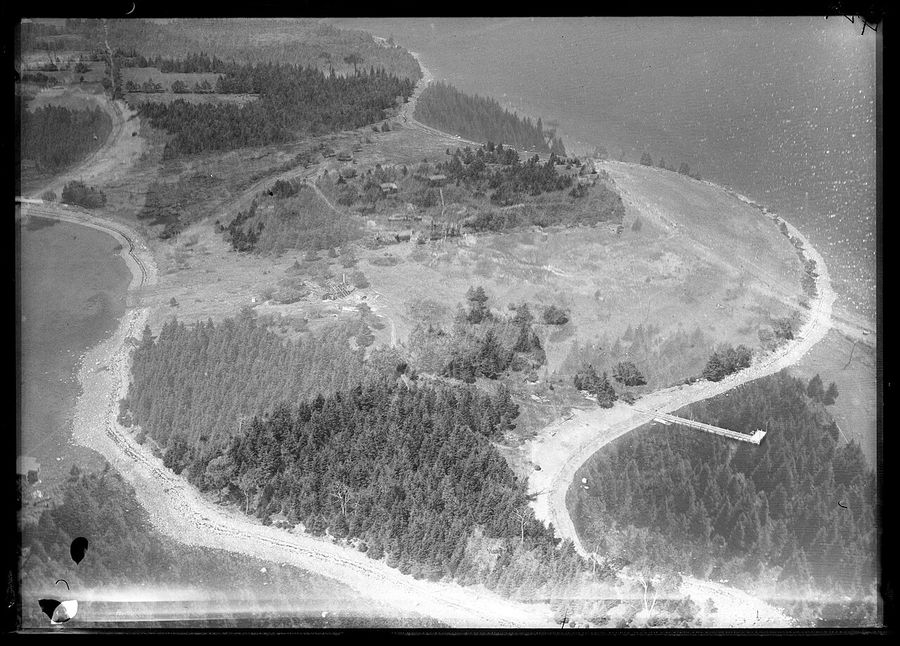
THE CLAIM
Beneath a small island in Mahone Bay lies an engineered shaft (oak platforms every ten feet, booby-trap flood tunnels fed by the sea, an inscribed stone promising millions) protecting a treasure variously attributed to Captain Kidd, the French crown, the Knights Templar, and the manuscripts of Francis Bacon. All that remains is to reach the bottom.
THE THEORY, AS ITS PROPONENTS TELL IT
The theory holds that something of great value was deliberately buried on a small island off Nova Scotia, protected by engineered flood tunnels, and that more than two centuries of excavation have failed to reach it because the trap still works.
The claimed contents vary by proponent and the list is itself instructive: the treasure of Captain Kidd; French crown jewels evacuated from Louisbourg; the lost manuscripts of Francis Bacon proving his authorship of Shakespeare; the treasure of the Knights Templar, up to and including the Ark of the Covenant or the Holy Grail; and Marie Antoinette's jewels, carried out by a fleeing lady-in-waiting.
The evidentiary tradition rests on a chain of reported finds, almost none of which survive to be examined: oak platforms at regular intervals down the shaft; a layer of coconut fibre, foreign to Nova Scotia, interpreted as filtering material for a flood system; the 1804 inscribed stone bearing a cipher supposedly reading "forty feet below two million pounds are buried," which vanished after being used as a hearthstone; and a fragment of parchment recovered from a drill core in 1897.
The counter-case is that Oak Island contains natural anhydrite sinkholes and box drains of a kind found elsewhere on the coast, that the flooding is simply the sea at the level the sea is at, and that six men have died pursuing an artefact that no expedition has ever produced. Proponents reply that repeated failure is what a well-designed trap looks like, which is the same unfalsifiable structure the archive encounters in the Skinwalker and Bermuda files.
WHAT IS KNOWN
The traditional story begins in 1795, when a local youth found a depression in the ground and began digging. What is documented is that organized treasure-hunting syndicates have worked the site since at least the mid-19th century, and that the canonical details (the oak platforms at regular ten-foot intervals, coconut fibre, the layers of charcoal and putty) come to us from newspaper accounts and promotional prospectuses written decades after the events they describe, generally by people raising money to dig. The famous "90-foot stone," allegedly inscribed with symbols translated as a promise of two million pounds buried forty feet below, was reportedly recovered around the early 1800s; the original has been lost, no verifiable image of it survives, and the popular translation comes from later retellings. The bureau flags this pattern as a recurring one: the pit's best evidence is always testimony about evidence that no longer exists.
The digging itself has been very real. Shafts flood, famously interpreted as engineered seawater tunnels, though the island sits on water-bearing limestone and anhydrite formations where natural flooding of deep shafts is expected. Six searchers have died over the years, four of them in 1965 from gas in a shaft. Excavation has been so continuous and chaotic that the original pit's precise location is itself uncertain. Since 2014 the History channel series The Curse of Oak Island has funded the most technologically intensive search to date, seismic surveys, boreholes, bulk excavation. It has recovered scattered artifacts consistent with centuries of human activity on a settled coastal island, and no treasure.
CANDIDATE EXPLANATIONS
- A genuine cache. Pirate deposits, French colonial funds, or something stranger. Nothing recovered in 230 years supports this, and the engineering attributed to the depositors (flood tunnels defeating all comers indefinitely) grows less plausible the more capable the searchers become.
- Natural formation, embellished. A sinkhole or collapsed cavity in soluble rock, common in the local geology, read as man-made in 1795, then improved by each generation of retelling and fundraising. This accounts for the depression, the flooding, and the persistent absence of treasure at once.
- Early works misread. Ordinary colonial-era activity (old shafts, wharf works, or agricultural pits) mistaken for a treasure vault. A mundane cousin of the sinkhole theory with the same predictive record: keep digging, find nothing.
ASSESSMENT
Unverified, trending toward a verdict on human nature rather than buried wealth. The documented facts (real deaths, real money, real machinery) all concern the search; the treasure exists only in accounts that improve with distance from 1795. The natural-cavity explanation fits the geology and requires no 18th-century engineers with a maintenance-free hydraulic defense system. What would change the stamp is simple and has been simple for two centuries: produce the treasure. The bureau notes that the pit's one proven capability is extracting money, and it takes it from above.
WHAT WOULD CHANGE THE GRADE
- To CONFIRMED: one recovered artifact of pre-1795 origin with documented provenance from a sealed depth. Two hundred and thirty years of excavation, and six deaths, have produced none.
- Every marquee feature, the oak platforms at regular ten-foot intervals, the inscribed stone, the flood tunnels, is known only from testimony about evidence that no longer exists, most of it recorded long after the fact.
- The natural reading, a sinkhole in soluble bedrock with natural voids and seawater ingress, accounts for the observed geology without requiring anyone to have buried anything at all.
FURTHER READING
- The Curse of Oak Island by Randall Sullivanbooksamillion.com, archived
- Wikipedia: Oak Island mystery
- Wikipedia: Oak Island
- Joe Nickell's skeptical analyses of the Money Pit accounts (Skeptical Inquirer)
RELATED FILES IN THIS ARCHIVE
- OSA-186 · THE AMBER ROOMOPEN CASEA gift from Prussia to Russia, looted by the Wehrmacht and lost
- OSA-110 · THE BEALE CIPHERSOPEN CASETwo unsolved ciphers said to locate a vault of gold in Virginia
- OSA-043 · THE VOYNICH MANUSCRIPTOPEN CASE240 pages in a script found nowhere else on Earth
- OSA-045 · THE DANCING PLAGUE OF 1518OPEN CASEStrasbourg's citizens danced for weeks and could not stop