THE ANTIKYTHERA MECHANISM
| FOUND | 1901, in a Roman-era shipwreck off Antikythera, Greece |
| DATED | Roughly 150 to 100 BC |
| FUNCTION | Predicts solar and lunar positions, eclipses, and the cycle of athletic games |
| STATUS | Confirmed and substantially decoded. Its isolation in the record remains unexplained |
THE CLAIM
That an ancient Greek device of a mechanical sophistication not seen again for well over a thousand years existed, and that its existence implies a lost technical tradition.
THE THEORY, AS ITS PROPONENTS TELL IT
This file is included as a corrective. It is the case where the extraordinary claim turned out to be true, was established by ordinary science, and is still routinely misused.
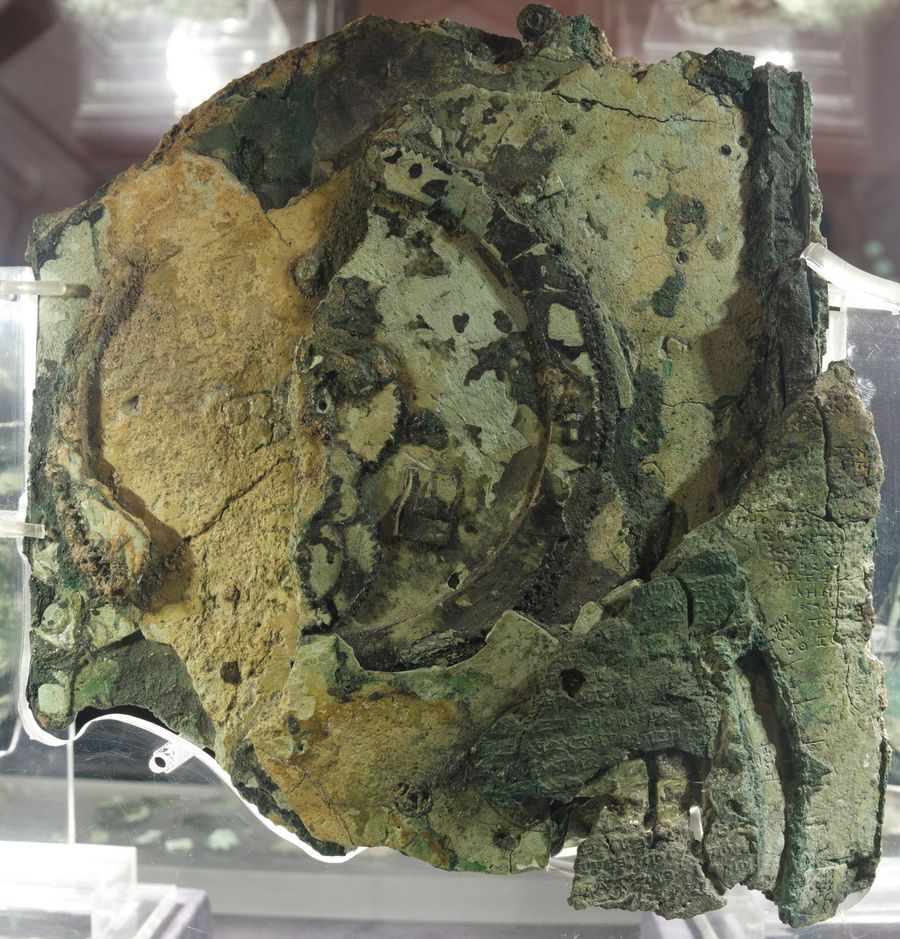
The mechanism was recovered from a shipwreck in 1901 as an unremarkable corroded lump. Its significance emerged slowly, and decisively from the 1970s onward with X-ray work by Derek de Solla Price, and then from 2005 with high-resolution computed tomography and surface imaging by an international team.
It contains at least thirty surviving bronze gears, and modelling indicates more are lost. It tracked the positions of the sun and moon, reproduced the moon's variable speed using a pin and slot mechanism that models elliptical motion, predicted eclipses using the Saros cycle, and displayed the four-year cycle of Panhellenic games. Inscriptions on it function as a user manual.
The genuinely open question is not what it is but why nothing like it appears again. Comparable geared complexity is not securely attested until Islamic and later European astronomical clocks, well over a millennium later.
WHAT IS KNOWN
The device is real, is in the National Archaeological Museum in Athens, and has been imaged and modelled repeatedly by independent teams.
Its function is substantially established. Reconstructions built from the imaging work operate as described.
Classical sources describe similar devices. Cicero mentions a planetary machine attributed to Archimedes, which had been treated as literary exaggeration until this object was understood.
The isolation is best explained by survival bias and by material: bronze was routinely melted down and reused, so the absence of other examples may reflect recycling rather than the absence of a tradition.
EVIDENCE FOR
- The object itself, imaged in three dimensions and modelled by multiple independent groups.
- Its inscriptions, which describe its own operation.
- Working reconstructions that reproduce the astronomical functions.
- Classical textual references to comparable devices, retrospectively vindicated.
EVIDENCE AGAINST (THE MISUSES)
- It is not evidence of extraterrestrial contact, a lost advanced civilisation, or anything outside Hellenistic Greek astronomy and metalworking, all of which are independently documented at the required level.
- The astronomy it encodes is Babylonian and Greek and is known from texts. The device implements existing knowledge rather than revealing unknown knowledge.
- The gearing, while remarkable, uses principles within the demonstrated capability of the period's craftsmen.
ASSESSMENT
Confirmed, and kept in this cabinet deliberately. Most files here are about claims that outran their evidence. This is the opposite: a genuinely astonishing object that sceptical instinct would reject on description alone, and which turned out to be exactly what it appeared to be, established by imaging and modelling that anyone can check. It is also routinely conscripted into claims it does not support. Both facts belong in the record, and the second does not diminish the first.
WHAT WOULD CHANGE THE GRADE
- CONFIRMED and substantially decoded by imaging and modelling that anyone can check, with working reconstructions reproducing the astronomical functions. Its own inscriptions describe its operation.
- The genuinely open question is not what it is but why nothing of comparable complexity appears for over a millennium. The best explanation is survival bias: bronze was routinely melted down and reused.
- It is not evidence of extraterrestrial contact or a lost advanced civilisation. The astronomy it encodes is Babylonian and Greek and is known from texts, and the gearing is within the demonstrated capability of the period.
FURTHER READING
- What is the Antikythera mechanism? Google Doodle marks discovery of ancient Greek computerexpress.co.uk, archived
- Important New Discoveries from Greece's Ancient Antikythera Shipwreckgreece.greekreporter.com, archived
- The Antikythera Mechanism — Institute for the Study of the Ancient Worldisaw.nyu.edu
- Antikythera mechanism · Wikipedia
- Freeth et al., Decoding the ancient Greek astronomical calculator, Nature (2006)
- Derek de Solla Price, Gears from the Greeks (1974)
RELATED FILES IN THIS ARCHIVE
- OSA-188 · THE SHROUD OF TURINCONTESTEDA linen cloth bearing a faint image, and forty years of argument about one test
- OSA-043 · THE VOYNICH MANUSCRIPTOPEN CASE240 pages in a script found nowhere else on Earth
- OSA-086 · THE LOST COLONY OF ROANOKEOPEN CASEOne word on a post, and no distress signal
- OSA-045 · THE DANCING PLAGUE OF 1518OPEN CASEStrasbourg's citizens danced for weeks and could not stop