THE FLANNAN ISLES LIGHTHOUSE
| DATE | Disappearance between 15 and 26 December 1900 |
| LOCATION | Eilean Mòr, Flannan Isles, Outer Hebrides, Scotland |
| MISSING | James Ducat, Thomas Marshall, and Donald MacArthur |
| STATUS | Officially resolved as accidental drowning; no bodies were ever recovered |
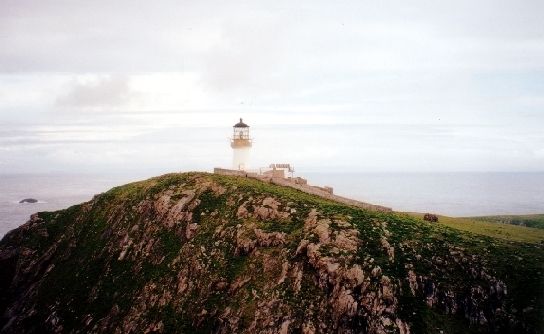
THE CLAIM
That three experienced keepers left a functioning lighthouse in circumstances no one witnessed, and that the popular version of what was found inside, with its stopped clock, overturned chair, and half-eaten meal, has almost nothing to do with the actual record.
THE THEORY, AS ITS PROPONENTS TELL IT
Three lighthouse keepers vanished from Eilean Mòr in December 1900, and the theory that the public knows is almost entirely fictional, which is the reason this file is worth keeping.
The legend holds that the relief party found a meal half-eaten on the table, a chair overturned as if in sudden flight, and a stopped clock; and that the station log recorded three days of an unnatural storm, with the hardened seaman Donald MacArthur weeping and the men praying, before ending mid-sentence. From this grew the supernatural readings: sea creatures, abduction, a rogue vessel, a murder-suicide among men driven mad by isolation.
None of the log entries are real. They were invented for later retellings and are still quoted as primary evidence. The meal and the overturned chair come from Wilfrid Wilson Gibson's 1912 poem "Flannan Isle," written twelve years after the event as a work of imagination.
What the relief party actually found was a station left in order: doors and gate closed, beds unmade, the kitchen tidy, and the lamps cleaned and refilled, meaning the keepers had completed their duties. Two sets of oilskins were gone; one remained on its hook. The west landing had been wrecked, a supply box smashed out of a crevice 110 feet above the sea, iron railings bent over, a rock of over a ton displaced, turf stripped to 33 feet. Superintendent Robert Muirhead concluded the men had gone down to secure gear and been taken by an exceptional wave, with the third running out without his coat to warn them. The real detail, one man's oilskins still hanging by the door, is more affecting than anything the legend added, and it is the only one that is true.
WHAT IS KNOWN
The light on Eilean Mòr, the largest of the Flannan Isles, had been operating for a year when the steamer Archtor passed on 15 December 1900 and noted it was dark. Bad weather delayed the relief vessel Hesperus until 26 December.
The relief party found no one. The entrance gate and doors were closed, the beds unmade, the kitchen tidy with the utensils clean, and the clock stopped. The lamps had been cleaned and refilled, indicating the keepers had completed their routine duties. Of the three sets of oilskins, two were gone and one remained on its hook, assessed as belonging to Donald MacArthur.
The west landing showed substantial storm damage. A supply box secured in a crevice roughly 110 feet above sea level had been torn out and smashed, iron railings were bent over, a large rock estimated at over a ton had been displaced, and turf had been stripped from the clifftop as high as 33 feet. The last log entries recorded severe weather.
The Northern Lighthouse Board's superintendent, Robert Muirhead, investigated and concluded that the men had gone to the west landing to secure equipment during or after heavy seas, and that an exceptional wave had swept them into the water, with MacArthur, seeing the danger from the station, running out without his oilskins to warn them. Muirhead noted he had personally appointed all three and regarded them as careful men.
Two elements of the popular story are fabrications. The dramatic log entries (recording MacArthur weeping, Ducat quiet, and all three praying) do not appear in the real logs and were invented for later retellings. The untouched meal and overturned chair come from Wilfrid Wilson Gibson's 1912 poem "Flannan Isle," which is a work of imagination and is the source of most of what the public believes about the case.
EVIDENCE FOR
- The physical storm damage at the west landing is extreme and documented, the sea genuinely reached and destroyed structures 110 feet above the water.
- The absence of one man's oilskins is consistent with an urgent departure in response to a visible emergency.
- All three men were experienced, and the lamps were serviced, the station was left in order, not in panic or neglect.
- Standing orders forbade all three keepers leaving the station simultaneously, which is exactly why an emergency is required to explain it.
EVIDENCE AGAINST (AND AGAINST THE LEGEND)
- No body was ever recovered, which the wave theory expects but cannot confirm.
- The wave explanation requires all three men to be in the danger zone at once, contrary to their own regulations.
- The lack of any witness or note means the sequence is entirely reconstructed from the state of the station.
- Over a century of embellishment (poem, invented log entries, and later fiction) has made it very difficult for the general reader to distinguish the real record from the story.
ASSESSMENT
OPEN in the narrow sense that no bodies were found, but this office regards Muirhead's 1901 conclusion as very likely correct, and files the case primarily as a corrective. Almost every element that makes the Flannan Isles famous (the stopped clock as omen, the abandoned meal, the keeper's diary of rising terror) was added afterwards by a poet and by subsequent storytellers. Strip them out and what remains is three careful men, a documented storm violent enough to hurl a ton of rock, and one set of oilskins left on a hook. That last detail is more affecting than anything the legend invented, and it is the only one that is true.
WHAT WOULD CHANGE THE GRADE
- To CLOSED: nothing survives beyond the station log and the relieving officer's report. The three keepers vanished in December 1900.
- The strongest reading is that two went to secure gear at the west landing during heavy seas and were taken by a wave, and that the third, seeing it, followed and was taken as well. Storm damage recorded at that landing was far above the sea's normal reach, which supports it.
- Two sets of oilskins gone and one still on its hook is the detail that keeps the file open, and it is entirely consistent with a man leaving in a hurry. The overturned chair and the uneaten meal that everyone remembers come from Wilfrid Wilson Gibson's 1912 poem, not from the record.
FURTHER READING
- Flannan Isles Lighthouse · Wikipedia
- Robert Muirhead's report to the Northern Lighthouse Board, 8 January 1901
- "Flannan Isle" · Wilfrid Wilson Gibson, 1912 (the poem responsible for the myth)
RELATED FILES IN THIS ARCHIVE
- OSA-085 · THE MARY CELESTEOPEN CASESound, stocked, sailing herself, and empty
- OSA-185 · THE ALCATRAZ ESCAPEOPEN CASEThree men left the island and were never found, alive or dead
- OSA-080 · THE TITANIC SWITCHDEBUNKEDThe insurance scam undone by a hull number
- OSA-131 · THE USS MAINECONTESTED266 dead, a war three months later, and no agreed cause in 128 years