THE USS MAINE
| SANK | 15 February 1898, Havana harbour; 266 of 355 aboard killed |
| 1898 INQUIRY | Sampson Board: external mine |
| 1976 STUDY | Rickover: internal coal bunker fire igniting a magazine |
| STATUS | Contested. No investigation has been decisive; the wreck was scuttled in 1912 |
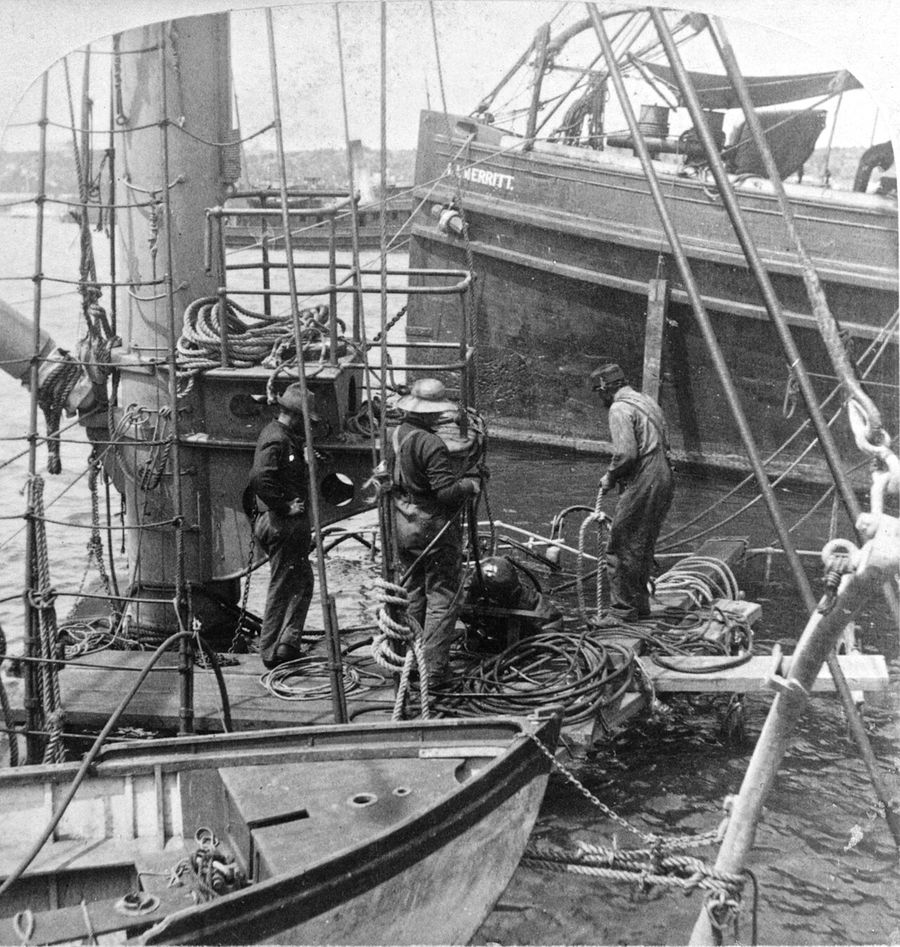
THE CLAIM
That the USS Maine was not destroyed by a Spanish mine, and that the explosion was either an accident misrepresented as an attack or a deliberate act used to justify a war the United States wanted.
THE THEORY, AS ITS PROPONENTS TELL IT
This is the original false flag allegation in American history, and it is worth separating what is documented from what is asserted.
The Maine was in Havana harbour during the Cuban war of independence. It exploded and sank with the loss of 266 men. Within weeks the American press, particularly the Hearst and Pulitzer papers then competing ferociously, had attributed it to Spain. Remember the Maine became the slogan of a war that began in April.
The naval board of inquiry in 1898 concluded an external mine had detonated a forward magazine. It did not assign blame to any party. Spain's own inquiry, denied access to the wreck, concluded an internal explosion.
In 1976 Admiral Hyman Rickover commissioned a technical reanalysis which concluded the most likely cause was spontaneous combustion in a coal bunker adjacent to a magazine, a known hazard of the bituminous coal then in use and the cause of several fires in other ships. A 1998 National Geographic analysis using computer modelling found that a mine remained possible and that Rickover's conclusion was not established. Proponents of the false flag reading argue that an accident became a war because powerful interests wanted one.
WHAT IS KNOWN
The competing investigations are real and reached genuinely different conclusions, which is unusual and is the core of this file.
Coal bunker fires were a documented and serious hazard in ships of that era, and the Maine's bunker arrangement placed coal adjacent to a magazine.
The wreck was raised in 1911, examined, and then scuttled in deep water in 1912, which removed the primary physical evidence permanently.
Spain had no plausible motive. It was attempting to avoid war with the United States, and destroying an American warship in its own harbour would have been, and was, catastrophic for it.
EVIDENCE FOR
- The 1976 Rickover study, which found an internal cause more consistent with the physical evidence than a mine.
- The absence of any Spanish motive, and Spain's active efforts at the time to avoid conflict.
- The documented role of a circulation war between American newspapers in driving public attribution before any evidence existed.
- The scuttling of the wreck in 1912, which foreclosed further examination.
EVIDENCE AGAINST (THE DELIBERATE READING)
- No evidence of any kind has ever emerged that the United States destroyed its own ship. The false flag reading rests entirely on motive and outcome.
- The 1998 modelling found a mine remained physically possible, so the accident conclusion is not settled either.
- Cuban insurgents also had a motive to provoke American intervention, and are a candidate the false flag framing usually ignores.
- 266 American sailors died. A deliberate act would have required accepting that, by a navy that then investigated it.
ASSESSMENT
Contested, and likely permanent. The honest position is that nobody knows: three serious investigations reached different conclusions, the wreck was disposed of in 1912, and the physical evidence is gone. What can be said with confidence is narrower and more interesting than the usual framing. There is no evidence of an American false flag, Spain had every reason not to do it, and an ambiguous disaster was converted into a certainty by a press with a commercial interest in the certainty. That mechanism, rather than any conspiracy, is what OSA-064 and OSA-012 both show working at larger scale later.
WHAT WOULD CHANGE THE GRADE
- Nobody knows, and this is one of the few files where that is the settled position rather than a placeholder. Three serious investigations reached three different conclusions.
- To CLOSED: nothing now can be. The wreck was raised in 1911 and scuttled in deep water in 1912, which permanently removed the physical evidence.
- Not supported in any degree: an American false flag. That reading rests entirely on motive and outcome, and 266 American sailors died.
- What is established is the mechanism that mattered: an ambiguous disaster was converted into a certainty by a press with a commercial interest in the certainty, months before any evidence existed.
FURTHER READING
- USS Maine · Wikipedia
- Hyman G. Rickover, How the Battleship Maine Was Destroyed (1976)
- Advisory analysis for National Geographic (1998) · the computer modelling reassessment
RELATED FILES IN THIS ARCHIVE
- OSA-137 · THE LUSITANIACONTESTED1,198 dead, a cargo manifest that was not complete, and a war it helped bring
- OSA-006 · THE MAX HEADROOM INCIDENTOPEN CASEAmerica's most famous broadcast hijacking
- OSA-080 · THE TITANIC SWITCHDEBUNKEDThe insurance scam undone by a hull number
- OSA-085 · THE MARY CELESTEOPEN CASESound, stocked, sailing herself, and empty