THE LUSITANIA
| SANK | 7 May 1915, off the Old Head of Kinsale; 1,198 of 1,959 aboard died |
| CARGO | Included over 4 million rifle cartridges and shrapnel shell casings, on the manifest |
| SANK IN | Roughly 18 minutes, after a single torpedo and a second internal explosion |
| STATUS | Contested. Munitions confirmed; deliberate exposure not established |
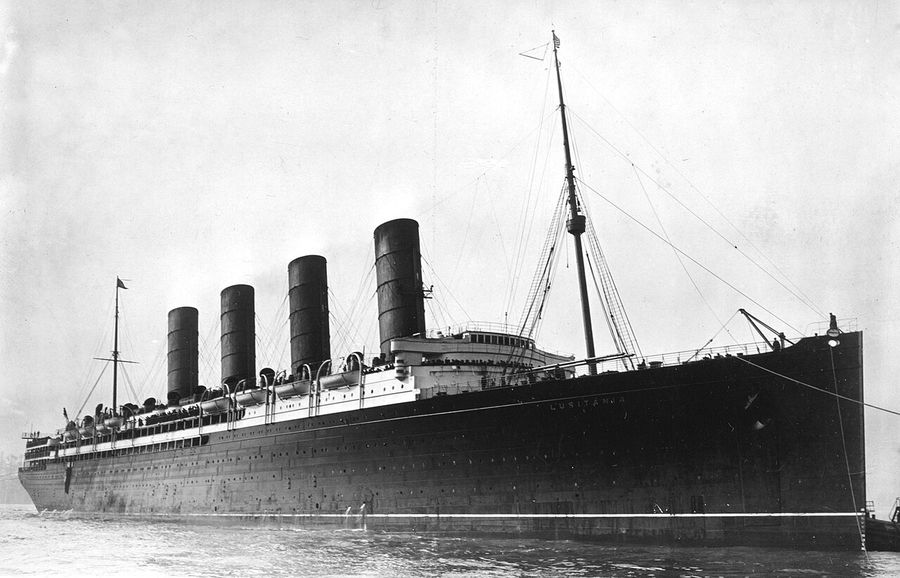
THE CLAIM
That the Lusitania was knowingly used to carry munitions through a declared war zone, that the British Admiralty exposed her deliberately or negligently in the hope of drawing the United States into the war, and that the cause of the fatal second explosion was concealed.
THE THEORY, AS ITS PROPONENTS TELL IT
Two of the three elements are documented, and the third is where this file turns.
The munitions are confirmed and were on the supplementary manifest: over four million rounds of rifle ammunition and a large quantity of empty shrapnel shell casings. Britain denied for decades that the ship carried war material, and divers on the wreck have since recovered ammunition.
The sinking speed is the physical anomaly. A single torpedo struck, and a second, much larger explosion followed. The ship went down in about eighteen minutes, far faster than her design should have allowed and far faster than comparable liners. Candidate causes include a boiler explosion, a coal dust explosion in near-empty bunkers, and the munitions themselves.
The Admiralty's conduct is the contested part. The escort cruiser Juno was withdrawn, warnings about submarine activity in the area were general rather than specific, and Captain Turner was blamed at the inquiry in a manner later historians have found unfair. Proponents argue that Winston Churchill, then First Lord, had written of the value of drawing neutral shipping into trouble with Germany, and read the pattern as deliberate.
WHAT IS KNOWN
The munitions cargo is established, as is the long official denial of it.
The second explosion happened and its cause has never been settled. Modern examination of the wreck, which is badly collapsed and has been damaged by depth charges at some point, has not resolved it.
The Mersey inquiry of 1915 blamed the German submarine and, in a section later criticised, the master's navigation. Papers released much later showed the Admiralty had pressed for that outcome.
Churchill did write, in a 1915 letter to the President of the Board of Trade, that it was most important to attract neutral shipping to British shores in the hope of embroiling the United States with Germany. That letter is real and is the strongest documentary basis for the strong reading. It concerns policy generally and does not mention the Lusitania.
EVIDENCE FOR
- A confirmed munitions cargo, denied officially for decades and since recovered from the wreck.
- A second explosion of unexplained origin, and a sinking time inconsistent with the ship's design.
- The withdrawal of the escort and the generality of the warnings given.
- Churchill's documented written interest in embroiling neutral shipping, and Admiralty pressure on the inquiry's findings.
EVIDENCE AGAINST (THE DELIBERATE READING)
- No document orders or arranges the exposure of the Lusitania specifically, and the Churchill letter is about policy in general.
- The German government had published warnings in American newspapers, and the submarine commander's decision to fire was his own.
- Naval escort practice at the time was inconsistent and under-resourced, so the absence of escort is well explained without intent.
- The United States did not enter the war for another two years, which is poor timing for a plot designed to produce that result.
ASSESSMENT
Contested, and a good example of a file where the establishment's dishonesty about a small thing has been asked to carry a much larger claim. The munitions were aboard and the denial was false, which is proven and matters. The second explosion is genuinely unexplained. Beyond that the evidence thins fast: there is no order, no plan, and no document connecting the general policy sentiment to this ship. This office finds negligence and post-hoc blame-shifting well supported, and deliberate sacrifice not supported, and notes that the same shape recurs in OSA-131 seventeen years earlier.
WHAT WOULD CHANGE THE GRADE
- CONFIRMED and long denied: the ship carried over four million rifle cartridges and shrapnel shell casings, listed on the supplementary manifest, and divers have since recovered ammunition from the wreck.
- Genuinely unexplained: the second explosion, and a sinking time of about eighteen minutes that the design should not have allowed. The wreck is collapsed and damaged and has not resolved it.
- Not supported: deliberate exposure. Churchill's 1915 letter about embroiling neutral shipping is real and concerns policy in general; no document connects it to this ship, and the United States did not enter the war for another two years.
FURTHER READING
- Deadly Cargolusitania.net, archived
- Lusitania divers warned of danger from war munitions in 1982, papers revealtheguardian.com, archived
- RMS Lusitania · Wikipedia
- Diana Preston, Lusitania: An Epic Tragedy (2002)
- Erik Larson, Dead Wake (2015)
RELATED FILES IN THIS ARCHIVE
- OSA-131 · THE USS MAINECONTESTED266 dead, a war three months later, and no agreed cause in 128 years
- OSA-080 · THE TITANIC SWITCHDEBUNKEDThe insurance scam undone by a hull number
- OSA-085 · THE MARY CELESTEOPEN CASESound, stocked, sailing herself, and empty
- OSA-093 · THE FLANNAN ISLES LIGHTHOUSEOPEN CASETwo sets of oilskins gone, one still on the hook