THE RADIUM GIRLS
| SUBJECT | Radium poisoning of dial painters and corporate suppression of the evidence |
| PERIOD | Painting from 1917; illness recognized 1920s; landmark suits 1927–1938 |
| PRINCIPAL SITES | Orange, New Jersey; Ottawa, Illinois; Waterbury, Connecticut |
| LEGACY | Foundational precedents in US occupational-disease law |
THE CLAIM
That American companies employed young women to paint watch dials with radium, taught them to shape the brushes with their lips, assured them the paint was harmless as they sickened and died, and worked to bury the medical evidence, until the dying women sued and changed the law. Confirmed in every particular.
THE THEORY, AS ITS PROPONENTS TELL IT
The theory the dial painters advanced, while they were dying, was that their employers knew the paint was killing them and said otherwise, and it was correct.
The women were taught to point their brushes with their lips to keep a fine tip, ingesting radium with every stroke. They were told the material was harmless, and some painted their nails and teeth with it for fun. When jaw necrosis, anaemia and bone fractures began appearing, the companies attributed the deaths to syphilis, a diagnosis that carried enough social stigma to discourage families from pressing.
The concealment is documented. The United States Radium Corporation commissioned studies and, when the findings were unfavourable, did not publish them; a company-linked physician examined the women and the results did not reach them. Meanwhile the male chemists handling radium in the laboratories used lead screens, tongs and masks, protection the painters were never offered and, proponents note, could not have been offered without conceding the hazard.
The wider claim this file supports is that the corporate playbook documented in the tobacco file (OSA-017) and the opioid file (OSA-066) was already fully formed by the 1920s: commission the science, suppress the unfavourable result, attack the claimants' character, and litigate until the plaintiffs die. Several of the women were too ill to raise their arms to take the oath in court. Their settlements were small and their case built the legal principle, occupational disease liability, that made later industrial claims possible at all.
WHAT IS KNOWN
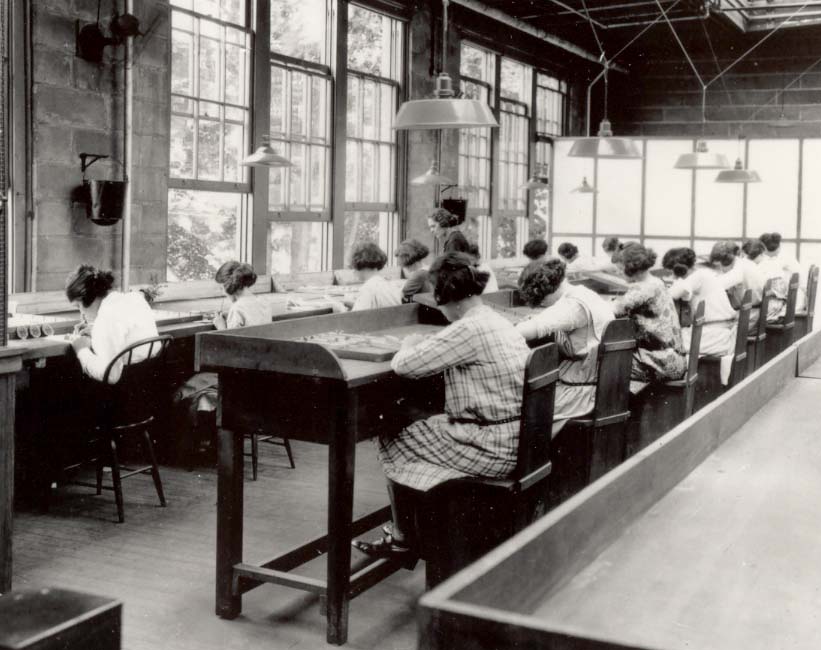
From 1917, the United States Radium Corporation in Orange, New Jersey (and later the Radium Dial Company in Ottawa, Illinois, among others) employed workforces of mostly young women to paint watch and instrument dials with luminous radium paint. To keep a fine point, they were instructed to "lip-point": draw the brush between their lips. Each pass delivered a small dose of radium, which the body deposits in bone. Some workers, told the paint was harmless, painted their nails and teeth with it for fun.
By the early 1920s the dial painters were sickening in ways their dentists could not explain: aching, loosening teeth; jaws that abscessed and crumbled, the condition now called radium jaw, along with anemia, spontaneous fractures, and bone cancers. In 1924, US Radium commissioned a Harvard industrial-hygiene study led by Cecil Drinker, which found the plant and workers contaminated; the company disputed the findings and circulated a misleadingly favorable account, and Drinker had to fight to publish the truth. Meanwhile company officials publicly blamed the women's illnesses on other causes, including syphilis. In 1925, Essex County medical examiner Harrison Martland developed tests that established radium poisoning as the cause, measuring the radioactivity in living workers' breath and in the bones of the dead.
In 1927, dial painter Grace Fryer and four coworkers, dubbed by the press the women "doomed to die", sued US Radium after years in which no lawyer would take the case and the statute of limitations was wielded against the already-poisoned. The suit settled in June 1928: $10,000 to each woman, an annuity, and payment of medical costs. In Illinois, Catherine Wolfe Donohue pressed her claim against Radium Dial from a sickbed and won before the Illinois Industrial Commission in 1938, a verdict that survived the company's appeals. The cases became foundations of occupational-disease law, strengthening workers' rights to compensation and employers' duty of care, knowledge later applied to protect atomic-era radiation workers.
EVIDENCE FOR
- Court and commission records of the New Jersey settlement (1928) and the Illinois award (1938).
- Martland's published medical findings establishing radium poisoning in the dial painters.
- The Drinker study and the documentary trail of the company's efforts to spin and suppress it.
- The women's remains themselves: dial painters' bones were measurably radioactive decades after death, and their cohort became a cornerstone of radiation epidemiology.
EVIDENCE AGAINST (THE WILDER VERSIONS)
- Retellings sometimes claim the companies knew from day one that lip-pointing was lethal. Radium's dangers to handlers were suspected early, company chemists used protective measures the painters were denied, but the specific fatal mechanism was established over the early 1920s. The confirmed offense is what the companies did once the evidence existed: deny, delay, and defame.
- The oft-quoted precise death tolls vary between sources; radium's slow toll makes any single number an estimate. The confirmed core, dozens of documented deaths and many more ruined lives, needs no inflation.
ASSESSMENT
The bureau files this among the clearest cover-ups on record: not a shadowy cabal but ordinary corporate incentives operating in daylight, with lawyers and hired experts where other files have safe houses. The women won because they refused to die quietly and because a handful of professionals (a medical examiner, a persistent researcher, reform advocates) declined to be purchased. Every workplace-safety standard has a price paid by someone; the dial painters paid in bone. This office records their names before their employers'.
WHAT WOULD CHANGE THE GRADE
- CONFIRMED in court: the dial painters sued and won, and the litigation established that an employer could be held liable for occupational disease.
- No extension is needed. US Radium's management provided its own chemists with lead shields and tongs while instructing the painters to shape brushes with their lips, and commissioned a medical report which it then suppressed.
- The result was the legal right to sue for occupational injury and the industrial safety regime that followed, which is why this sits with the tobacco case rather than with the mysteries.
FURTHER READING
- Safety Light Corporation | Nuclear Regulatory Commissionnrc.gov
- Radium Girls · Wikipedia overview.
- Kate Moore, The Radium Girls (2017), the fullest popular account of the women's lives and cases.
- Claudia Clark, Radium Girls: Women and Industrial Health Reform, 1910–1935 (1997), the scholarly treatment.
- United States Radium Corporation, the New Jersey defendant; its plant site later became an EPA Superfund site.
RELATED FILES IN THIS ARCHIVE
- OSA-183 · KAREN SILKWOODCONTESTEDA union activist gathering evidence on plant safety, dead in a single-car crash
- OSA-147 · THE CASH-LANDRUM INCIDENTOPEN CASEMedical injuries consistent with radiation, and a lawsuit dismissed for lack of a defendant
- OSA-122 · CASTLE BRAVOCONFIRMEDThe worst radiological accident in US history, and the islands not evacuated
- OSA-123 · THE PLUTONIUM INJECTIONSCONFIRMEDHospital patients injected with plutonium to measure how the body handles it