THE VILLISCA AXE MURDERS
| OCCURRED | Night of 9 to 10 June 1912, Villisca, Iowa |
| VICTIMS | Josiah and Sarah Moore, their four children, and two visiting girls |
| WEAPON | An axe belonging to the household, left at the scene |
| STATUS | Open. Two men tried, both acquitted or released; no conviction stands |
THE CLAIM
That the Villisca killings were never solved, that the investigation was fatally compromised on the first morning, and that the crime may belong to a series of similar axe murders across the American Midwest.
THE THEORY, AS ITS PROPONENTS TELL IT
There is no conspiracy claim in the ordinary sense here. The proponents' argument is that a solvable case was destroyed by its own investigation and that the pattern was missed.
Eight people were killed with an axe in their beds. The killer took specific and unusual care afterwards: covering every mirror and glass surface in the house, covering the victims' faces, drawing the blinds, and leaving a pan of bloody water, a plate of uneaten food and a four-pound piece of bacon in the downstairs room.
By late morning hundreds of townspeople had walked through the house. There was no cordon, no preservation, and no photography before disturbance. Whatever physical evidence existed was gone within hours.
The serial argument is the strongest structural point. A series of axe murders of families in their beds occurred across the Midwest between 1911 and 1912, in Colorado Springs, Ellsworth, Paola and elsewhere, with similar features including covered mirrors and the weapon left at the scene. Several occurred near rail lines. Some researchers attribute the series to one travelling killer, most often identified as Henry Lee Moore or an unidentified man.
WHAT IS KNOWN
The scene contamination is well documented and is the reason nothing forensic survives.
Two prosecutions failed. Frank Jones, a local businessman and rival of Josiah Moore, was accused on a conspiracy theory advanced by a private detective and never convicted. Reverend George Kelly, a travelling minister, confessed, retracted, was tried twice, and was acquitted. His confession was obtained after prolonged questioning and he had a documented history of mental illness.
The private detective involved, James Wilkerson, promoted the Jones theory publicly and had financial interests in doing so, which poisoned the case further.
The related Midwest axe murders are real and the similarities are genuine, though attribution to a single perpetrator has never been established.
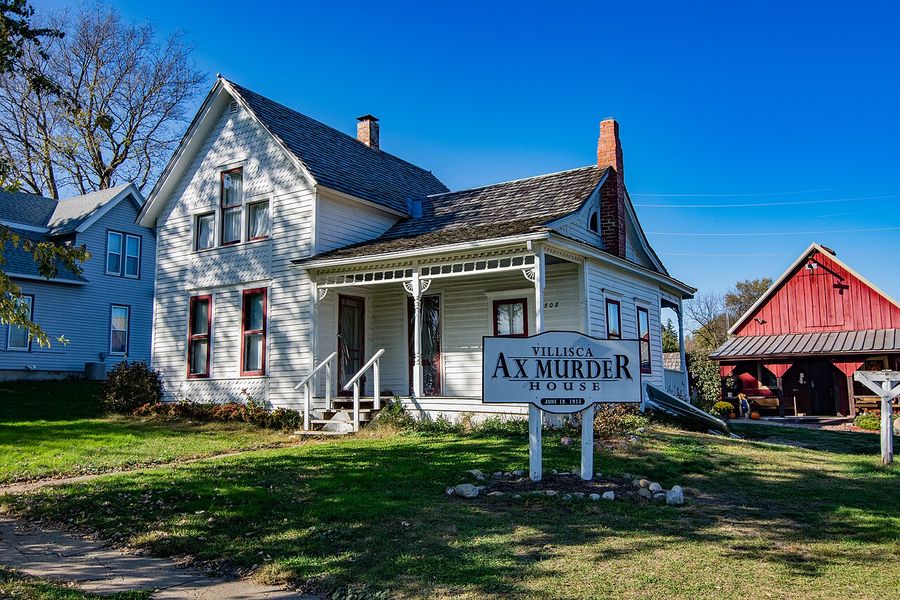
The house is preserved and operates as a museum, which has attracted a great deal of paranormal-tourism material that is not evidence of anything.
EVIDENCE FOR
- A distinctive and consistent behavioural signature, including covered mirrors and covered faces, shared with several other killings in the same period.
- The geographic and temporal clustering of similar family axe murders near rail lines.
- Two failed prosecutions, one based on a paid detective's theory and one on a retracted confession.
EVIDENCE AGAINST (RESOLUTION)
- The physical evidence was destroyed within hours by uncontrolled access, and cannot be recovered.
- The serial attribution rests on behavioural similarity, which is suggestive and is not proof, and 1912 record-keeping across jurisdictions was poor.
- Every suspect is long dead and no DNA or fingerprint material survives in a usable state.
ASSESSMENT
Open, and permanently so. This file belongs beside OSA-039 as a demonstration of a hard limit: after a certain point, a case is not unsolved because it is mysterious but because the evidence was thrown away before anyone understood it mattered. What is genuinely interesting is the pattern across the Midwest in 1911 and 1912, which was not recognised at the time because no mechanism existed for recognising it, and which now cannot be tested because nothing physical remains from any of the scenes.
WHAT WOULD CHANGE THE GRADE
- To CLOSED: nothing realistic. Hundreds of townspeople walked through the house by late morning, and whatever physical evidence existed was gone within hours of the discovery.
- The strongest structural lead is the pattern: similar family axe murders across the Midwest in 1911 and 1912, several near rail lines, sharing details including covered mirrors and the weapon left at the scene.
- Both prosecutions failed for identifiable reasons. One rested on a paid private detective's theory, the other on a confession obtained after prolonged questioning from a man with documented mental illness, which he retracted.
FURTHER READING
- The Ax Murderer Who Got Awaysmithsonianmag.com
- Villisca axe murders · Wikipedia
- Roy Marshall, Villisca: The True Account of the Unsolved 1912 Mass Murder (2003)
- Contemporary Iowa press coverage, June 1912 onward
RELATED FILES IN THIS ARCHIVE
- OSA-038 · THE ZODIAC KILLEROPEN CASEFive dead, two survivors, and ciphers mailed to the press
- OSA-039 · JACK THE RIPPEROPEN CASEWhitechapel, autumn 1888, the oldest file in the drawer
- OSA-046 · THE SOMERTON MANOPEN CASEA body on an Adelaide beach, a scrap of Persian poetry, an uncracked code
- OSA-081 · THE TYLENOL MURDERSOPEN CASESeven dead, no charges, and the reason every bottle is sealed